
You’ve seen them in futuristic homes and high-end showrooms: faucets that turn on with a wave of a hand, a gentle tap, or even a voice command. But as this technology moves into the mainstream, the big question remains: are smart faucets really worth the investment?
As manufacturers at the forefront of faucet engineering, our answer is a definitive yes, for the right user. The smart faucet is the next logical evolution of the kitchen’s most essential tool. It represents a fundamental shift from a simple mechanical device to an intelligent, integrated hub that offers unprecedented levels of hygiene, convenience, water conservation, and precision control.
But this leap forward comes with a new layer of complexity. To truly understand if a smart faucet is right for you—or your customers—you need to look under the hood. This technology breakdown will give you the complete picture, from the microchips to the solenoid valves, so you can make an informed decision.
Last Updated: Nov 2025 | Estimated Reading Time: 23 minutes
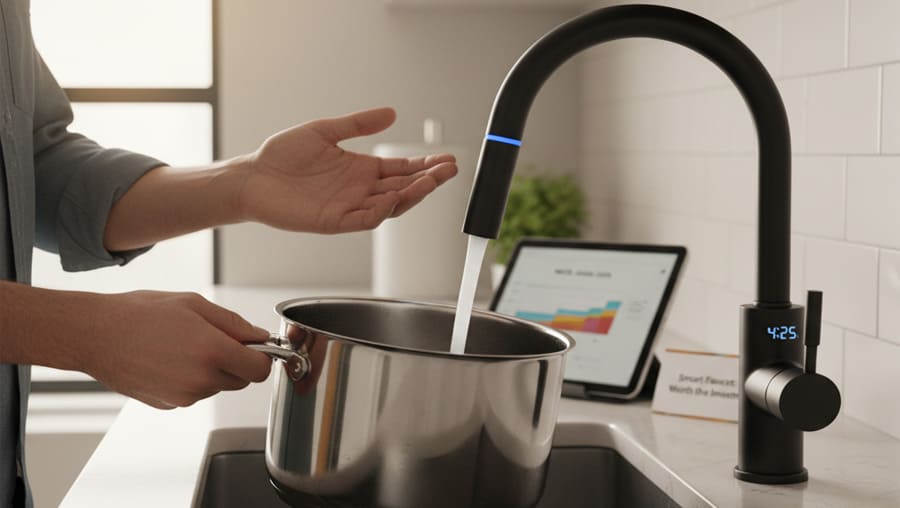
How a Smart Faucet Actually Works: The Technology Inside
A smart faucet may look like a normal faucet on the outside, but inside it’s a sophisticated electronic system. Understanding these three core components is key to appreciating its function and potential points of failure.
| Core Component | Analogy | Its Function in Plain English | Why Its Quality Matters |
|---|---|---|---|
| 1. The Sensor(s) | The Eyes & Ears | This is what detects your command. It could be an infrared (IR) sensor seeing your hands, a capacitive sensor feeling your touch, or a microphone hearing your voice. | A low-quality sensor leads to frustration: missed activations, delayed responses, or faucets turning on randomly. |
| 2. The Control Unit (ECU) | The Brain | This is a small circuit board with a microchip. It receives the signal from the sensor (“turn on!”) and sends the command to the valve. In advanced models, it also processes voice commands or manages the digital display. | The ECU’s programming determines the faucet’s “intelligence”—its responsiveness, custom settings, and reliability. |
| 3. The Solenoid Valve | The Electronic Muscle | This is the crucial part. It’s a small, electronically controlled gate that replaces the traditional mechanical valve. When the ECU sends a signal, a magnetic piston inside the solenoid retracts, opening the gate and letting water flow. When the signal stops, it closes instantly. | This is the most critical mechanical part of a smart faucet. A cheap solenoid is the #1 cause of failure, leading to leaks or a faucet that won’t turn on or off. |
A Deeper Look at Sensor Types
The type of sensor defines your daily interaction with the faucet.
- Infrared (IR) Touchless Sensors: These project a beam of invisible infrared light. When your hands or a dish break the beam, the sensor triggers the valve. This is the most hygienic option and is common in commercial restrooms and modern kitchens.
- Capacitive Touch Sensors: This technology works just like your smartphone screen. The entire faucet spout and body hold a tiny electrical charge. When you touch it with your skin, you change the charge, and the sensor detects it. This is the “tap anywhere” functionality.
- Voice Control & WiFi: The most advanced faucets integrate a microphone and WiFi module. This connects the faucet to your home network and smart assistants (like Alexa or Google Assistant), allowing for commands like, “Hey Google, ask the faucet to dispense one cup of warm water.”
The Tangible Benefits: Is It Worth the Upgrade?
The advanced technology translates into four powerful, real-world advantages that traditional faucets simply cannot offer.
1. Unmatched Hygiene
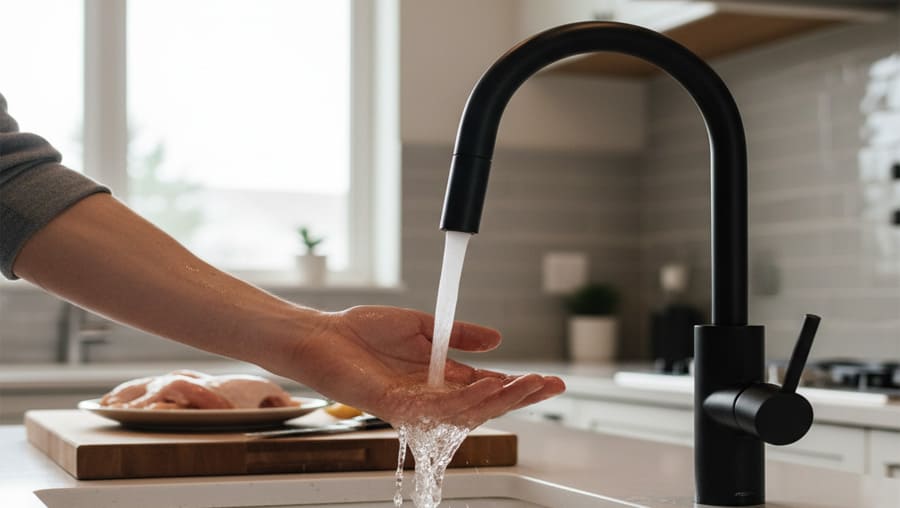
This is the most compelling benefit. Think about handling raw chicken and then needing to wash your hands. With a traditional faucet, you contaminate the handle. With a touchless or voice-activated faucet, you can complete the entire task without ever touching the fixture, preventing cross-contamination and keeping your kitchen safer.
2. Radical Convenience
The “hands-full” scenario is where smart faucets shine.
- Carrying a heavy pot? Tap the spout with your wrist to turn it on.
- Hands covered in dough? Use your voice to get the water running.
- Need a precise amount of water for a recipe? Tell the faucet exactly how much you need.
3. Precision and Safety
High-end smart faucets often feature an integrated LED digital display showing the exact water temperature.
- Safety: This is a game-changer for families with young children, eliminating the risk of accidental scalding. The display often changes color (blue for cold, red for hot) for an at-a-glance warning.
- Precision Cooking: For tasks like baking bread (activating yeast) or preparing a baby’s bottle, you can get water at the precise temperature you need, every single time.
4. Meaningful Water Conservation
Smart faucets are inherently water-saving. Because the water shuts off automatically the moment you move your hands away or tap it off, you eliminate the waste of a continuously running tap during “in-between” tasks like scrubbing a dish or soaping your hands.
| Task | Traditional Faucet (Running) | Smart Faucet (Auto-off) | Potential Yearly Savings (Avg. Family) |
|---|---|---|---|
| Washing Hands | 30-60 seconds of flow | 10-15 seconds of flow | 500+ Gallons |
| Washing Produce | 2 minutes of continuous flow | 45 seconds of intermittent flow | 700+ Gallons |
The Reality Check: Costs, Installation, and Long-Term Maintenance
To make an informed decision, you must weigh the benefits against the real-world drawbacks. As manufacturers, we believe in transparency about the entire product lifecycle.
1. The Upfront Investment
There’s no way around it: smart faucets carry a significant price premium over their mechanical counterparts. You are paying for the sensors, the control unit, the high-quality solenoid valve, and the R&D that went into the product.
2. Installation is Not a DIY Job
While a handy homeowner might be able to install a traditional faucet, a smart faucet is different.
- Power Source: It needs power, either from a battery pack (which needs to be mounted securely under the sink) or a hardwired connection to an outlet, which may require an electrician.
- Complexity: There are more components, more wires, and more connections to manage. A professional plumber is highly recommended to ensure a leak-free and correctly functioning installation.
3. Maintenance and Repair Are More Complex
This is the most critical long-term consideration. When a traditional faucet drips, the fix is usually a simple, inexpensive part like a rubber O-ring or a ceramic cartridge. When a smart faucet malfunctions, the troubleshooting is more involved.
| Issue | Traditional Faucet Fix | Smart Faucet Fix |
|---|---|---|
| No Water Flow | Check for clogged aerator or failed cartridge. (Low cost, easy) | Could be a dead battery, failed sensor, faulty ECU, or a stuck solenoid valve. (Requires diagnosis, can be costly) |
| Constant Drip/Leak | Replace washer or cartridge. (Low cost, easy) | Could be a solenoid valve that is not closing properly. (Requires a specific, expensive replacement part) |
B2B Perspective: Sourcing Quality and the Foundational Importance of Mechanics

For business buyers—importers, distributors, and property developers—the allure of the smart faucet trend is immense. However, sourcing these products requires a higher level of diligence.
The most advanced smart features are worthless if the fundamental faucet is poorly made.
Before a faucet can be smart, it must first be an exceptional mechanical faucet. The durability of the body, the quality of the waterway, the reliability of the ceramic cartridge (for manual override), and the smoothness of the pull-out hose system are the bedrock upon which all electronic features are built. A failure in these core components will doom the product, regardless of how clever its sensors are.
This is why mastering fundamental principles is a prerequisite for innovation. For example, our SpringFaucet faucets not only represent the pinnacle of mechanical faucet engineering but also feature a digital display to show the water temperature, preventing scalding. Crafted from premium brass, equipped with a high-precision ceramic valve core and a stylish matte black finish, they embody the reliability and quality essential for any advanced technology. When choosing products, first look for manufacturers that demonstrate such exquisite craftsmanship in their traditional products.
Frequently Asked Questions (FAQ)
Q1: What happens to a smart faucet if the power goes out? Most battery-operated models will simply cease to function until the batteries are replaced. Many hardwired models also have a battery backup for this reason. Critically, almost all smart faucets also have a standard manual handle that works mechanically, so you will never be left without water.
Q2: How long do the batteries last in a battery-powered smart faucet? Depending on usage, a set of standard AA or C batteries will typically last 1 to 2 years. Most models have an indicator light that will flash to let you know when the batteries are running low.
Q3: Can I turn a regular faucet into a smart faucet? There are some retrofit adapters available, but they are often clunky and less reliable than an integrated smart faucet. These devices typically mount on the end of the spout and control water flow after the handle, offering a limited touchless experience without the full benefits of a truly smart fixture.
Conclusion: A Worthwhile Investment in the Future
So, are smart faucets worth it?
For the homeowner who embraces technology and prioritizes hygiene, convenience, and water conservation, the answer is a resounding yes. The initial investment pays off through a cleaner, more efficient, and more enjoyable kitchen experience.
However, this investment must be made with a clear understanding of the technology’s complexities, including the need for professional installation and the potential for more involved maintenance. The key to a successful investment lies in choosing a product from a reputable manufacturer who not only excels in electronic innovation but also has a proven mastery of the fundamental, mechanical quality that ensures a faucet will last a lifetime. The future of the kitchen is smart, but it’s built on a foundation of solid engineering.
Recommended Links
Internal Links:
- The Ultimate Guide to Kitchen Faucet Materials: Brass vs. Stainless Steel
- 2025 Kitchen Faucet Trends: A Manufacturer’s Forecast
- Why a High-Quality Ceramic Cartridge is Non-Negotiable
External Links (Authoritative Sources):
- How Capacitive Touch Sensing Works (Wikipedia) – A technical resource for understanding “tap” technology.
- Solenoid Valve: How It Works (YouTube Tech Channel) – A visual explanation of the core electronic valve in a smart faucet.
- National Kitchen & Bath Association (NKBA) – An authoritative source for the latest trends and technology in kitchen design.