
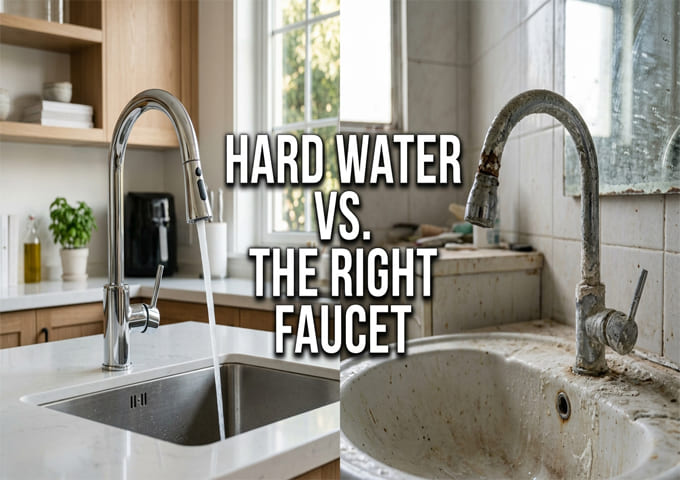
The short answer is yes, the quality of your water is one of the single most significant factors determining your faucet’s performance and how long it will last. The water flowing from your tap—whether it’s “hard” and full of minerals or “soft” and corrosive—is constantly interacting with your faucet’s internal parts and external finish. Think of it as a daily stress test. For you, as a homeowner or a building professional, understanding this relationship is the key to preventing premature failures, leaks, and cosmetic damage. This guide will give you the expert insights needed to diagnose your water’s impact, choose a faucet built to last, and protect your investment.
Last Updated: September 2026 | Estimated Reading Time: 12 minutes
This Article Will Uncover:
- The hidden ways hard and soft water secretly attack your faucets.
- Why your faucet’s finish is getting ruined (and which finishes fight back).
- The internal components that fail first and how manufacturers like SPRINGFAUCET engineer solutions.
- Practical steps for testing your water and what the results mean for your plumbing.
- Actionable solutions for both homeowners (B2C) and industry professionals (B2B) to maximize faucet longevity.
What’s Really in Your Water? A Faucet’s Guide to Water Chemistry
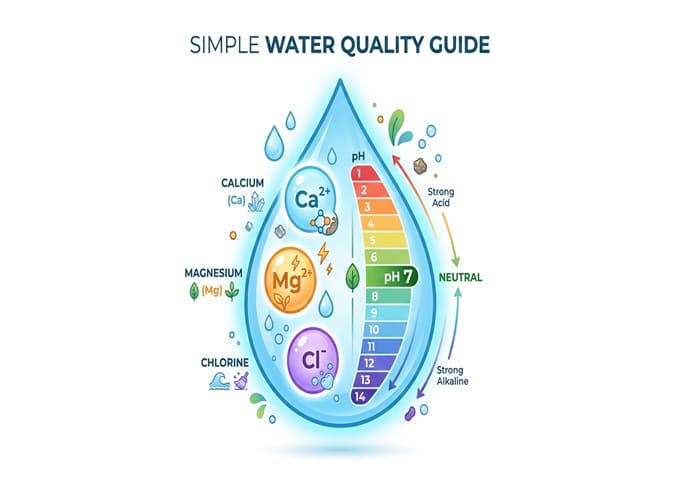
The water that reaches your tap is more than just H₂O. It carries a dissolved chemical and mineral load that directly interacts with every surface it touches, from the internal valve to the tip of the spout. Understanding what’s in your water is the first step to understanding why your faucets might be failing.
The Hard Water Problem: Mineral Assault and Limescale Buildup
Hard water, packed with dissolved minerals like calcium and magnesium, is the most common enemy of plumbing fixtures. When this water evaporates, it leaves behind a chalky, white deposit known as limescale. This buildup isn’t just ugly; it’s destructive. It clogs aerator screens, restricts water flow, and can cause faucet handles to become stiff and difficult to operate. Over time, these mineral deposits can even etch and permanently damage the faucet’s finish.
Think of limescale like plaque on your teeth—a persistent buildup that requires regular attention to prevent long-term damage. In regions with very hard water (over 180 mg/L), you might notice reduced water pressure from a faucet in as little as 6-12 months if the aerator isn’t cleaned.
The Soft Water Surprise: Is It Always Better?
While soft water eliminates limescale, it can introduce a different problem: corrosion. Soft water is often slightly more acidic (with a lower pH) and, lacking minerals, it can be aggressive in trying to achieve a chemical balance. It does this by leaching metals from its environment—namely, your pipes and faucet fittings. This process, known as dezincification in brass components, can weaken the faucet’s body from the inside out, eventually leading to pinhole leaks.
While less common, this corrosive action is why plumbers in soft water regions are particular about the materials they use. The myth that soft water is universally “good” for all plumbing is a misunderstanding; it’s simply a different kind of challenge that requires a different engineering solution.
Beyond Hard and Soft: Hidden Troublemakers
- Chlorine & Chloramine: These disinfectants, essential for public health, are oxidizers that can be tough on plumbing. They are particularly damaging to rubber seals, O-rings, and gaskets inside your faucet. Over time, chlorine exposure causes these flexible parts to become brittle and crack, leading to drips and leaks.
- Acidity/Alkalinity (pH): Water with a pH below 7.0 is considered acidic and aggressively corrodes metal pipes and fixtures. This can lead to blue-green stains in your sink (from copper pipes) and a metallic taste. Faucets installed in low-pH environments are at high risk of internal corrosion.
- Sediment and Particulates: Sand, silt, and other small debris can act like sandpaper on the internal workings of your faucet. These particles can score the surfaces of ceramic disc cartridges, compromising their ability to seal and leading to a faucet that constantly drips.
Pro Tip: If your faucet starts to “spit” or the stream is uneven, the first and easiest thing to check is a clogged aerator. Unscrew it and soak it in a 50/50 solution of white vinegar and water for a few hours to dissolve mineral buildup.
| Water Quality Issue | Primary Effect on Faucets | How You’ll Notice It |
|---|---|---|
| Hard Water (High Calcium & Magnesium) | Limescale buildup, clogging | White, chalky film on faucet; weak or spraying water flow. |
| Soft Water (Low Mineral, often acidic) | Corrosion, metal leaching (dezincification) | Pinhole leaks, blue-green stains in sink, potential metallic taste. |
| High Chlorine/Chloramine | Degradation of rubber seals and gaskets | Persistent drips from the spout or leaks around the handle base. |
| High Sediment/Debris | Abrasion of internal valves and cartridges | A gritty feeling when turning the handle; a faucet that won’t shut off completely. |
How Faucet Components React to a Life Under Water
A faucet is more than just a pretty fixture; it’s a small machine with several critical components that are constantly exposed to water. Here’s how different parts stand up—or fail—to poor water quality.
The Heart of the Faucet: Cartridges and Valves
The cartridge is the internal valve that controls the flow and temperature of the water. Its longevity is directly tied to water quality.
- Ceramic Disc Cartridges: These are the modern standard, valued for their durability. They feature two ultra-hard ceramic discs that slide against each other to control water flow. However, hard water minerals and sediment can get crushed between these discs. This causes a grinding sensation when you turn the handle and eventually creates micro-scratches that break the perfect seal, leading to a dreaded drip.
- Ball, Compression, and Sleeve Cartridges: While less common in new faucets, these types rely on rubber seats and O-rings to form a seal. Both hard water minerals (which cause abrasion) and chlorine (which hardens the rubber) can cause these seals to fail rapidly, requiring frequent maintenance.
The Finish Line: Why Your Faucet’s Beauty Fades
A faucet’s finish is its first line of defense, but not all finishes are created equal, especially in hard water areas.
- Polished Chrome: A classic for a reason. It’s relatively hard and easy to clean, but it shows every single water spot from hard water, making it look constantly dirty. Cheap chrome plating can also be worn down by the minerals in hard water over time, leading to pitting and corrosion of the underlying metal.
- Brushed Nickel & Stainless Steel: These are the top recommendations for hard water areas because their slightly textured surfaces are excellent at hiding water spots and fingerprints. This reduces the need for constant wiping.
- Matte Black: Hugely popular for its modern aesthetic, but it can be challenging with hard water. The white mineral deposits stand out dramatically against the dark finish. High-quality powder-coated or PVD matte black finishes are more resistant, but they still require diligent cleaning to look their best.
- PVD (Physical Vapor Deposition) Finishes: This is the gold standard for durability. Available in many colors (like brushed gold, gunmetal, and even black), PVD finishes are created by bonding the finish to the faucet at a molecular level in a vacuum chamber. The result is a surface that is incredibly resistant to scratches, tarnishing, and—most importantly—the corrosive effects of both hard and soft water.
Manufacturer Tip: When selecting a faucet, don’t just ask what the finish is; ask how it was applied. A PVD finish will dramatically outlast a standard electroplated finish in a harsh water environment, often looking new for 5-7 years longer, or more.
A Manufacturer’s Perspective: Engineering Faucets for Tough Water
For a manufacturer with global reach, designing for diverse water quality isn’t an option—it’s a necessity. With nearly 20 years of OEM/ODM experience, we at SPRINGFAUCET have seen firsthand how water conditions in Europe, the Middle East, and North America demand different engineering approaches.
“My team doesn’t design a faucet for a showroom; we design it for a decade of real-world use in places like Arizona, with its rock-hard water, or the Scottish Highlands, with its soft, aggressive water. The first question we ask is, ‘What’s in the water?’ The material, the cartridge, and the finish are all chosen to answer that question.” – David Chen, Head of Engineering, SPRINGFAUCET
Material Selection: The First Line of Defense
The metal body of your faucet is its foundation. Choosing the right one is critical.
- Standard Brass (e.g., CW617N): A common alloy of copper and zinc, brass is the industry standard for its durability and machinability.
- DZR Brass (Dezincification Resistant): This is a specialized brass alloy (like CW602N) with a chemical composition designed to resist dezincification—the leaching of zinc caused by soft, acidic water. For markets with known aggressive water, specifying DZR brass is a non-negotiable for ensuring long-term structural integrity.
- Stainless Steel: An excellent material that is naturally resistant to rust and corrosion. It is a great choice for any water type, but it is often more expensive to manufacture than brass.
Advanced Technology for Superior Performance
At SPRINGFAUCET, we engineer our faucets to withstand these challenges. For example, our popular Modern Wall Mount Lavatory Faucet, a top seller in demanding markets across Europe, the Middle East, and Africa, is a case study in robust design. It features a high-grade, low-lead brass body to ensure water safety and is available with DZR brass for specific market requirements. We pair this with a precision European ceramic cartridge, which is more resilient to mineral buildup, and offer advanced PVD finishes to guarantee its stunning appearance lasts, regardless of water quality.
Water Quality Testing: A Practical Guide
You can’t solve a problem you don’t understand. Testing your water is the only way to know exactly what you’re dealing with.
Simple DIY Water Testing
For a quick assessment, DIY test strips are a good starting point. You can buy them online or at a home improvement store. They can give you a general reading for:
- Total Hardness: Measured in grains per gallon (GPG) or parts per million (PPM). Anything over 7 GPG or 120 PPM is considered hard.
- pH: A measure of acidity/alkalinity. A neutral pH is 7.0.
- Chlorine: Shows the level of disinfectant in your water.
When to Call in the Pros: Lab Testing
While DIY kits are useful, they can’t detect everything. A certified lab test is the definitive way to understand your water. It’s highly recommended if:
- You use a private well.
- Your home has older plumbing (pre-1986) and you’re concerned about lead.
- You have persistent plumbing issues, stains, or a metallic taste in your water.
| Water Test Result | What It Means for Your Faucets | Recommended Action |
|---|---|---|
| Hardness > 120 PPM | Limescale will clog aerators and damage finishes. | Choose faucets with PVD or brushed finishes; clean aerators quarterly. |
| pH < 6.8 | Water is acidic and corrosive to metals. | Specify DZR brass faucets; consider a whole-house pH neutralizing system. |
| Chlorine > 2.0 PPM | Rubber seals and gaskets will degrade faster. | Choose faucets with high-quality silicone or EPDM seals over standard rubber. |
| Iron > 0.3 PPM | Can cause reddish-brown staining and a metallic taste. | Choose stain-resistant finishes and consider an iron filter for your water supply. |
Solutions & Strategies: Protecting Your Faucet Investment
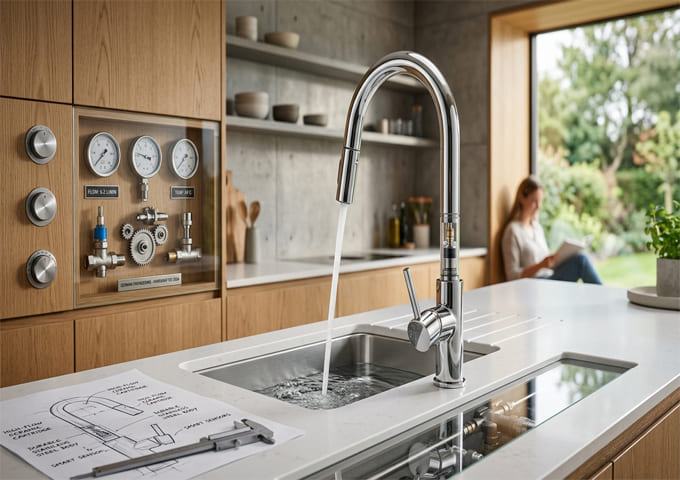
Whether you’re a homeowner or a professional, you have the power to mitigate the effects of poor water quality.
For Homeowners (B2C): Maintenance is Key
- Clean Aerators Regularly: This is the single most effective task you can do. Every 3-6 months, unscrew your faucet aerators and soak them in vinegar to dissolve mineral buildup.
- Wipe Down Faucets: After use, wipe down your faucet with a soft, dry cloth. This prevents hard water spots from forming and etching the finish.
- Use the Right Cleaners: Avoid abrasive powders, scrubbing pads, and harsh chemicals. A simple solution of mild soap and water is best for most finishes. For PVD finishes, often a damp cloth is all that’s needed.
- Consider Water Treatment: If you have very hard water, a whole-house water softener can protect not just your faucets, but all of your water-using appliances. It works by swapping mineral ions (calcium, magnesium) for sodium ions.
For Professionals (B2B): Specify for Success
- Read the Spec Sheet: Don’t just look at the picture. Look for keywords like “Solid Brass Body,” “Ceramic Disc Cartridge,” “PVD Finish,” and “DZR Certified.” These indicate a product engineered for durability.
- Know Your Region: When sourcing for a project, understand the local water quality. Specifying a standard faucet for a luxury development in a known hard water area is a recipe for warranty claims and unhappy clients.
- Partner with an Experienced Manufacturer: An OEM/ODM partner like SPRINGFAUCET brings invaluable experience. With a 20-year track record, we understand the nuances of global water quality and can guide you to the right product or develop a custom solution that meets the specific demands of your market. This expertise de-risks your projects and enhances your reputation for quality.
Pro Tip: For wall-mounted faucets like our Modern Lavatory Faucet, limescale can build up where the spout enters the wall. Periodically wiping this area with a soft cloth and a vinegar solution can prevent long-term finish damage.
FAQ: Your Water Quality Questions Answered
Q1: Does hard water permanently damage faucets? It can. While light limescale can be cleaned off, heavy, long-term buildup can physically etch and ruin a faucet’s finish. Internally, it can cause wear that leads to leaks requiring cartridge replacement.
Q2: Can a water filter really extend my faucet’s life? Absolutely. A whole-house carbon filter can remove chlorine, protecting rubber seals. A water softener prevents limescale, protecting both the finish and the internal cartridge. Even a simple point-of-use filter can reduce sediment that causes wear.
Q3: Why is my matte black faucet showing white spots? Those are hard water mineral deposits (limescale). They are very visible on a dark surface. To remove them, use a soft cloth with a 50/50 vinegar-water solution and rinse thoroughly. To prevent them, wipe the faucet dry after each use. Choosing a high-quality PVD matte black finish offers more resistance than a simple powder coat.
Q4: How often should I clean my faucet’s aerator in a hard water area? A good rule of thumb is at least every six months. However, if you notice a drop in water pressure or an erratic spray pattern, clean it sooner. In extremely hard water areas, you may need to clean it quarterly.
Q5: What’s the best faucet material for well water? Well water can be unpredictable, often with high iron, sediment, or low pH. The safest choice is a faucet made of solid stainless steel or DZR brass to resist potential corrosion. It is crucial to get your well water professionally tested to know exactly what you are dealing with.
Conclusion: Your Faucet’s Future is in Your Water
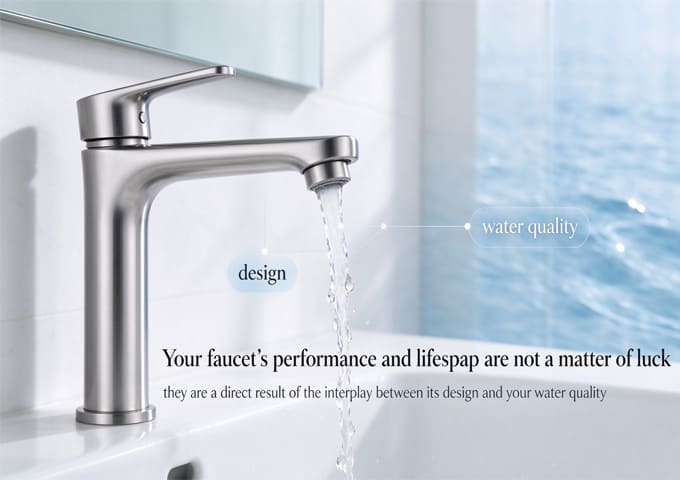
Your faucet’s performance and lifespan are not a matter of luck; they are a direct result of the interplay between its design and your water quality. Hard water attacks with mineral buildup, while soft water can corrode from within. Chlorine and sediment add to the daily assault.
The solution is a two-pronged approach:
- Know Your Water: Test it to understand its specific challenges.
- Choose Intelligently: Select a faucet engineered to withstand those challenges. Look for superior materials like solid DZR brass, advanced components like ceramic disc cartridges, and durable finishes like PVD.
By investing in a high-quality, well-engineered faucet and performing simple, regular maintenance, you can ensure it functions flawlessly and looks beautiful for years to come. Whether you’re a homeowner looking for a single reliable fixture or a developer sourcing for thousands of units, making an informed choice is the best way to protect your investment. As an experienced manufacturer, SPRINGFAUCET is committed to producing faucets that don’t just meet standards but exceed expectations in the real world, ensuring every customer gets lasting value and performance.
Recommended Internal & External Links:
- Internal Link: Modern Wall Mount Lavatory Faucet – Explore a faucet engineered for performance in diverse water conditions.
- Internal Link: Faucet Finish Guide: Choosing Durability and Style – A deeper dive into PVD, chrome, and other finishes.
- Internal Link: Understanding Faucet Materials: Brass vs. Stainless Steel – An expert comparison of core faucet materials.
- External Link: U.S. EPA – Drinking Water Regulations – Authoritative information on U.S. water quality standards.
- External Link: World Health Organization (WHO) – Guidelines for Drinking-water Quality – Global standards and health information on water contaminants.
- External Link: Wikipedia – Water Hardness – A comprehensive overview of the science behind hard water.