
When you look at a faucet, you see its design, finish, and features. But what you often don’t see are the small, stamped acronyms—cUPC, NSF, WATERMARK, ACS—that represent the most important features of all: safety, quality, and reliability. These certifications are far more than just bureaucratic red tape; they are a faucet’s passport to a specific market and your ultimate assurance of quality.
So, what do these certifications actually mean for you?
In short, they are a non-negotiable guarantee. For a homeowner, they mean the product you’re bringing into your home is safe for your family’s health, won’t leak, and meets strict performance standards. For a business, they signify that a manufacturer, like us, understands the specific technical, safety, and legal requirements of your market. A certified faucet is a promise that the product is not just designed to look good, but engineered to be safe, durable, and compliant.
This guide, from a manufacturer’s perspective, will decode this complex world. We’ll show you what these critical marks mean, why they are essential, and how they serve as your most powerful tool for choosing a faucet you can trust.
Last Updated: Nov 2025 | Estimated Reading Time: 26 minutes
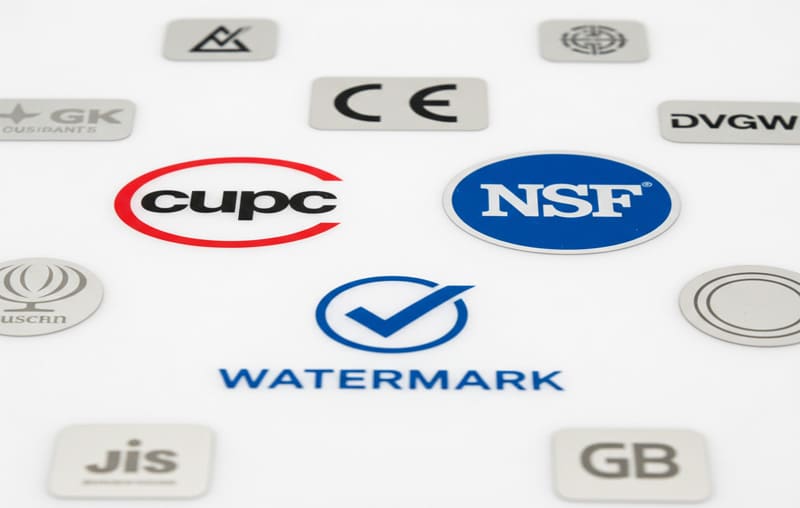
Why Do Faucet Certifications Even Exist? The Three Pillars of Trust
At their core, all faucet certifications are designed to protect the end-user. They are established by independent, third-party organizations to verify that a product meets rigorous standards. These standards are built on three fundamental pillars.
- Public Health & Safety: This is the most critical pillar. Certifications ensure that the materials used in the faucet—the brass, the solder, the plastics, the seals—will not leach harmful substances like lead, cadmium, or other chemicals into your drinking water.
- Performance & Durability: A certification guarantees that the faucet works as intended. It tests for mechanical strength, the lifespan of the cartridge (e.g., 500,000 cycles), the ability to withstand pressure spikes without bursting, and that the connections are correctly sized to fit your home’s plumbing.
- Water Conservation: In many regions, water is a precious resource. Certifications like WELS in Australia or WaterSense in the USA mandate that faucets and showerheads meet strict flow rate limits, ensuring efficiency without sacrificing performance.
A faucet without a valid, third-party certification for your region offers no verifiable proof that it meets any of these essential criteria. It is an unknown and unnecessary risk.
The Global Passport System: A Regional Guide to Major Faucet Certifications
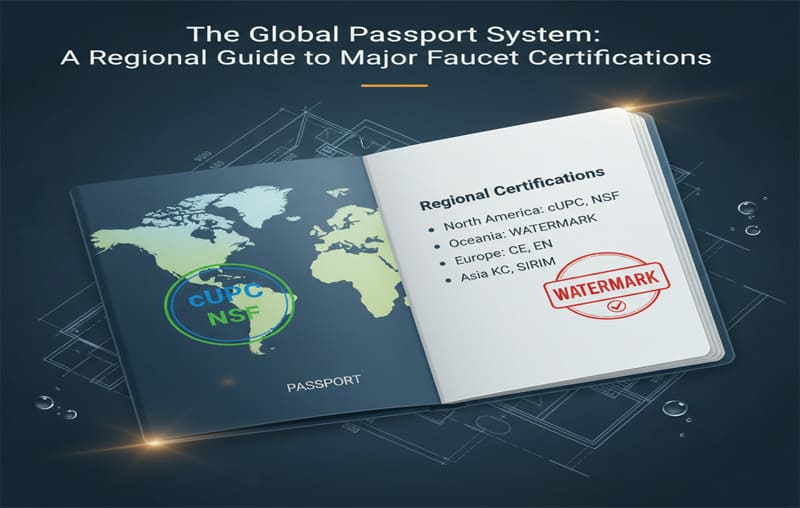
Think of the world of faucets as different countries, each with its own entry requirements. A manufacturer must have the right “passport” (certification) for their products to be legally sold and installed in that country. This is a clear signal that the manufacturer has done their homework and built the product to meet local expectations.
| Region / Country | Key Certification(s) | What It Guarantees for YOU |
|---|---|---|
| North America (USA & Canada) | cUPC® (Uniform Plumbing Code) | Guarantees the faucet complies with the North American plumbing code for safety, performance, and mechanical function. This is the primary “license to operate.” |
| NSF/ANSI/CAN 61 | The leading health effects standard. Certifies that the faucet will not leach contaminants into the water. This is your drinking water safety guarantee. | |
| WaterSense® (EPA Program) | A voluntary certification for water efficiency. Guarantees the faucet uses at least 20% less water than the federal standard without sacrificing performance. | |
| Australia & New Zealand | WaterMark™ | A mandatory certification for all plumbing products. Guarantees the product is fit for purpose, safe, and complies with the Plumbing Code of Australia. It is illegal to install a non-WaterMarked faucet. |
| WELS (Water Efficiency Labelling Scheme) | A mandatory water efficiency rating. The star rating (1 to 6 stars) clearly shows the faucet’s water consumption, allowing you to make an informed, eco-conscious choice. | |
| United Kingdom | WRAS (Water Regulations Advisory Scheme) | Demonstrates that a product, when installed correctly, complies with the Water Supply Regulations. It primarily focuses on preventing contamination of the public water supply. |
| France | ACS (Attestation de Conformité Sanitaire) | A mandatory health certification. It certifies that all materials in contact with water are safe and will not alter the water’s quality (taste, color, safety). |
| Germany | DVGW (Deutscher Verein des Gas- und Wasserfaches) | A highly respected certification for gas and water products. It signifies the highest standards of safety, hygiene, and quality, often exceeding basic European requirements. |
| European Union | CE Mark | A declaration by the manufacturer that the product meets EU standards for health, safety, and environmental protection. It is a broader mark, less specific to plumbing than ACS or DVGW. |
Deep Dive: cUPC vs. NSF – A Crucial Distinction for North America
For the US and Canadian markets, two certifications are often mentioned together: cUPC and NSF/ANSI 61. They are not interchangeable; they test for different things, and having both is the gold standard of a high-quality, compliant faucet.
| Aspect | cUPC® Certification | NSF/ANSI/CAN 61 Certification |
|---|---|---|
| Primary Focus | Plumbing Code Compliance | Health Effects & Material Safety |
| What It Tests | Mechanical performance, durability, flow rates, thread sizes, connection integrity, backflow prevention. | If any material in contact with water will leach lead, mercury, BPA, or other chemicals at unsafe levels. |
| Simple Analogy | It’s like a car’s safety inspection: “Do the brakes work? Are the tires the right size? Will it fall apart on the road?” | It’s like a food safety rating: “Are the ingredients in this meal safe to consume? Is anything toxic?” |
| Why You Need It | To be legally installed by a licensed plumber. It ensures the faucet won’t cause leaks, floods, or structural plumbing problems. | To ensure your drinking water is safe. It’s your peace of mind that the faucet itself isn’t contaminating your water. |
A cheap, uncertified faucet may have threads that don’t match US pipe standards, a cartridge that fails under normal water pressure, or, most dangerously, be made from a brass alloy with high lead content. Specifying a faucet with both cUPC and NSF marks eliminates all of these risks.
For B2B Buyers: Why Certifications are Your Most Powerful Sourcing Tool
For our partners—importers, distributors, developers, and retailers—certifications are not just a feature. They are the cornerstone of a sound business strategy and an indispensable risk management tool.
- Guarantees Market Access: This is the most basic function. Without the mandatory certification for a region (e.g., WaterMark for Australia, cUPC for the USA), your product cannot be legally sold or installed. It’s a non-starter.
- Dramatically Reduces Liability: Selling or specifying a non-compliant product opens you up to significant legal and financial liability. If a non-certified faucet fails and causes water damage, or is found to be leaching lead, the responsibility can fall on you. Certifications are your shield.
- Simplifies Supplier Vetting: A manufacturer who has invested the significant time and capital to achieve major international certifications has already been vetted. Their factory has been audited, their quality control processes have been inspected, and their materials have been tested by a third party. It’s a powerful signal of their capability, professionalism, and commitment to quality.
- Protects Your Brand Reputation: Your brand is your most valuable asset. Associating your name with safe, reliable, and compliant products builds trust and loyalty. A product recall or a series of failures due to non-compliance can inflict irreparable damage on your reputation.
The Manufacturer’s Commitment: Behind the Scenes of Certification
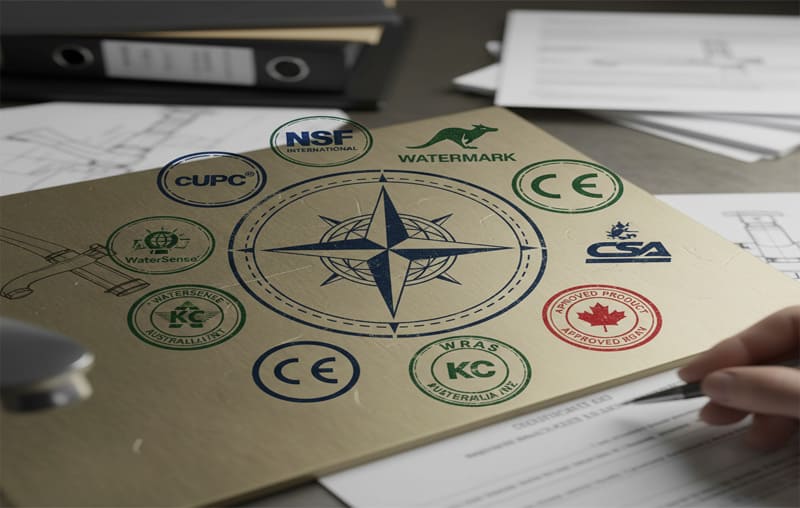
Achieving and maintaining these certifications is a serious and ongoing commitment. It’s not a one-time test.
The process involves:
- Initial Product Testing: Sending multiple product samples to a certified lab for rigorous mechanical, material, and endurance testing.
- Factory Audits: Auditors from the certification body physically inspect our manufacturing facility, examining everything from raw material sourcing to quality control checkpoints and record-keeping.
- Ongoing Compliance: We are subject to regular, often unannounced, follow-up inspections and product testing to ensure that we continue to meet the standard day in and day out.
This is why foundational quality systems are so important. Our factory at SpringFaucet is ISO 9001 certified, a global standard for quality management systems. This robust internal framework makes it possible for us to consistently produce products that meet the demanding requirements of certifications like CE for Europe and ACS for France. It is a testament to our dedication to producing world-class products for global markets.
Insider Tip: When evaluating a potential supplier, don’t just ask “Do you have the certification?” Ask to see the certification certificate itself. It should be from a recognized body (like IAPMO for cUPC or NSF International) and have a current date and a valid file number that you can often verify on the certifier’s website.
Frequently Asked Questions (FAQ)
Q1: Is a faucet without a certification automatically unsafe? Not necessarily, but it is an unverified risk. There is no independent proof that it is safe, durable, or compliant. Given the importance of drinking water safety, it’s a risk that is simply not worth taking.
Q2: How can I tell if a faucet is certified? Look for the mark of the certification body (e.g., the cUPC shield, the NSF circle) stamped or etched directly onto the faucet body, spout, or base. It should also be on the product’s packaging and specification sheet.
Q3: Do certifications make faucets more expensive? Yes, the rigorous testing, factory audits, and licensing fees are a significant investment for the manufacturer. This cost is reflected in the final price. However, you are not just paying for a faucet; you are paying for the verified assurance of safety, quality, and peace of mind.
Conclusion: Your Non-Negotiable Mark of Trust
In a global marketplace filled with endless choices, faucet certifications cut through the noise. They are the clear, objective, and verifiable language of quality. They transform a faucet from a simple piece of hardware into a product you can trust to protect your family’s health, perform reliably for years, and meet the legal and technical standards of your home.
Whether you are choosing one faucet for a bathroom remodel or sourcing thousands for a large-scale project, make certifications your first and most important criterion. They are your guarantee that the manufacturer stands behind their product with a commitment that has been tested, audited, and proven by the world’s leading authorities.
Recommended Links
Internal Links:
External Links (Authoritative Sources):
- IAPMO Group (Certifying Body for cUPC) – The official organization behind the Uniform Plumbing Code and cUPC certification.
- NSF International | The Public Health and Safety Organization – The official website for NSF, where you can learn about standards and verify listings.
- Australian Building Codes Board (ABCB) – WaterMark – The official government authority for the WaterMark certification scheme in Australia.