
You’re sourcing or designing a new faucet, and you keep seeing numbers like GPM, L/min, and terms like WaterSense. What do they really mean for your business? Faucet flow rate isn’t just a technical specification; it’s the critical intersection of user experience, water conservation, and complex international regulations. Getting it wrong means a product that can’t be sold, while getting it right creates a competitive advantage.
This isn’t about chasing the lowest number. The ideal flow rate is a strategic balance. It must comply with mandatory laws in markets like the US, Europe, and China, provide a comfortable and effective experience for the user, and align with voluntary eco-labels that drive sales. This definitive guide is built from our decades of OEM/ODM manufacturing experience to give you a clear, practical roadmap for making compliant, competitive, and successful choices for your target market.
Last Updated: March 2026 | Estimated Reading Time: 16 minutes

This Guide Will Empower You To:
- Master the core concepts of faucet flow rate and its influencing factors.
- Navigate the complex web of regulations in the US, Europe, and China.
- Strategically design flow rates for different faucet types like kitchen and bathroom.
- Implement a 3-step process to ensure your products are both compliant and competitive.
- Understand future trends in smart water conservation to stay ahead of the curve.
What Exactly Is a Faucet Flow Rate?
At its simplest, faucet flow rate is the volume of water that flows out of a faucet in a given amount of time, typically measured in gallons per minute (GPM) or liters per minute (L/min). However, this number is only meaningful when measured under a standardized water pressure.
A flow rate stated without a corresponding pressure (like 60 psi or 3 bar) is like stating a car’s top speed without mentioning the road conditions—it’s not a reliable comparison. This is why global standards are so crucial.
Four main factors determine a faucet’s final flow rate:
- Supply Pressure: Higher water pressure from the pipes will force more water through the faucet. This is why tests are done at a specific, controlled pressure.
- Internal Waterway Design: The diameter and smoothness of the channels inside the faucet body affect how easily water can pass through.
- Aerator or Flow Restrictor: This small, critical component at the tip of the spout is the primary tool for controlling the flow rate. It mixes air with water to create a full, soft-feeling stream while using less water.
- Cartridge Type and Opening: The internal valve (cartridge) that controls the on/off and temperature mix also dictates the maximum volume of water that can pass through it.
Manufacturer’s Pro Tip: The aerator is the most cost-effective way to customize a faucet for different markets. A single faucet body can be made compliant for California, Germany, or China simply by installing the correct, market-specific aerator. This is a core strategy we use at Springfaucet to provide flexible OEM solutions.
A Deep Dive into Global Faucet Flow Rate Standards

Navigating the world of faucet regulations can be daunting. Each major market has its own set of mandatory laws, voluntary eco-labels, and testing pressures. Understanding these differences is non-negotiable for successful market entry.
Here is a breakdown of the core requirements for the world’s three largest markets, based on our experience manufacturing for global clients.
Table 1: 2026 Global Faucet Flow Rate Regulations at a Glance
| Feature | USA | Europe (EU) | China |
|---|---|---|---|
| Primary Standard | ASME A112.18.1 / CSA B125.1 | EN 817 / EN 200 | GB 25501-2019 / GB 18145 |
| Testing Pressure | 60 psi (lavatory/kitchen) / 80 psi (shower) | 3 bar (approx. 43.5 psi) | 0.1 MPa (approx. 14.5 psi) |
| Lavatory Faucet Limit | ≤ 2.2 GPM (8.3 L/min) | ~6.0 L/min (Standard) | ≤ 6.0 L/min (Grade 3) |
| Kitchen Faucet Limit | ≤ 2.2 GPM (8.3 L/min) | ~6.0 L/min (Standard) | ≤ 6.0 L/min (Grade 3) |
| Showerhead Limit | ≤ 2.0 GPM (7.6 L/min) | ~9.0 L/min (Standard) | Varies, has separate standard |
| Key Eco-Label | EPA WaterSense (Voluntary) | Various national labels (e.g., WELL) | Water Efficiency Grades (Mandatory) |
The United States Market (ASME & WaterSense)
In the U.S., the baseline is set by federal law, but the real market driver is the voluntary WaterSense label.
- Mandatory Limit: Federal regulations, enforced via the ASME A112.18.1 standard, cap lavatory and kitchen faucets at a maximum of 2.2 GPM.
- The California Factor: Be aware of state-level laws. California, through its CalGreen code, enforces stricter limits, such as 1.2 GPM for lavatory faucets and 1.8 GPM for kitchen faucets. As a major market, California’s standards often influence product design for the entire country.
- The WaterSense Advantage: The EPA WaterSense program is a voluntary partnership that labels products that are at least 20% more water-efficient than the federal standard. For a lavatory faucet, this means a flow rate of 1.5 GPM or less. Achieving WaterSense certification is a powerful marketing tool, often required for government projects and preferred by environmentally conscious consumers.
The European Market (EN Standards)
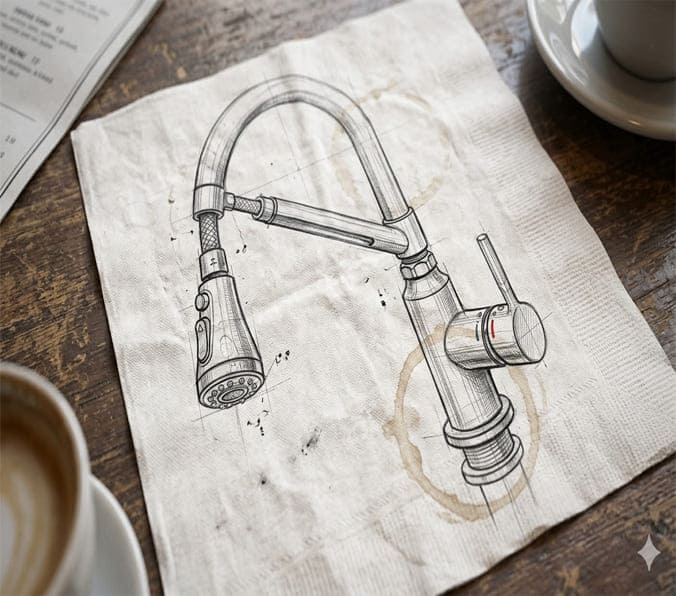
The European approach focuses on standardized performance categories defined by standards like EN 817 (for mixers) and EN 200 (for single taps).
- Standardized Categories: Unlike the US’s hard caps, EN standards define flow rate classes. Manufacturers must test their products at a pressure of 3 bar and declare which class they fall into.
- Lavatory/Kitchen Faucets: A “standard” flow rate is typically around 6.0 L/min, while a “water-saving” model might be around 3.0 L/min.
- Shower Systems: A standard flow is around 9.0 L/min, with water-saving versions targeting 6.0 L/min.
- Clear Labeling: The key here is not a strict limit, but the requirement to clearly state the flow rate on the product’s technical data sheet. This allows specifiers and consumers to make an informed choice.
- Eco-Design (ErP): The EU’s overarching Ecodesign Directive (ErP) is pushing all energy- and water-related products towards greater efficiency. This framework is expected to lead to stricter flow rate requirements in the future.
The Chinese Market (Mandatory Water Efficiency Grades)
China has one of the most structured and stringent systems in the world, based on a mandatory water efficiency labeling program defined by GB 25501-2019.
- Mandatory Labeling: Every faucet sold in China must be tested and display a “Water Efficiency Label,” similar to an energy-efficiency sticker on an appliance. This label shows its efficiency grade from 1 to 3.
- Low Testing Pressure: Critically, Chinese standards test at a much lower pressure of 0.1 MPa (1 bar). This means a faucet designed for the high-pressure US market may fail to perform adequately or meet the grade requirements in China without modification.
Table 2: China’s Water Efficiency Grades for Faucets
| Water Efficiency Grade | Flow Rate Requirement (@ 0.1 MPa) | Market Perception |
|---|---|---|
| Grade 1 (Most Efficient) | ≤ 4.5 L/min | Premium, eco-friendly, top-tier product |
| Grade 2 (Efficient) | ≤ 5.0 L/min | Good quality, standard for most reputable brands |
| Grade 3 (Basic Compliance) | ≤ 6.0 L/min | Minimum acceptable level for market entry |
As an OEM/ODM partner, Springfaucet has deep experience in engineering products to meet these specific grades. For clients targeting the Chinese market, we advise aiming for Grade 2 as a baseline and developing flagship products that achieve Grade 1 to stand out.
Designing for Function: Flow Rates by Faucet Type
A one-size-fits-all approach to flow rate doesn’t work. The optimal design must be tied directly to how the faucet is used every day.

Lavatory (Bathroom) Faucets
- Primary Use: Washing hands, brushing teeth. These are short, frequent tasks.
- Design Goal: Quick, effective wetting and rinsing without splashing. User experience is paramount. A flow rate that is too low feels weak and requires the user to run the water longer, defeating the purpose of conservation.
- Strategic Approach: Focus on aerator technology. A high-quality aerator can make a 1.2 GPM (4.5 L/min) flow feel as full and powerful as a much higher flow rate by creating a “soft” and voluminous stream. This is the key to meeting strict standards (like WaterSense or China’s Grade 1) without sacrificing user comfort.
Kitchen Faucets
- Primary Use: Highly versatile. Needs to do everything from washing vegetables (gentle spray) to filling large pots (high flow).
- Design Goal: Flexibility and power.
- Strategic Approach: Dual-functionality is the industry standard.
- Aerated Stream: A powerful, splash-free stream that meets the market’s maximum allowable flow rate (e.g., 1.8 GPM in California) for fast filling.
- Spray Mode: A wider, gentler spray for rinsing. This mode can be designed with a lower flow rate (~1.0-1.5 GPM) to provide a clear water-saving benefit and marketing claim.
Shower Systems
- Primary Use: Full-body rinsing and creating a comfortable, immersive experience.
- Design Goal: Balance coverage and force within strict regulatory limits.
- Strategic Approach: Technology is key. To make a 2.0 GPM showerhead feel powerful, engineers use:
- Air-Induction Technology: This draws air into the water stream, making the droplets larger and feel more substantial.
- Optimized Nozzles: Carefully designed silicone nozzles create pressurized, focused streams that improve rinsing power without increasing water consumption.
Your 3-Step Strategy for Competitive Flow Rate Design
As an OEM/ODM manufacturer, we guide our clients through a simple but effective strategic process.
Step 1: Define Your Target Market and Product Category</h3>
Be specific. Are you launching a mid-range kitchen faucet for the U.S. market or a high-end lavatory faucet for Europe? The answer determines your entire set of technical requirements.
Step 2: Identify Regulatory Caps and Certification Goals</h3>
- For the US: Design to meet the strictest state law (usually California’s 1.2 GPM for lavatory). Make achieving WaterSense a primary R&D goal.
- For Europe: Decide if you are marketing a “standard” or “water-saving” model and ensure your technical file reflects the correct EN 200 flow class.
- For China: Target a specific Water Efficiency Grade. We strongly recommend aiming for Grade 2 or higher.
Step 3: Engineer for Experience and Market It as a Benefit</h3>
Once you have your target flow rate, work on the “feel.” Invest in high-quality aerators and shower engines. Then, turn your compliance into a selling point. Clearly display the GPM/LPM, the WaterSense logo, or the Water Efficiency Grade on your packaging and marketing materials. This transforms a technical requirement into a tangible benefit for the customer.
Many of the OEM faucets we produce at Springfaucet are favored by professional plumbers because we engineer them for easy installation and reliable performance that meets local codes right out of the box. This built-in compliance saves them time and headaches on the job site. Our diverse product lines, like our versatile bidet sprayer systems, demonstrate our ability to engineer for specific functions and markets.
The Future of Water Flow: 2026 Trends in Smart & Precise Conservation

The drive for water efficiency is only accelerating. Here’s what’s next:
- Real-Time Visualization: Faucets with integrated digital displays or that connect to smart home apps will show users their exact water consumption in real-time, encouraging behavioral change.
- Adaptive Flow Control: We will see more faucets that can automatically or manually switch between different flow rates based on the task. Imagine a faucet that provides a low-flow mist for washing hands but switches to a full-flow stream when it detects a pot underneath it.
- Ever-Stricter Standards: As water scarcity becomes a more pressing global issue, expect governments to continue lowering the maximum allowable flow rates. Proactively designing ultra-high-efficiency products now is a smart long-term strategy.
Frequently Asked Questions (FAQ) {#faq}
Q1: Does a lower flow rate always mean better water conservation?
Not necessarily. If a flow rate is so low that you have to run the tap for twice as long to rinse soap off your hands, you may not save any water. The goal is water efficiency—getting the job done effectively with the least amount of water, not just reducing flow.
Q2: If my faucet meets the flow rate standard, does the design matter?
Absolutely. Two faucets can both be rated at 1.2 GPM, but one might produce a weak, unsatisfying trickle while the other produces a full, soft, and effective stream. This difference in user experience comes from superior hydraulic design and a better aerator, and it’s a key product differentiator.
Q3: How do I design one product for multiple international markets?
The most effective strategy is to design the core faucet body to be compatible with the most restrictive standard (e.g., China’s Grade 1 at 4.5 L/min). Then, create a modular system with different aerators that can be installed at the factory to meet the specific requirements of the US, European, or other markets. This “design once, adapt for many” approach is highly efficient.
Conclusion: Flow Rate is Your Green Competitive Edge
Mastering faucet flow rates has evolved from a simple compliance checkbox into a powerful strategic tool. It is the bridge connecting regulatory adherence, commercial success, and corporate sustainability.
By starting with a clear understanding of your target market’s standards, leveraging smart design to optimize user experience within those limits, and marketing your compliance as a clear environmental benefit, you transform a technical number into a compelling reason for customers to choose your product. This is how you win in the modern global marketplace.
Immediate Action Checklist:
- Identify: What are the mandatory flow rate limits for your primary target market?
- Test: What is the real-world user experience of your current prototype? Does it feel powerful enough?
- Strategize: Is your design flexible enough to achieve a voluntary eco-label like WaterSense?
- Communicate: Does your product manual and marketing copy clearly state the flow rate and its water-saving benefits?
Recommended Links
Internal Links:
- The Ultimate Guide to SUS304 Stainless Steel Faucets
- PVD vs. Electroplating: A Manufacturer’s Guide to Faucet Finishes
- OEM/ODM Partnership with Springfaucet: How We Work
External Links (Authoritative Sources):
- EPA WaterSense Program for Faucets – Official resource for the U.S. water-saving certification.
- European Standard EN 817:2008 (via BSI) – The key technical standard for mechanical mixers in Europe.
- International Water, Sanitation and Hygiene Foundation (IWSH) – A global organization focused on the role of plumbing in public health and sustainability.