
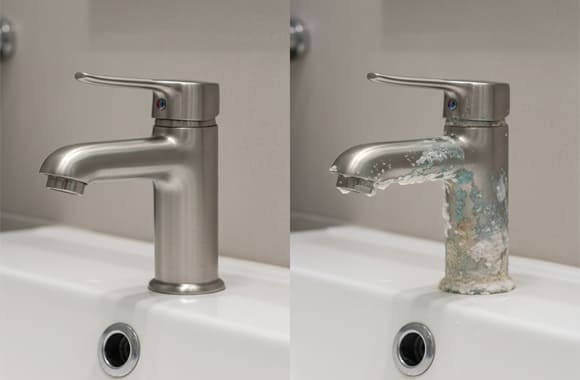
Hard water affects 85% of U.S. households and causes premature faucet failure, reduced flow rates, and customer complaints that could destroy your brand reputation. If you’re sourcing faucets for areas with mineral-rich water—whether you’re a distributor, contractor, or private label brand—understanding how calcium and magnesium deposits impact different materials and finishes will save you thousands in warranty claims and customer service issues.
After two decades of manufacturing faucets for global markets, I’ve seen how hard water turns premium fixtures into maintenance nightmares when the wrong materials are specified. The difference between a faucet that lasts 2 years versus 15 years in hard water conditions often comes down to specification decisions made during the sourcing phase.
This guide will show you exactly which materials, finishes, and internal components resist mineral buildup, how to engineer hard water resistance into your specifications, and what maintenance requirements you should communicate to end customers to prevent warranty issues.
Last Updated: July 2026 | Estimated Reading Time: 36 minutes
What You’ll Learn:
- Material performance rankings in hard water conditions with failure timelines
- Finish durability comparison across chrome, PVD, and specialty coatings
- Internal component specifications that resist mineral buildup and maintain flow rates
- Engineering solutions B2B buyers can specify to extend faucet lifespan
- Maintenance protocols to share with end customers for warranty protection
Understanding Hard Water’s Impact: The Science Behind Faucet Failure
Hard water contains dissolved minerals—primarily calcium and magnesium—that create multiple failure modes in faucets. Understanding these mechanisms helps you specify the right solutions.
The Mineral Scale Formation Process
Stage 1: Initial Contact (Days 1-30)
- Minerals begin adhering to internal surfaces, especially at temperature transition points
- Aerator screens start collecting particles, reducing flow rate by 5-10%
- No visible external damage, but internal buildup begins
Stage 2: Accumulation (Months 1-6)
- Cartridge operation becomes stiff due to mineral deposits on sealing surfaces
- Flow rate reduction accelerates to 15-25% in severely hard water (>15 grains per gallon)
- External finish shows water spots that become harder to clean
Stage 3: Functional Degradation (Months 6-18)
- Cartridge may stick in open/closed positions due to scale buildup
- Internal waterways experience significant restriction (30-50% flow loss)
- Finish degradation accelerates where minerals concentrate (spout tip, handles)
Stage 4: Complete Failure (Months 12-36)
- Cartridge replacement required, but mineral damage may affect housing threads
- Flow becomes irregular or stops completely due to blocked passages
- Finish failure creates permanent staining and pitting that cleaning cannot resolve
Hard Water Classification and Faucet Impact Timeline
| Water Hardness Level | Mineral Content (ppm/gpg) | Typical Faucet Lifespan | Primary Failure Mode |
|---|---|---|---|
| Soft | <60 ppm / <3.5 gpg | 15+ years | Normal wear patterns |
| Moderately Hard | 61-120 ppm / 3.6-7 gpg | 8-12 years | Gradual flow reduction |
| Hard | 121-180 ppm / 7.1-10.5 gpg | 5-8 years | Cartridge sticking, finish staining |
| Very Hard | >180 ppm / >10.5 gpg | 2-5 years | Rapid internal buildup, premature failure |
Regional Reality Check: Areas like Phoenix (Arizona), San Antonio (Texas), and Indianapolis (Indiana) commonly exceed 15 grains per gallon. If you’re selling in these markets without hard water specifications, expect 60-80% higher warranty claims compared to soft water regions.
Finish Showdown: Performance in Mineral-Rich Water Conditions
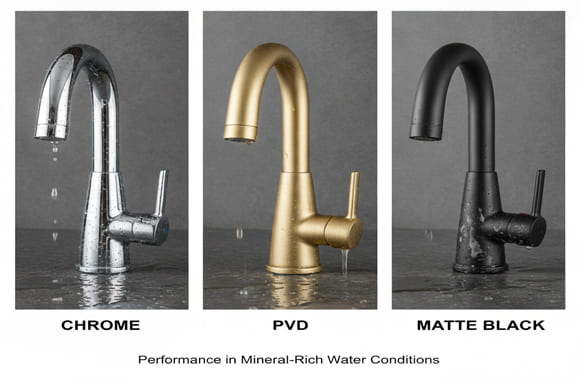
Different finishes react dramatically differently to mineral deposits and cleaning chemicals used to remove them:
Chrome Finishes in Hard Water
Performance Timeline:
- Months 1-3: Water spots appear but can be removed with standard cleaners
- Months 3-9: Mineral etching begins, requiring aggressive cleaning that may damage finish
- Months 9-18: Permanent pitting develops, especially around aerator and spout areas
- Beyond 18 months: Finish failure accelerates, leading to corrosion of underlying brass
Chrome Advantages:
- Lowest initial cost for manufacturers
- Familiar appearance to consumers
- Easy to clean when new
Chrome Disadvantages in Hard Water:
- Shows every water spot and mineral deposit
- Susceptible to etching from acidic cleaners used to remove scale
- Requires frequent maintenance to prevent permanent staining
PVD (Physical Vapor Deposition) Finishes: The Hard Water Champion
Performance Timeline:
- Year 1: Minimal visible impact from mineral deposits
- Years 1-3: Maintains appearance with standard cleaning
- Years 3-7: Some mineral buildup possible but finish remains intact
- Beyond 7 years: Gradual wear in high-contact areas only
PVD Advantages:
- Significantly harder surface (1,400-2,000 HV vs 150-200 HV for chrome)
- Chemically inert—resists both minerals and cleaning chemicals
- Maintains appearance with minimal maintenance
PVD Considerations:
- 30-50% higher manufacturing cost
- Limited color options compared to other finishes
- Repair requires complete refinishing if damaged
Matte Black and Specialty Finishes
Brushed Nickel Performance:
- Hides water spots better than chrome but still shows mineral buildup
- Susceptible to scratching from abrasive cleaning required for scale removal
- Moderate durability—better than chrome, not as good as PVD
Matte Black Coating Performance:
- Excellent at hiding water spots and minor mineral deposits
- Quality varies dramatically between powder coating, PVD, and electroplating
- PVD matte black performs best but costs 40-60% more than standard options
Finish Selection Tip: For hard water areas (>7 gpg), specify PVD finishes despite higher cost. The reduced warranty claims and customer satisfaction issues typically justify the 30-50% material cost premium within the first year of sales.
Base Material Performance: Engineering for Longevity
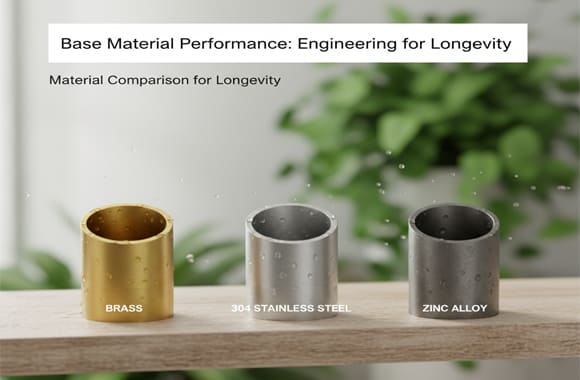
The base material determines how your faucets perform when mineral deposits inevitably form:
Brass: The Traditional Choice with Modern Improvements
Standard Brass (CuZn39Pb3) Performance:
- Excellent machinability allows precise internal geometries
- Lead content creates galvanic corrosion concerns in hard water
- Mineral deposits bond more aggressively to rough surface finish
Lead-Free Brass (CuZn21Si3P) Performance:
- Improved corrosion resistance in mineral-rich environments
- Harder surface reduces mineral adhesion compared to traditional brass
- Higher silicon content provides better scale resistance
- 15-25% longer lifespan in hard water conditions
Brass Advantages:
- Proven manufacturing processes and quality control
- Antimicrobial properties reduce bacterial growth
- Repairable—can be refinished or replated if needed
- Cost-effective for complex internal geometries
Brass Considerations in Hard Water:
- Requires quality surface finishing to minimize mineral adhesion
- Internal passages need proper sizing to accommodate some scale buildup
- Regular maintenance still required in very hard water areas
304 Stainless Steel: The Corrosion-Resistant Alternative
304 SS Performance in Hard Water:
- Excellent resistance to mineral corrosion and pitting
- Smooth surface finish reduces mineral adhesion points
- Maintains structural integrity even with heavy scale buildup
- No galvanic corrosion issues with mixed-metal installations
Manufacturing Considerations:
- More difficult to machine complex internal passages
- Welding and forming require specialized expertise
- Limited casting options—mostly machined or formed construction
- Higher material and labor costs (40-60% premium over brass)
Application Recommendations:
- Ideal for commercial applications with minimal maintenance budgets
- Excellent choice for coastal areas with both hard water and salt exposure
- Recommended for healthcare and food service where cleanability is critical
Zinc Alloy: When to Avoid in Hard Water Applications
Zinc Alloy Performance Issues:
- Rapid corrosion in presence of dissolved minerals
- Galvanic corrosion accelerated by mineral deposits
- Surface pitting develops within 6-12 months in hard water
- Internal threads strip easily when mineral buildup occurs
Why Manufacturers Use Zinc Alloy:
- 60-70% lower material costs than brass
- Easy to die-cast complex shapes
- Acceptable performance in soft water conditions
B2B Buyer Warning: Avoid zinc alloy construction for any application where water hardness exceeds 5 grains per gallon. The short-term cost savings create long-term warranty liabilities.
| Material | Hard Water Resistance | Typical Lifespan (>10 gpg) | Maintenance Requirements | Cost Premium |
|---|---|---|---|---|
| Lead-Free Brass | Good | 5-8 years | Moderate | Baseline |
| 304 Stainless Steel | Excellent | 10-15 years | Low | +40-60% |
| Traditional Brass | Fair | 3-6 years | High | -10-15% |
| Zinc Alloy | Poor | 1-3 years | Very High | -60-70% |
Internal Components: Engineering Flow Performance in Hard Water
The components inside your faucets determine whether they maintain proper function as minerals accumulate:
Cartridge Design for Mineral Resistance
Ceramic Disc Cartridges:
- Advantages: Hard ceramic surfaces resist mineral etching and scoring
- Hard Water Performance: Maintains sealing capability even with moderate scale buildup
- Failure Mode: Minerals can accumulate between discs, causing stiffness rather than leaks
- Maintenance: Can often be restored with proper descaling procedures
Ball Valve Cartridges:
- Advantages: Single moving part reduces failure points
- Hard Water Performance: Ball surface can develop mineral pitting that affects sealing
- Failure Mode: Typically develops leaks rather than operational stiffness
- Maintenance: Usually requires complete replacement rather than cleaning
Compression Cartridges:
- Advantages: Simple design, easily serviceable
- Hard Water Performance: Rubber components degrade faster in mineral-rich water
- Failure Mode: Rapid seal degradation leading to drips and leaks
- Maintenance: Frequent seal replacement required (every 12-24 months)
Aerator and Flow Control Engineering
Standard Aerator Problems in Hard Water:
- Screen mesh (typically 24-40 mesh) clogs rapidly with mineral particles
- Flow rate drops from 2.2 GPM to 1.0 GPM or less within 3-6 months
- Non-removable aerators become permanent flow restrictions
Hard Water Aerator Solutions:
- Larger Mesh Openings: 16-20 mesh allows mineral particles to pass through
- Self-Cleaning Designs: Turbulent flow patterns prevent particle accumulation
- Removable Construction: Allows regular cleaning and maintenance
- Anti-Mineral Coatings: Specialized treatments reduce particle adhesion
Internal Waterway Design Considerations
Standard Internal Geometry Issues:
- Sharp corners and sudden diameter changes create mineral accumulation points
- Minimum internal diameter of 8mm required to accommodate some scale buildup
- Thread designs must account for mineral buildup affecting assembly/disassembly
Hard Water Optimized Designs:
- Smooth, gradual transitions in water passages
- Oversized internal passages (10-12mm minimum diameter)
- Special thread coatings or designs for maintainability
- Strategic placement of access points for cleaning
Engineering Insight: At SPRINGFAUCET, we’ve developed specialized internal geometries for hard water markets. Our thermostatic bathroom faucets use oversized waterways and ceramic mixing chambers that maintain temperature accuracy even as mineral deposits form—critical for Nordic markets where both water hardness and temperature control are concerns.
What B2B Buyers Can Engineer Into Specifications
Beyond material selection, specific engineering features dramatically improve hard water performance:
Specification Language for Hard Water Resistance
Water Quality Testing Requirements:
Internal Component Specifications:
Finish Durability Requirements:
Maintenance Access Engineering
Serviceability Requirements:
- All cartridges accessible with standard plumbing tools
- Aerators removable without damaging finish or threads
- Internal components cleanable without disassembly of valve body
- Replacement parts availability guaranteed for minimum 10 years
Documentation Requirements:
- Detailed maintenance schedules based on local water hardness levels
- Step-by-step descaling procedures with approved chemical compatibility
- Troubleshooting guide for common hard water symptoms
- Warranty coverage clarification for maintenance-related issues
Quality Control for Hard Water Performance
Incoming Inspection Protocols:
- Surface roughness testing of internal passages (Ra ≤1.6μm)
- Finish adhesion testing with thermal cycling
- Flow rate verification at multiple pressure differentials
- Cartridge operational force measurement
Accelerated Life Testing:
- 10,000-cycle operation test with hard water solution
- Thermal cycling between 40°F and 180°F with mineral solution
- Chemical compatibility testing with common descaling products
- Long-term flow degradation analysis
Regional Hard Water Challenges: Market-Specific Solutions
Different geographic markets present unique hard water challenges requiring specific solutions:
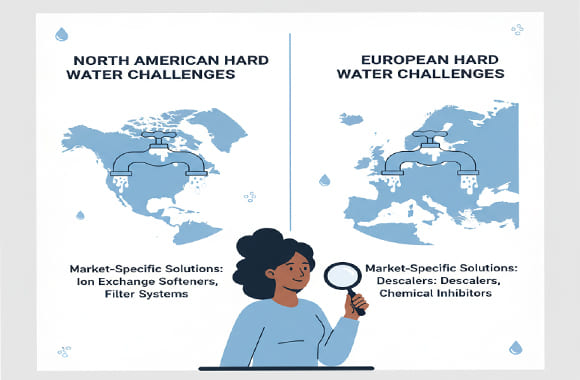
North American Hard Water Hotspots
Southwest United States (Arizona, Nevada, New Mexico):
- Challenge: Extreme hardness (15-25 grains per gallon) with high temperatures
- Solution Requirements: PVD finishes mandatory, oversized internal passages
- Recommended Materials: 304 stainless steel for commercial, lead-free brass for residential
Great Plains (Kansas, Nebraska, parts of Texas):
- Challenge: High calcium content with seasonal temperature variations
- Solution Requirements: Ceramic cartridges with wide temperature tolerance
- Recommended Features: Tool-free aerator removal, enhanced descaling access
Great Lakes Region (Michigan, Ohio, Indiana):
- Challenge: Variable hardness with chlorine treatment interactions
- Solution Requirements: Finishes resistant to both minerals and chlorine exposure
- Recommended Specifications: Chemical compatibility testing for municipal treatments
European Market Considerations
Nordic Countries (Sweden, Norway, Finland):
- Challenge: Moderate hardness but extreme temperature cycling requirements
- Solution Requirements: Thermostatic accuracy maintenance despite mineral buildup
- Market Success: SPRINGFAUCET’s thermostatic faucets excel here due to ceramic mixing chambers
Mediterranean Region (Spain, Italy, Greece):
- Challenge: High mineral content with elevated operating temperatures
- Solution Requirements: Enhanced heat resistance combined with scale resistance
- Recommended Approach: Stainless steel internal components with PVD exteriors
Specification Recommendations by Market Region
| Region | Primary Challenge | Recommended Base Material | Required Finish | Special Features |
|---|---|---|---|---|
| SW United States | Extreme hardness (15-25 gpg) | 304 Stainless Steel | PVD coating | Oversized passages, ceramic cartridges |
| Great Plains | High calcium + temperature swings | Lead-free brass | Brushed nickel or PVD | Tool-free maintenance access |
| Great Lakes | Hardness + chlorine interaction | Lead-free brass | Chrome or PVD | Chemical-resistant seals |
| Nordic Europe | Moderate hardness + temp control | Brass with ceramic internals | Any quality finish | Thermostatic accuracy retention |
| Mediterranean | High minerals + heat | Stainless steel preferred | PVD mandatory | Enhanced heat resistance |
The Maintenance Reality: What End-Customers Will Experience
Understanding the maintenance requirements helps B2B buyers set proper expectations and avoid warranty disputes:
Maintenance Frequency by Water Hardness Level
Soft Water Areas (<3.5 grains per gallon):
- Aerator Cleaning: Annual inspection, cleaning as needed
- Cartridge Service: 8-12 years typical replacement interval
- Finish Care: Standard cleaning with mild detergents sufficient
- Overall Maintenance: Minimal beyond normal use
Moderate Hardness (3.6-7 grains per gallon):
- Aerator Cleaning: Quarterly removal and descaling required
- Cartridge Service: 5-8 years typical replacement interval
- Finish Care: Weekly cleaning with appropriate products to prevent staining
- Descaling: Semi-annual complete faucet descaling recommended
Hard Water Areas (7.1-10.5 grains per gallon):
- Aerator Cleaning: Monthly removal and thorough cleaning essential
- Cartridge Service: 3-5 years replacement interval, may require interim servicing
- Finish Care: 2-3 times weekly cleaning required to prevent permanent staining
- Descaling: Quarterly complete descaling with appropriate chemicals
Very Hard Water (>10.5 grains per gallon):
- Aerator Cleaning: Bi-weekly cleaning required to maintain flow rates
- Cartridge Service: 1-3 years replacement, often requires professional service
- Finish Care: Daily attention needed, weekly deep cleaning essential
- Descaling: Monthly complete descaling, may require professional service
Customer Education Requirements
Cleaning Product Compatibility:
- Specify approved descaling chemicals (typically citric acid-based)
- Prohibit abrasive cleaners that damage finishes
- Provide pH guidelines for safe cleaning solutions (6.0-8.5 pH range)
- Include warnings about bleach and ammonia-based products
Maintenance Procedure Documentation:
Warranty Protection Guidelines:
- Document maintenance performed with dates and methods
- Use only manufacturer-approved cleaning products
- Address mineral buildup promptly to prevent permanent damage
- Keep water quality test results if available for warranty claims
Maintenance Reality Tip: In areas exceeding 12 grains per gallon hardness, consider recommending water softener systems to customers. The cost of water treatment often pays for itself within 2-3 years through reduced faucet maintenance and replacement needs.
Advanced Solutions: Next-Generation Hard Water Technologies
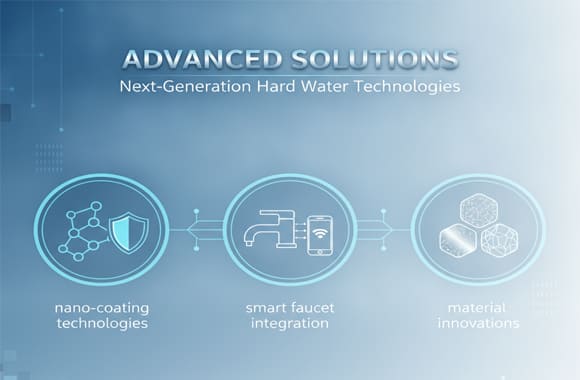
Emerging technologies offer new approaches to hard water resistance:
Nano-Coating Technologies
Hydrophobic Nano Coatings:
- Create microscopic surface texture that reduces mineral adhesion
- Water beads and rolls off, taking loose minerals with it
- Durability concerns—typically 2-3 year effectiveness
- 20-30% cost premium over standard finishes
Self-Cleaning Surface Treatments:
- Photocatalytic coatings break down organic deposits
- Titanium dioxide-based treatments show promise
- Requires UV exposure for activation—limited to certain applications
- Still in development for widespread faucet applications
Smart Faucet Integration for Hard Water Management
Flow Monitoring Systems:
- Sensors detect flow rate degradation indicating mineral buildup
- Mobile app notifications alert users to maintenance needs
- Preventive maintenance scheduling based on actual performance
- Premium feature—adds $100-200 to manufacturing cost
Automated Descaling Features:
- Programmable reverse flow cycles to dislodge mineral deposits
- Chemical injection ports for automated descaling (commercial applications)
- Temperature cycling to thermal shock mineral deposits loose
- Complex systems requiring professional installation and service
Material Innovations
Advanced Stainless Steel Alloys:
- 316L stainless with enhanced surface treatments
- Duplex stainless steels for extreme corrosion resistance
- Significantly higher cost but exceptional durability
- Primarily for commercial and industrial applications
Engineered Ceramic Components:
- Full ceramic valve bodies for ultimate mineral resistance
- Extremely hard surfaces resist all forms of mineral buildup
- Brittle failure mode concerns limit residential applications
- Excellent for high-end commercial installations
Cost-Benefit Analysis: Investing in Hard Water Resistance
Understanding the total cost of ownership helps justify specification upgrades:
10-Year Total Cost Analysis (Very Hard Water – 15+ grains per gallon)
Standard Chrome/Brass Faucet ($45 manufacturing cost):
- Initial cost: $45
- Warranty replacements (2 units over 10 years): $90
- Customer service costs: $25
- Brand reputation impact: $50 (estimated)
- Total 10-year cost: $210
PVD/Lead-Free Brass Faucet ($65 manufacturing cost):
- Initial cost: $65
- Warranty replacements (0.5 units over 10 years): $32.50
- Customer service costs: $8
- Brand reputation impact: $10 (estimated)
- Total 10-year cost: $115.50
Stainless Steel/PVD Faucet ($85 manufacturing cost):
- Initial cost: $85
- Warranty replacements (0.1 units over 10 years): $8.50
- Customer service costs: $3
- Brand reputation impact: $2 (estimated)
- Total 10-year cost: $98.50
ROI Calculation for Specification Upgrades
| Upgrade Level | Additional Cost | Warranty Savings | Service Savings | Net 10-Year Benefit |
|---|---|---|---|---|
| Chrome to PVD Finish | +$15 | $45 | $12 | +$42 per unit |
| Brass to Lead-Free Brass | +$8 | $20 | $8 | +$20 per unit |
| Brass to Stainless Steel | +$25 | $70 | $18 | +$63 per unit |
| Standard to Hard Water Optimized | +$35 | $85 | $25 | +$75 per unit |
Business Case Insight: For distributors selling into hard water markets, the specification upgrades typically pay for themselves within 18-24 months through reduced warranty costs alone. The brand protection value adds additional ROI that’s harder to quantify but equally important.
Testing and Validation: Ensuring Hard Water Performance
Proper testing validates your hard water specifications before market release:
Standard Test Protocols
ASME A112.18.1 Modified for Hard Water:
- Standard flow rate and pressure testing
- Extended operation cycles with synthetic hard water solution
- Accelerated aging with mineral-rich solutions at elevated temperatures
- Post-test disassembly and internal inspection for mineral buildup
Custom Hard Water Testing Protocol:
Quality Control Checkpoints
Pre-Production Validation:
- Material certification for hard water resistance specifications
- Surface finish quality and adhesion testing
- Internal geometry verification (passage sizes, transition radii)
- Cartridge compatibility and performance baseline
Production Quality Control:
- Statistical sampling of finish thickness and hardness
- Flow rate verification on every production lot
- Cartridge operational force consistency
- Final assembly torque specifications for maintainability
Field Performance Monitoring:
- Warranty claim analysis by geographic region
- Customer feedback correlation with local water hardness data
- Service technician reports on common failure modes
- Continuous improvement feedback to design and manufacturing
Regional Compliance and Standards
Different markets have specific requirements for hard water performance:
North American Standards
NSF/ANSI 61 – Drinking Water System Components:
- Material compatibility with municipal water treatment chemicals
- Leaching requirements for extended contact with treated water
- Specific testing protocols for chloramine-treated systems
IAPMO Installation Standards:
- Accessibility requirements for maintenance in hard water areas
- Minimum clearances for cartridge replacement
- Documentation requirements for warranty compliance
European Compliance Requirements
CE Marking for Faucets (EN 817):
- Mechanical endurance testing with hard water simulation
- Hydraulic performance retention over operational life
- Material compatibility with European water treatment methods
DVGW (German) Water Quality Standards:
- Specific testing for Central European water mineral content
- Long-term performance validation in real-world conditions
- Compatibility with decentralized water softening systems
Emerging Market Considerations
Water Quality Variability:
- Municipal systems may have inconsistent mineral content
- Well water applications with extreme hardness levels
- Seasonal variations in mineral content and temperature
Infrastructure Limitations:
- Limited access to replacement parts and service technicians
- Reduced availability of appropriate maintenance chemicals
- Need for extended warranty coverage and local support
Frequently Asked Questions
Q: How can I determine the water hardness in my target market areas?
Contact local water utilities for annual water quality reports, which include hardness measurements. For private wells, recommend customers use test strips or professional water analysis. The USGS maintains national water quality databases that provide regional averages. Plan for variations—municipal systems can range from 3-15 grains per gallon seasonally.
Q: Is it worth specifying hard water-resistant faucets for all markets, even soft water areas?
Generally no, due to cost implications. However, if your distribution covers multiple regions, standardizing on moderate hard water specifications (PVD finishes, ceramic cartridges) may simplify inventory and provide universal compatibility. The 15-25% cost premium is often justified by operational simplification.
Q: What’s the difference between water softener compatibility and hard water resistance?
Water softener compatibility means the faucet works with softened water (high sodium content, different pH). Hard water resistance means it functions well with mineral-rich water. Softened water can actually be more corrosive to some metals, so you need both characteristics for comprehensive coverage.
Q: How do I handle warranty claims when customers don’t maintain faucets properly in hard water?
Establish clear maintenance requirements in warranty terms. Provide detailed maintenance schedules and approved cleaning products. Consider offering extended warranties for customers who document proper maintenance. Some manufacturers void warranties if recommended maintenance isn’t performed in areas exceeding specified water hardness levels.
Q: Are there quick visual inspections to identify hard water damage vs. normal wear?
Yes. Hard water damage shows characteristic mineral buildup patterns—white or brown deposits around aerators, spout tips, and handle bases. Normal wear appears as uniform finish degradation or mechanical looseness. Mineral deposits feel rough and crystalline, while normal wear creates smooth surface changes.
Implementation Strategy: Rolling Out Hard Water Solutions
Successfully implementing hard water solutions requires systematic planning:
Market Analysis and Segmentation
Step 1: Geographic Water Quality Mapping
- Obtain water hardness data for all distribution territories
- Identify high-risk areas requiring specialized specifications
- Map seasonal variations and municipal treatment changes
- Correlate existing warranty claims with water hardness data
Step 2: Customer Education Program
- Develop water hardness awareness materials for sales teams
- Create customer-facing maintenance guides and schedules
- Establish technical support protocols for hard water issues
- Train service technicians on hard water-specific troubleshooting
Step 3: Product Line Optimization
- Develop tiered product offerings based on water hardness requirements
- Standardize specifications for different hardness levels
- Establish clear SKU differentiation and marketing messaging
- Create installation and maintenance documentation packages
Supplier Development for Hard Water Solutions
Manufacturing Partner Requirements:
- Demonstrated experience with hard water testing protocols
- Quality control systems for finish thickness and adhesion
- Capability for oversized internal passage manufacturing
- Access to PVD coating facilities or reliable subcontractors
Supply Chain Considerations:
- Alternative sources for specialized coatings and treatments
- Inventory management for region-specific product variants
- Technical support capabilities for complex specifications
- Continuous improvement processes based on field performance
Future Trends in Hard Water Faucet Technology
The industry continues developing new solutions for mineral-rich water challenges:
Emerging Material Technologies
Advanced Ceramic Matrix Composites:
- Ultra-hard surfaces with improved impact resistance
- Self-lubricating properties reduce mineral adhesion
- Manufacturing cost reductions making broader applications viable
- Expected 20-30% performance improvement over current ceramics
Biomimetic Surface Treatments:
- Shark skin-inspired textures reduce mineral attachment points
- Lotus leaf effect coatings for self-cleaning properties
- Nature-inspired designs showing 40-60% reduction in maintenance needs
- Commercial applications expected within 3-5 years
Smart Technology Integration
Predictive Maintenance Systems:
- IoT sensors monitoring flow degradation patterns
- Machine learning algorithms predicting maintenance needs
- Integration with home automation systems for scheduling
- Potential 50-70% reduction in emergency service calls
Automated Cleaning Systems:
- Ultrasonic cleaning integration for mineral deposit removal
- Programmable chemical injection for descaling cycles
- Self-diagnostic capabilities identifying specific maintenance needs
- Premium applications with professional installation requirements
Conclusion: Building Your Hard Water Strategy
Hard water affects the majority of North American households and presents both challenges and opportunities for faucet businesses. The key to success lies in understanding your specific market conditions and specifying appropriate solutions rather than applying one-size-fits-all approaches.
Strategic recommendations for B2B success:
- Know your markets – Map water hardness levels across your distribution territories
- Specify appropriately – Match material and finish specifications to actual water conditions
- Educate customers – Provide clear maintenance requirements and approved procedures
- Plan for service – Establish support systems for hard water-specific issues
- Monitor performance – Track warranty claims and customer feedback by region
The investment in hard water-resistant specifications typically pays for itself within 18-24 months through reduced warranty costs and improved customer satisfaction. More importantly, it protects your brand reputation in markets where inferior products create lasting damage to customer relationships.
At SPRINGFAUCET, we’ve seen companies transform their market position by properly addressing hard water challenges. Our experience across global markets—from the mineral-rich waters of the American Southwest to the temperature-critical applications in Nordic regions—shows that proactive specification beats reactive problem-solving every time.
Ready to protect your faucet business from hard water challenges? The specification decisions you make today determine whether you’ll be managing warranty claims or celebrating customer loyalty tomorrow. Whether you need hard water-optimized designs or want to upgrade existing specifications, the solution starts with understanding the science behind mineral buildup and engineering solutions that actually work.
Recommended Internal & External Links:
- Internal: OEM vs ODM Faucet Manufacturing Which Model Fits Your Private Label Strategy – Understanding different model requirements for different markets
- Internal: B2B Faucet Sourcing the Ultimate Factory Audit Checklist – Compliance requirements for factory audit checking
- Internal: Faucet Material Selection Guide: Brass vs. Stainless Steel Performance – Comprehensive material comparison for different applications
- External: USGS Water Quality Data – Government database for regional water hardness information
- External: [Water Quality Association – Hard Water Information](https://www.wqa.org/learn