
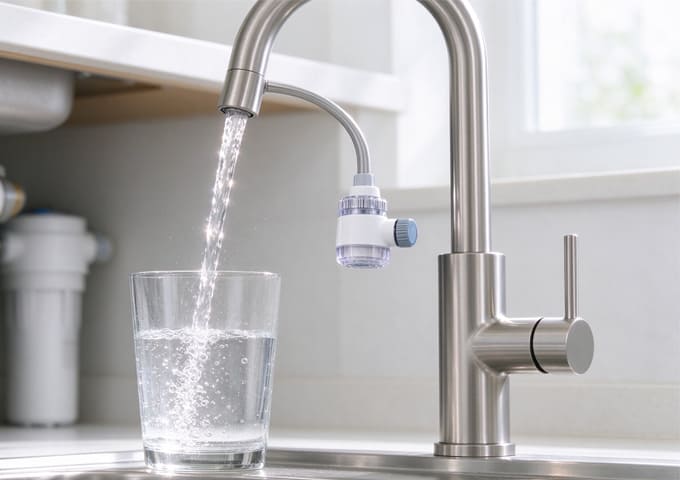
The best water filter for your sink faucet is the one that is specifically matched to your water’s unique chemistry, your budget, and your household’s needs. There is no single “best” filter for everyone. Think of it like choosing tires for your car; you wouldn’t put racing slicks on a vehicle you drive in the snow. Similarly, a filter designed for chlorine taste won’t help if your main problem is hard water mineral buildup or industrial contaminants.
This guide is your expert roadmap. We’ll move beyond marketing hype and empower you to diagnose your water’s real issues. You’ll learn to compare the different types of filters—from simple faucet-mounted units to powerful under-sink systems—and understand which one will give you the safe, great-tasting water you deserve while protecting your plumbing investments.
Last Updated: October 2026 | Estimated Reading Time: 18 minutes
This In-Depth Guide Will Help You Understand:
- Why you should test your water before you even think about buying a filter.
- The critical differences between faucet-mounted, under-sink, and reverse osmosis systems.
- Which filter types are best for common problems like hard water, chlorine taste, lead, and well water contaminants.
- How to read and understand crucial NSF certifications (and why you should never buy a filter without them).
- Expert considerations for B2B professionals specifying filters for large-scale projects.
- How your choice of filter impacts high-design faucets, and what manufacturers like SPRINGFAUCET recommend.
Step 1: Don’t Guess, Test! Why Knowing Your Water Is Crucial
Before you spend a single dollar on a filter, you need to know what you’re trying to remove. Filtering water is a science. Buying a filter without testing your water is like a doctor prescribing medicine without a diagnosis—it’s a shot in the dark.
Your water’s “profile” can vary dramatically based on your geography (GEO). Municipal water in Las Vegas is notoriously hard, while water in Seattle is very soft. A rural home on a well has a completely different set of potential issues (like bacteria or nitrates) than a city apartment with chlorinated water.
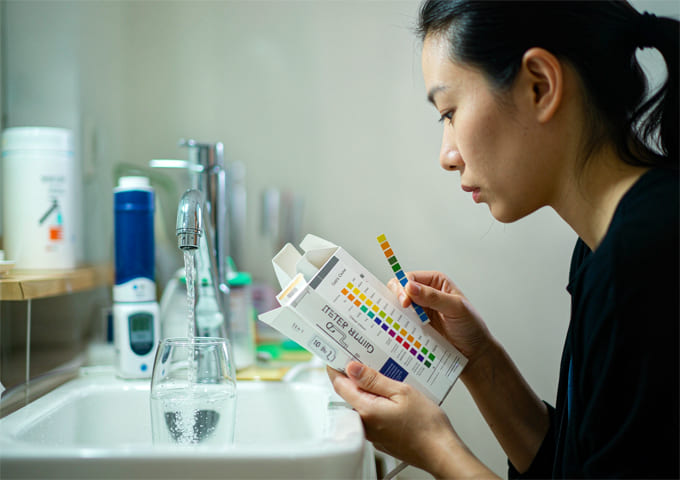
Quick & Easy DIY Testing
For a baseline understanding, you can start with an inexpensive home water test kit. These kits typically use test strips or droppers and can give you a general idea of:
- Hardness (Calcium & Magnesium): The primary cause of limescale that clogs faucets and appliances.
- Chlorine: The disinfectant used by cities, which causes a “pool” taste and smell.
- pH Level: Indicates if your water is acidic (corrosive) or alkaline.
- Lead & Pesticides: Some more advanced kits can detect these harmful contaminants.
When to Get a Professional Lab Test
A DIY kit is a good start, but for a definitive analysis, especially if you have specific concerns, a state-certified lab test is the gold standard. You should always get a professional test if:
- You use a private well.
- Your home was built before 1986 (risk of lead pipes and solder).
- You live near industrial or agricultural areas.
- Someone in your household is immunocompromised or pregnant.
Pro Tip: When you get your water report, pay attention to the “Total Dissolved Solids” (TDS) reading. This number gives you a sense of the total amount of “stuff” in your water. A high TDS (over 500 ppm) is a strong indicator that you might benefit from a more robust filtration system like Reverse Osmosis.
Step 2: Choosing Your Weapon – A Breakdown of Faucet Filter Types
Once you know what’s in your water, you can choose the right tool for the job. Faucet filters generally fall into three main categories for point-of-use (POU) filtration at your sink.

1. Faucet-Mounted Filters
These are the small units that attach directly to the end of your faucet spout. You can typically switch between filtered and unfiltered water with a small lever.
- How They Work: Water passes through a small, replaceable cartridge containing activated carbon and other media.
- Best For: Renters, students, and anyone looking for a low-cost, easy-to-install solution primarily for improving taste and smell by reducing chlorine.
- Pros: Very affordable (often 20−20-50), installs in minutes without tools, doesn’t take up counter space.
- Cons: Slow flow rate, filters need frequent replacement (every 2-3 months), incompatible with many pull-down or designer faucets, and they offer the most basic level of filtration.
2. Countertop Filters
These systems sit on your counter and connect to your main faucet via a diverter tube. You turn on the faucet and divert the water through the filtration unit.
- How They Work: Uses larger, more robust filter cartridges than faucet-mounted units, allowing for more advanced filtration media and longer contact time with the water.
- Best For: Those who want better-than-basic filtration without making permanent plumbing modifications. Good for removing chlorine, lead, cysts, and VOCs.
- Pros: Better filtration performance and longer filter life (6-12 months) than faucet-mounts, easy to install.
- Cons: Takes up valuable counter space, and the connecting tube can be visually unappealing.
3. Under-Sink Filters (Direct Connect)
These are the most popular and balanced option for homeowners. The filter system is installed out of sight under the sink and connects directly to your cold water line. Water is filtered before it ever reaches your faucet.
- How They Work: Water from the cold line is routed through one or more filter “canisters” before continuing to the main faucet. Some systems use a dedicated, smaller drinking water faucet.
- Best For: Homeowners who want a seamless, high-performance solution that’s hidden from view. Excellent for removing a wide range of contaminants without sacrificing flow rate.
- Pros: Completely hidden, excellent flow rate, long filter life (6-12+ months), huge variety of filter types available to target specific contaminants.
- Cons: More complex installation (may require a plumber), higher initial cost (100−100-500+).
4. Under-Sink Reverse Osmosis (RO) Systems
This is the heavyweight champion of water filtration, offering the highest level of purification available for residential use.
- How They Work: An RO system uses pressure to force water through a semi-permeable membrane. This membrane has microscopic pores that block almost everything that isn’t a pure water molecule. A typical system has 3-5 stages, including sediment pre-filters, carbon filters, the RO membrane, and a post-filter.
- Best For: Anyone wanting the purest water possible, especially those with high TDS, nitrates, heavy metals, or on well water. Also ideal for those who are immunocompromised.
- Pros: Removes the widest range of contaminants (95-99%+), including heavy metals, arsenic, nitrates, fluoride, and salts. Produces exceptionally pure, great-tasting water.
- Cons: Highest initial cost (250−250-800+), requires a dedicated drinking faucet and a storage tank under the sink, produces wastewater (brine) during the filtration process, and removes healthy minerals (which can be added back with a remineralization stage).
Pro Tip: If you choose a Reverse Osmosis system, consider adding a remineralization filter as a final stage. RO water is so pure it can taste “flat.” This stage adds back healthy minerals like calcium and magnesium, improving the taste and raising the pH slightly for less acidic water.
| Feature | Faucet-Mounted | Countertop | Under-Sink (Direct) | Under-Sink (RO) |
|---|---|---|---|---|
| Typical Cost | 20−20 – 50 | 70−70 – 200 | 100−100 – 500 | 250−250 – 800+ |
| Installation | DIY (Easy) | DIY (Easy) | DIY (Moderate) to Pro | Pro Recommended |
| Primary Contaminants | Chlorine, Taste, Odor | Chlorine, Lead, Cysts, VOCs | Chlorine, Lead, Sediment, Cysts, VOCs | Everything: Metals, Nitrates, Fluoride, Salts |
| Effect on Flow Rate | Significant Reduction | Minor to Moderate Reduction | Very Little Reduction | Uses a separate, slower faucet |
| Aesthetic Impact | Visible on Faucet | Takes up Counter Space | Completely Hidden | Hidden + Small Extra Faucet |
| Best For | Renters, Basic Taste | Good Filtration, No Plumbing | Most Homeowners | Maximum Purity, Well Water |
A Manufacturer’s Insight: Filter Compatibility is Non-Negotiable
“As a faucet manufacturer for nearly 20 years, we’ve seen it all. A client in the Middle East specifies a beautiful wall-mounted faucet for a luxury hotel but pairs it with an under-sized filtration system. Within a year, flow rates drop and guest complaints rise. The filter, not the faucet, was the problem. For us at SPRINGFAUCET, design and function go hand-in-hand. We advise our OEM/ODM partners to consider water treatment as part of the total system design from day one.” – Daniel Lee, Senior Product Manager at SPRINGFAUCET
This is especially critical for designer faucets. For instance, a sophisticated fixture like our Modern Wall Mount Shower Faucet has specific in-wall plumbing requirements. An under-sink filter is the only compatible option, and the system must be sized correctly to provide adequate pressure and flow to the fixture. Trying to pair it with a faucet-mounted filter is impossible, and a countertop unit would ruin the minimalist aesthetic.
When specifying faucets for a project (B2B), your filtration choice impacts:
- Flow Rate and Pressure: The filter must be able to process water fast enough for the faucet’s designed flow.
- Warranty: Using an incompatible filter or failing to replace cartridges can void a faucet’s warranty.
- Longevity: A proper filter protects the faucet’s internal cartridge from sediment and its finish from hard water, extending its life.
Step 3: Decoding the Alphabet Soup – Understanding NSF Certifications
Don’t trust a filter brand’s marketing claims. Trust the certification. NSF International (formerly the National Sanitation Foundation) is an independent organization that tests and certifies water filtration products to ensure they do what they say they do.
If a filter isn’t NSF certified, DO NOT buy it.
Here are the most important certifications to look for on a sink faucet filter:
| NSF/ANSI Standard | What It Guarantees in Plain English | Why It Matters to You |
|---|---|---|
| NSF 42 | Aesthetic Effects: Certified to reduce non-health-related contaminants like chlorine, taste, odor, and particulates. | This is your baseline for better-tasting, clearer water. If your water just tastes “off,” this is the certification you need. |
| NSF 53 | Health Effects: Certified to reduce specific health-related contaminants like lead, mercury, cysts (e.g., Giardia), and VOCs. | This is crucial for safety. If your water test shows lead or you’re concerned about industrial pollutants, your filter MUST have this certification. |
| NSF 401 | Emerging Contaminants: Certified to reduce up to 15 specific emerging contaminants, like certain prescription drugs, herbicides, and pesticides. | Provides an extra layer of protection against modern pollutants that aren’t yet federally regulated in drinking water. |
| NSF 58 | Reverse Osmosis Systems: Certifies the effectiveness of RO systems in reducing a wide range of contaminants, including arsenic, fluoride, and nitrates. | This is the gold standard for RO systems, ensuring the membrane and entire system meet strict performance criteria. |
Special Cases: Filters for Well Water and Hard Water
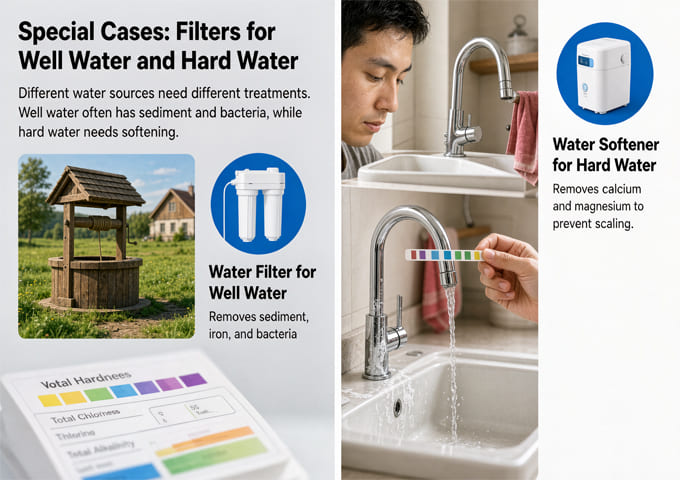
Best Filter for Well Water: Well water is a wild card. It can contain bacteria, nitrates from fertilizer runoff, iron, and high levels of sediment.
- Your Best Bet: A multi-stage Under-Sink Reverse Osmosis (RO) system is almost always the best solution. It’s a brute-force approach that removes the widest array of potential contaminants.
- Crucial Addition: You should also consider a UV Purifier. This uses ultraviolet light to kill bacteria, viruses, and other microorganisms, providing a critical layer of microbiological safety that standard filters do not.
Best “Filter” for Hard Water: This is a trick question. Standard sink filters are not designed to “soften” water. Activated carbon and RO membranes can be damaged and clogged by the high mineral content in hard water.
- The Real Solution: A whole-house water softener. This system treats all the water entering your home, protecting not just your kitchen faucet but your showerheads, washing machine, and dishwasher from limescale buildup.
- At the Sink: You can then add an under-sink carbon or RO filter to the now-softened water to improve taste and remove other contaminants. This combination gives you the best of both worlds.
FAQ: Your Top Filter Questions Answered
Q1: How often do I really need to change the filter cartridge? Follow the manufacturer’s guidelines religiously. An old, clogged filter doesn’t just stop working; it can become a breeding ground for bacteria and release bursts of the very contaminants it’s supposed to capture. Set a recurring reminder on your phone’s calendar the day you install a new one.
Q2: Do water filters remove fluoride? Only Reverse Osmosis (RO) systems are certified to effectively remove fluoride. Standard activated carbon filters (faucet-mounted, countertop, most under-sink) will not remove it.
Q3: Will a water filter reduce my home’s water pressure? Faucet-mounted filters will noticeably reduce flow. Good quality under-sink systems are designed to have a minimal impact on the flow from your main faucet. RO systems use a dedicated faucet that has a slower, but very steady, flow.
Q4: Can I install an under-sink filter myself? If you are comfortable with basic plumbing (turning off water, using a wrench), installing a direct-connect under-sink filter is a manageable DIY project that takes 1-2 hours. RO systems are more complex and many people prefer to hire a plumber.
Q5: Is it okay to run hot water through a faucet filter? No. Never run hot water through most POU filter systems (unless they are specifically rated for it, which is rare). Hot water can damage the filter media, especially activated carbon, and may cause it to release trapped contaminants into your water.
Final Verdict: Your Path to Perfect Water
Choosing the best water filter for your sink isn’t about finding a single magic bullet. It’s a logical, three-step process:
- Test Your Water: Identify your specific contaminants. This is the most important step.
- Match the Filter to the Problem: Use our guide to select the filter type (Under-Sink, RO, etc.) and the right NSF Certifications (42, 53, 58) that directly target your water’s issues.
- Consider Your Faucet and Lifestyle: Ensure the filter is compatible with your faucet, fits your budget, and matches your maintenance willingness.
For most homeowners with typical city water, a high-quality, NSF-certified under-sink filter offers the ideal balance of performance, convenience, and value. For those on well water or demanding the absolute highest purity, a Reverse Osmosis system is the undisputed champion.
By investing in the right filtration system, you’re not just getting better-tasting coffee; you’re taking control of your health, protecting your plumbing, and ensuring your beautiful faucets perform flawlessly for years to come.
Recommended Internal & External Links:
- Internal Link: Modern Wall Mount Bath Tub Faucet – See an example of a designer faucet that requires compatible under-sink filtration.
- Internal Link: Water Quality’s Impact on Faucet Longevity – Learn more about how filters protect your faucet investment.
- Internal Link: OEM/ODM Faucet Manufacturing with SPRINGFAUCET – For B2B partners looking to develop faucets for specific market and water conditions.
- External Link: NSF International – Certified Product Listings for Drinking Water – An authoritative database to verify if a filter is genuinely certified.
- External Link: U.S. EPA – Find Your Local Water Quality Report – A tool to access your local utility’s water quality data.
- External Link: Wikipedia – Reverse Osmosis – A detailed technical explanation of how RO technology works.