
Here’s a harsh reality that costs importers millions annually: a factory with perfect UPC, NSF, and WaterSense certificates can still deliver faucets that burst under pressure, leach lead, or suffer plating failures within months. Why? Because certifications only validate specific samples from specific production runs—not the factory’s ongoing manufacturing capability.
If you’re sourcing faucets for retail, distribution, or private label, you need more than certificates. You need to verify that your supplier can consistently produce quality products at scale. This comprehensive factory audit checklist will help you identify the red flags that certifications miss and ensure your supplier can deliver reliable products month after month.
After 20 years in faucet manufacturing and having audited hundreds of facilities worldwide, I’ve seen every trick suppliers use to present their “best face” during evaluations. This guide will show you what to really look for.
Last Updated: July 2026 | Estimated Reading Time: 19 minutes

What You’ll Learn in This Guide:
- Why certifications create a dangerous “sample vs. bulk” gap in faucet quality
- The 4-pillar factory audit framework that predicts long-term supplier performance
- 40+ specific checkpoints covering raw materials, production, and quality systems
- Red flags that indicate a factory is masking operational weaknesses
- When to use third-party inspections vs. self-audits for maximum cost-effectiveness
Why Certifications Alone Are Not Enough: The “Sample vs. Bulk” Gap
Every experienced faucet buyer has lived this nightmare: You receive beautiful samples that pass all tests, place a large order based on solid certifications, and then discover that the bulk production has quality issues that never appeared during the certification process.
The Certification Limitation Reality
cUPC, NSF, and WaterSense certifications are snapshots, not guarantees. They validate that specific product samples from specific production runs met standards at a specific point in time. They don’t validate:
- Ongoing process control across different production batches
- Material consistency when suppliers switch copper alloy sources
- Quality system effectiveness during high-volume production periods
- Operator training levels that affect assembly quality day-to-day
The Industry’s Dirty Secret: “Certification Samples vs. Production Samples”
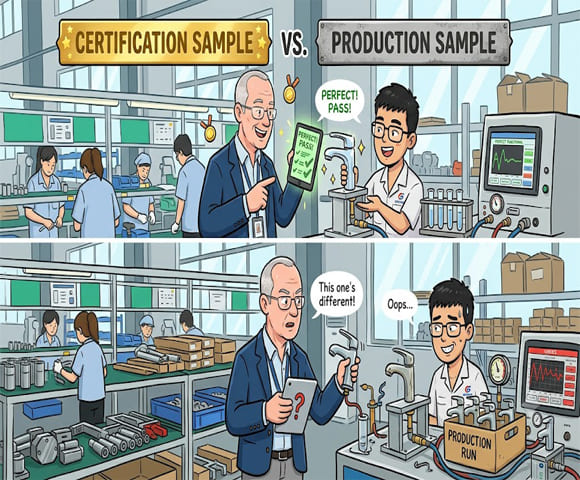
After auditing over 300 faucet factories across China, Vietnam, and Turkey, I can tell you this practice is more common than you’d expect: Some manufacturers maintain two sets of tooling—one optimized for certification samples (perfect surface finish, precise dimensions) and another for volume production (faster cycle time, lower cost per unit).
Industry Insider Note: At SPRINGFAUCET, we’ve built our reputation on “what you see is what you get” consistency. Our 20 years of manufacturing experience has taught us that maintaining separate quality standards for samples vs. production is unsustainable and ultimately destroys customer relationships. Our Modern Stainless Steel Pull-Down Faucet bestselling in the US market maintains identical specifications whether you order 10 samples or 10,000 units.
Process Capability: What You’re Really Buying
When you source faucets, you’re not buying copper, valves, or plating services. You’re buying process capability—the supplier’s ability to repeatedly produce parts within specification limits. A factory with poor process control might deliver 95% good parts one month and 70% the next, depending on operator skill, material lot variations, or equipment wear.
Pre-Audit Phase: Vetting Suppliers Before You Visit
Smart sourcing starts before you book your flight. These remote verification steps can eliminate 70% of unsuitable suppliers and save thousands in travel costs.
Document Deep Dive: Look Beyond Marketing Materials
What to Request:
- Production records from the last 6 months (not certificates)—actual daily output logs, scrap rates, and customer complaints
- Customer complaint logs and corrective action reports
- Supplier qualification records for key raw materials (copper, ceramic cartridges, packaging)
Red Flag Alert: If a factory can’t provide detailed production records or says their data is “confidential,” they either don’t track critical metrics or have something to hide.
Virtual Factory Tours: See the Real Operation
Before committing to an on-site visit, request live video calls of key production areas during actual production hours (not setup time). Focus on:
- Die casting or gravity casting area during pour operations
- Machining centers showing actual parts being processed
- Plating line during active production
- Assembly and testing stations with workers present
Reference Verification: The North American Brand Test
Ask for current customers, specifically North American brands if that’s your target market. US and Canadian buyers typically have stricter quality requirements than many other markets. A factory serving major North American brands successfully for 2+ years demonstrates proven capability.
Pro Tip: Don’t just ask for reference letters. Request contact information and actually call these references. Ask specific questions about delivery performance, quality consistency, and problem resolution speed.
The 4-Pillar Factory Audit Framework
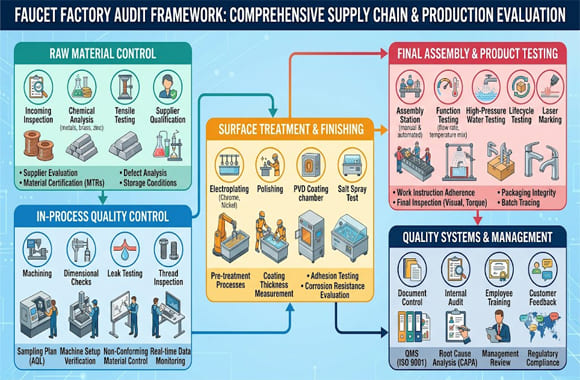
This systematic approach evaluates the four foundation elements that determine long-term supplier reliability. Each pillar has specific checkpoints that predict different types of quality failures.
Pillar 1: Raw Material Control (Lead-Free Compliance & Consistency)
Material control failures cause the most expensive problems: lead contamination that triggers product recalls, or mechanical failures from substandard copper alloys.
| Checkpoint | What to Look For | Why It Matters |
|---|---|---|
| Copper Alloy Segregation | Separate storage areas for CW617N (leaded) vs. C36000/C68700 (lead-free) with clear labeling | Prevents accidental mixing that causes lead contamination |
| Incoming Inspection | Spectrometer testing of every copper lot with documented results | Verifies actual composition vs. supplier certificates |
| Furnace Chemistry Control | Pre-pour sampling and analysis with correction procedures | Ensures alloy composition stays within specification during melting |
Critical Questions to Ask:
- “Show me your spectrometer calibration records for the last 6 months.”
- “What happens if an incoming copper lot fails specification?”
- “How do you prevent cross-contamination between leaded and lead-free alloys?”
Pillar 2: In-Process Quality Control (Preventing Leaks & Failures)
This pillar prevents the mechanical failures that damage your brand reputation: leaking faucets, bursting under pressure, or premature wear.
| Manufacturing Stage | Key Controls | Failure Prevention |
|---|---|---|
| Casting | X-ray inspection for porosity, runner/riser removal inspection | Eliminates weak spots that cause pressure failures |
| Machining | Thread gauge verification, surface finish measurement | Ensures proper sealing and smooth operation |
| Assembly | 100% air pressure testing, water pressure testing >150 PSI | Catches assembly defects before shipping |
Manufacturing Audit Deep Dive:
Die Casting Quality: Look for automated trimming of runners and risers. Hand trimming leaves inconsistent surfaces that affect sealing. Quality factories invest in CNC trimming stations.
Thread Quality: Ask to see their thread gauges and calibration certificates. Poor thread quality is the #1 cause of field installation leaks.
Pressure Testing: Every faucet should undergo both air and water pressure testing. Air testing (typically 60-80 PSI) finds gross leaks quickly. Water testing at 150+ PSI simulates real-world pressure conditions.
Pillar 3: Surface Treatment & Finishing (Corrosion & Aesthetic Durability)
Plating failures create customer complaints and return costs. This pillar evaluates long-term finish durability.
| Process | Inspection Point | Quality Standard |
|---|---|---|
| Pre-treatment | Surface cleanliness, activation effectiveness | Clean surface = good adhesion |
| Plating | Thickness measurement (3-5 microns minimum nickel) | Adequate thickness prevents corrosion breakthrough |
| Post-treatment | Salt spray testing capability, actual test records | Validates real-world corrosion resistance |
Advanced Finishing Evaluation:
- PVD Coating Capability: If the factory offers Physical Vapor Deposition (matte black, brushed gold), inspect their chamber equipment and test protocols.
- Automated vs. Manual Polishing: Automated polishing creates more consistent surface preparation. Hand polishing varies by operator skill.
Factory Visit Insider Tip: Ask to see their plating line’s waste water treatment system. A factory that properly manages plating chemistry typically maintains better process control overall. Poor chemical management = inconsistent plating quality.
Pillar 4: Final Assembly & Quality Systems (Functional Reliability)
The final pillar ensures products function properly long-term and arrive undamaged.
Critical Assembly Controls:
- Cartridge Installation: Proper torque specification and verification
- Handle/Spout Tightness: Torque wrench usage and calibration
- Function Testing: Multi-cycle operation testing before packaging
Packaging & Logistics Quality:
- Drop testing of packaged products
- Export packaging design for long transit times
- Warehouse inventory rotation systems
Red Flags: 5 Warning Signs During Factory Visits
These warning signs indicate deeper problems that certifications and presentations can’t mask:
1. No Dedicated R&D Department
What it looks like: Only sales offices and production lines, with no tooling or product development capability. Why it matters: Without R&D capability, they can’t customize products or solve technical problems. You’re limited to their existing catalog.
2. Excessive Finished Goods Inventory
What it looks like: Warehouses packed with finished faucets gathering dust. What it signals: Cash flow problems, poor demand forecasting, or products that don’t meet customer requirements. This creates pressure to ship old inventory.
3. Outsourced Critical Processes
What it looks like: They proudly show their assembly line but mention that plating is done “by our partner factory down the road.” The risk: You lose control over the most quality-critical process. When problems arise, finger-pointing between facilities delays resolution.
4. Poor 5S Implementation
What it looks like: Disorganized work areas, tools scattered around, no visual management systems. Why it matters: 5S discipline correlates directly with quality system effectiveness. If they can’t maintain basic workplace organization, their quality systems are likely weak too.
5. Vague or Missing Test Data
What it looks like: Beautiful printed test reports but no raw data logs, calibration records, or trend analysis. The concern: Professional quality systems generate mountains of raw data. If they can’t show you measurement trends, control charts, or calibration schedules, their quality system is likely cosmetic.
Third-Party Inspection vs. Self-Audit: Making the Right Choice
Different sourcing situations call for different verification approaches. Here’s when to use each:
| Approach | Best For | Cost Range | Pros | Cons |
|---|---|---|---|---|
| Self-Audit | Experienced buyers, established relationships, lower-risk products | $2,000-5,000 (travel costs) | Deep relationship building, complete control, immediate feedback | Requires expertise, potential for manipulation |
| Third-Party Audit | New suppliers, high-risk products, regulatory compliance | $3,000-8,000 | Objective assessment, professional reporting, credible with management | Less relationship building, scheduling constraints |
| Hybrid Approach | Large orders, ongoing relationships | $4,000-10,000 | Best of both worlds | Higher total cost |
The SPRINGFAUCET Approach to Auditing
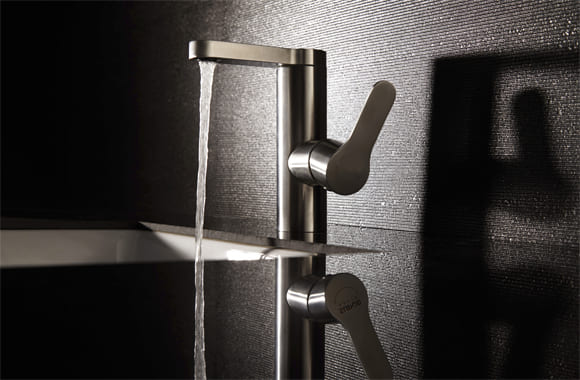
As a manufacturer that regularly hosts customer audits, we’ve learned that the most successful partnerships develop when buyers understand our processes deeply. We encourage comprehensive audits because transparency builds trust. Our philosophy: if we can’t proudly show every aspect of our operation, we shouldn’t be manufacturing faucets.
Industry Standards Comparison: Global Requirements
Understanding different market requirements helps you evaluate supplier capabilities:
| Standard/Market | Key Requirements | Testing Focus | Compliance Notes |
|---|---|---|---|
| NSF/ANSI 61 (North America) | Lead content <0.25%, extraction testing | Heavy metal leaching | Requires ongoing surveillance |
| EN 200/EN 817 (Europe) | Material specifications, performance testing | Mechanical endurance | CE marking required |
| AS/NZS 3718 (Australia/NZ) | WaterMark certification, flow rates | Water efficiency | Local agent requirements |
Your 40-Point Factory Audit Checklist
Pre-Visit Documentation (10 Points)
- Business license and export credentials current
- Insurance certificates (product liability minimum $2M)
- Environmental compliance certificates
- Customer reference list with contact information
- Organization chart showing key personnel
- Quality manual or documented procedures
- Recent third-party audit reports (if available)
- Production capacity declarations
- Supplier qualification procedures for raw materials
- Complaint handling and corrective action procedures
On-Site Manufacturing Assessment (20 Points)
- Raw material storage and identification systems
- Incoming inspection procedures and equipment
- Casting process controls and monitoring
- Machining accuracy and tool maintenance
- Assembly process standardization
- Pressure testing protocols and equipment
- Plating process controls and waste treatment
- Surface finish consistency and inspection
- Packaging design and protection adequacy
- Finished goods storage and inventory management
- Equipment calibration and maintenance programs
- Employee training records and competency verification
- Statistical process control implementation
- Non-conforming product identification and segregation
- Corrective and preventive action systems
- Management review and continuous improvement
- Internal audit schedules and effectiveness
- Customer complaint trending and analysis
- Supplier evaluation and development programs
- Emergency response and business continuity plans
Final Verification (10 Points)
- Reference customer satisfaction verification
- Financial stability indicators
- Capacity planning and scalability assessment
- Lead time reliability and tracking systems
- Export documentation accuracy and completeness
- Communication systems and language capabilities
- Cultural fit and partnership potential
- Innovation capability and future development
- Sustainability practices and environmental responsibility
- Overall risk assessment and mitigation strategies
From “Cheap Sourcing” to “Strategic Sourcing”
The faucet industry has evolved far beyond simple price competition. Today’s successful buyers focus on total cost of ownership, which includes:
- Initial product cost (typically 60-70% of total cost)
- Quality failure costs (returns, replacements, lost sales)
- Relationship management costs (communication, problem resolution)
- Market reputation risks (brand damage from quality issues)
The Audit Investment ROI: A comprehensive factory audit costs 3,000−8,000butcanpreventqualityfailuresthatcost3,000-8,000 but can prevent quality failures that cost 50,000-500,000 in returns, replacements, and brand damage. The math is clear: professional supplier verification pays for itself many times over.
Building Long-Term Partnerships
The best supplier relationships develop when both parties understand each other’s requirements and capabilities deeply. A thorough audit process creates this mutual understanding and sets the foundation for years of successful collaboration.
At SPRINGFAUCET, we’ve found that customers who invest time in understanding our processes become our best long-term partners. They know our capabilities, limitations, and quality standards intimately, which eliminates surprises and builds mutual respect.
Ready to implement strategic sourcing? Start with this audit framework for your next supplier evaluation. The time and cost invested in proper verification will pay dividends in quality, reliability, and peace of mind.
Recommended Internal & External Links:
- Internal: Faucet certifications explained CUPC NSF,Lead Free Requirements – Understanding certification requirements for different markets
- Internal: Why OEM Faucet Manufacturing in China is Your Strategic Advantage? – Strategic sourcing decisions for private label brands
- External: U.S. EPA Safe Drinking Water Act – Federal regulations governing lead content in plumbing fixtures
- External: International Association of Plumbing and Mechanical Officials (IAPMO) – Uniform Plumbing Code development and certification
- Product Reference: SPRINGFAUCET Modern Stainless Steel Pull-Down Faucet – Example of quality manufacturing standards in practice