
Behind the clean lines of your kitchen and the serene comfort of your bathroom lies a vast, hidden network of pipes, valves, and fixtures. This network is the circulatory system of your home, and its integrity is non-negotiable. But how do you know the faucets, pipes, and drains are safe, durable, and efficient? The answer lies in plumbing certification standards.
These standards are not just bureaucratic red tape; they are the bedrock of public health, safety, and consumer confidence. They are a universal language of quality understood by manufacturers, plumbers, and inspectors worldwide. Whether you are a homeowner choosing a new faucet, a professional plumber building your career, or a business importing plumbing products, understanding these certifications is essential. This guide is your definitive map to navigating the world of plumbing standards, ensuring every choice you make is a safe and compliant one.
Last Updated: June 2026 | Estimated Reading Time: 13 minutes

In This Ultimate Guide, You Will Discover:
- The three critical reasons why plumbing standards are essential for your safety and wallet.
- A breakdown of major international certification bodies like IAPMO, NSF, and WaterMark.
- What inspectors are actually looking for: material safety, water efficiency, and performance.
- The step-by-step journey of a product and a professional to become certified.
- How OEM/ODM manufacturers like SpringFaucet build compliance into products from day one.
Why Do Plumbing Certifications Matter? (It’s More Than Just a Sticker)
Before we dive into the “what,” we must understand the “why.” Plumbing standards are the silent guardians of modern living, protecting us in three fundamental ways.
- Protecting Public Health: This is the primary mission. Certifications ensure that the materials in your faucets and pipes do not leach harmful substances like lead or other toxins into your drinking water. They also mandate designs that prevent cross-contamination and the backflow of wastewater into the clean water supply.
- Ensuring Financial Protection: A certified product has been rigorously tested for durability and performance. It’s designed to withstand water pressure, resist leaks, and function correctly for its intended lifespan. This protects you from the catastrophic costs of water damage caused by failed, non-compliant fixtures.
- Establishing Professional Credibility: For plumbers and manufacturers, certifications are a mark of quality and expertise. They signal that a professional has the required knowledge and that a product meets the legal requirements for installation, giving consumers peace of mind.
The Global Landscape of Plumbing Standards: A Deep Dive
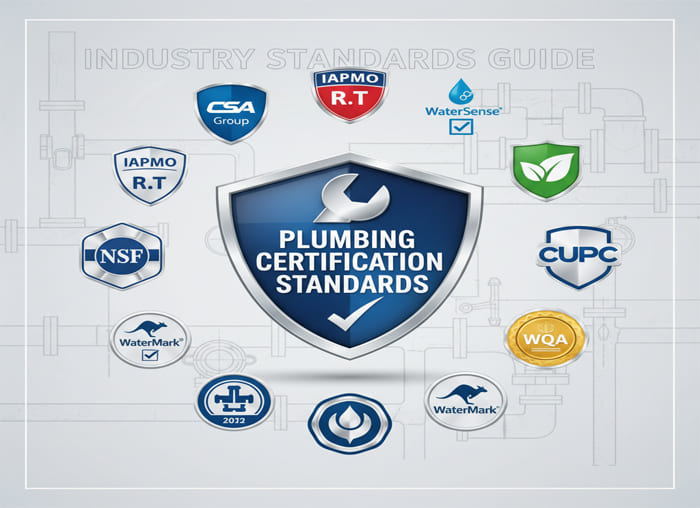
While the goal of safety is universal, the specific standards and certifying bodies can vary significantly by region. For importers and manufacturers, understanding these differences is crucial. For consumers, it’s about knowing which logo to look for.
Key Certification Bodies in North America (USA & Canada)
North America has one of the most robust and stringent regulatory systems, primarily governed by these organizations:
- IAPMO (International Association of Plumbing and Mechanical Officials): The publisher of the UPC (Uniform Plumbing Code), the foundational code for much of the United States. A product bearing the cUPC mark (the “c” signifies compliance for both USA and Canada) has been tested to meet established performance and safety standards.
- NSF International (National Sanitation Foundation): While not a code, NSF is a world-renowned testing laboratory that certifies products against specific health and safety standards. NSF/ANSI 61 is the critical standard for any product that touches drinking water, certifying that it is free from harmful levels of lead and other contaminants.
- EPA WaterSense: A voluntary program from the U.S. Environmental Protection Agency. Products with the WaterSense label are certified to be at least 20% more water-efficient than standard models without sacrificing performance.
Navigating European and Australian Standards
- CE Marking (Europe): In the European Union, the CE mark indicates that a product conforms with health, safety, and environmental protection standards. While it’s a broader declaration of conformity, specific EN (European Norms) standards apply to plumbing fixtures.
- WaterMark (Australia & New Zealand): This is a mandatory certification for plumbing products sold in Australia and New Zealand. The WaterMark logo ensures the product is fit for purpose and has been tested for material safety and performance according to the Plumbing Code of Australia (PCA).
| Standard / Mark | Governing Region | Primary Focus | What It Means For You |
|---|---|---|---|
| cUPC | USA & Canada | Overall performance, safety, and installation compliance. | Your product is legal to install and meets broad quality benchmarks. |
| NSF/ANSI 61 | North America (Globally Recognized) | Drinking water safety. Ensures no harmful chemicals or lead leach into the water. | This is the single most important health certification for a faucet or pipe. |
| WaterSense | USA (Voluntary) | Water efficiency and conservation. | Your product will save water and reduce your utility bills. |
| WaterMark | Australia & New Zealand | Mandatory compliance with national plumbing codes, safety, and performance. | The product is legally approved for installation and use in Australia/NZ. |
What Do These Certifications Actually Test For?
A certification mark represents a battery of grueling tests. Here’s a look under the hood at what a typical faucet must endure to earn its mark of approval.
- Material Safety & Purity: The faucet’s material is analyzed to ensure it meets strict composition requirements. For NSF/ANSI 61, the fixture is exposed to aggressive water for an extended period, and the water is then tested to ensure contaminant levels are well below the safe limits set by the EPA.
- Performance & Durability: The faucet’s valve is subjected to life cycle testing, often enduring 500,000 cycles (the equivalent of decades of use) to ensure it remains drip-free. It’s also tested against high water pressure to guarantee it won’t burst or leak.
- Water Efficiency & Flow Rate: The flow rate (in Gallons Per Minute or Liters Per Minute) is precisely measured to ensure it complies with national and regional regulations (e.g., a maximum of 1.8 GPM for kitchen faucets in California).
- Finish & Coating Durability: The finish is subjected to abrasion and chemical resistance tests (like salt spray tests) to ensure it won’t easily scratch, corrode, or tarnish over time.
Expert Tip: Never confuse a company’s ISO 9001 certification (which relates to their management processes) with a product’s cUPC or NSF certification (which relates to the safety and performance of the actual product). Both are valuable, but they certify very different things.
The Manufacturer’s Role: Building Compliance from the Ground Up
For an OEM/ODM manufacturer like SpringFaucet, compliance isn’t an afterthought—it’s the foundation of the entire design and production process. This is where importers and brands gain a massive advantage by partnering with a knowledgeable factory.
The process begins long before production:
- Design & Engineering: We design products from scratch to meet the specific requirements of target markets. This means engineering waterways to be lead-free and selecting materials that are pre-certified to meet NSF standards.
- Supply Chain Management: We source raw materials (like lead-free brass or SUS304 stainless steel) and components (like ceramic cartridges) exclusively from suppliers who can provide documentation of their own compliance.
- In-House Testing: Before submitting a new faucet for official certification, we subject it to the same rigorous tests in our own laboratory. This pre-qualification process saves time and money, ensuring a higher first-pass success rate with official labs like IAPMO or NSF.
This integrated approach is why our products are favored by plumbers and trusted by international buyers. By managing compliance at every stage, we provide our partners at SpringFaucet with market-ready products that are guaranteed to meet the standards of the USA, Canada, Australia, and Europe.
| Certification Stage | OEM/ODM Manufacturer’s Action | Value to the B2B Buyer |
|---|---|---|
| 1. Concept | Design product specifically to meet UPC, NSF, and WaterSense criteria. | Reduces risk of non-compliance and ensures the product is marketable from day one. |
| 2. Materials | Source certified lead-free brass/steel and low-lead components with full traceability. | Guarantees the fundamental safety of the product and simplifies the certification process. |
| 3. Prototyping | Conduct in-house life cycle, pressure, and flow rate testing. | Catches potential failures early, saving tens of thousands in official re-testing fees. |
| 4. Certification | Prepare all technical documentation and manage the submission to IAPMO/NSF. | Streamlines a complex and bureaucratic process, accelerating time-to-market. |
The Path to Professional Certification: For Plumbers & Technicians
Product certification is only half the equation. The other half is the certified professional who installs it. The path to becoming a licensed plumber is a structured journey of education, experience, and examination.
- Apprenticeship: This is the starting point, combining on-the-job training under a licensed plumber with classroom instruction (typically 4-5 years).
- Journeyman License: After completing an apprenticeship and passing a state or municipal licensing exam, a plumber becomes a Journeyman. This allows them to work independently.
- Master Plumber License: After several years as a Journeyman, a plumber can take an even more comprehensive exam to become a Master Plumber, which allows them to own a business, pull permits, and train apprentices.
- Continuing Education: Most jurisdictions require licensed plumbers to complete ongoing education courses to stay current with changes to the plumbing code and new technologies.
How Consumers Can Identify Compliant Products and Professionals
As a consumer, you have the power to ensure safety by making informed choices.
- Look for the Mark: Check the product itself, its packaging, or the online specification sheet for certification marks like cUPC, NSF, and WaterSense. The mark should be permanently etched or stamped on the product, not just a sticker.
- Verify Online: Certification bodies maintain public databases. You can visit the IAPMO or NSF websites and search by manufacturer or model number to verify a product’s certification status.
- Ask Your Plumber: Before hiring, ask for their license number. A licensed professional will be proud to provide it. You can often verify this number on your state or city’s licensing board website.
The Future of Plumbing Standards: Smart Tech & Sustainability
The world of plumbing is evolving, and certification standards are evolving with it.
- Smart Plumbing Systems: The rise of smart faucets, leak detectors, and automatic shut-off valves presents a new challenge. Standards bodies are now developing protocols for testing the software reliability, cybersecurity, and electrical safety of these connected devices.
- Sustainability & Water Reuse: As water scarcity becomes a global issue, new standards are emerging for greywater recycling systems and other water-saving technologies. These certifications will ensure that these systems are not only efficient but also safe and hygienic.
These trends will drive further innovation, pushing manufacturers to create smarter, more sustainable, and safer products. The framework of standardization ensures that as technology advances, public health and safety remain the top priority.
Conclusion: The Unseen Guarantee of Quality
Plumbing certification standards are the unseen framework that supports the health, safety, and durability of our modern infrastructure. From the faucet in your kitchen to the complex systems in a skyscraper, these codes and marks provide a crucial guarantee of quality.
For consumers, they offer peace of mind. For professionals, they provide a pathway to a trusted career. And for the industry at large, they create a level playing field where safety and performance are the ultimate measures of success. By choosing certified products and licensed professionals, you are not just making a smart investment—you are upholding a system designed to protect us all.
Recommended Links
Internal Links:
- The Ultimate Guide to SUS304 Stainless Steel Faucets
- Why Choose SUS304 Stainless Steel Faucet
- OEM vs. ODM Manufacturing: Which is Right for Your Brand?
External Links (Authoritative Sources):
- IAPMO Product Certification Database – Verify if a product is cUPC certified.
- NSF Certified Products Database – Search for products certified for drinking water safety.
- EPA WaterSense Program – Learn more about water-efficient products and find certified models.