
The choice between OEM and ODM manufacturing will determine your faucet business’s profitability, market positioning, and long-term competitive advantage. If you’re launching a private label faucet brand or expanding your product line, this decision affects everything from your initial investment and time-to-market to your ability to differentiate and scale.
After working with hundreds of faucet brands over two decades—from startup bathroom fixture companies to major home improvement retailers—I can tell you that 70% of businesses choose the wrong manufacturing model initially. This mistake costs them either excessive development time and money (wrong choice of OEM) or inability to differentiate in crowded markets (wrong choice of ODM).
This guide will help you make the right choice based on your specific business situation, budget, and market goals. You’ll learn the real-world differences between OEM and ODM in the faucet industry, see actual cost and timeline comparisons, and get a decision framework used by successful private label brands.
Last Updated: July 2026 | Estimated Reading Time: 34 minutes
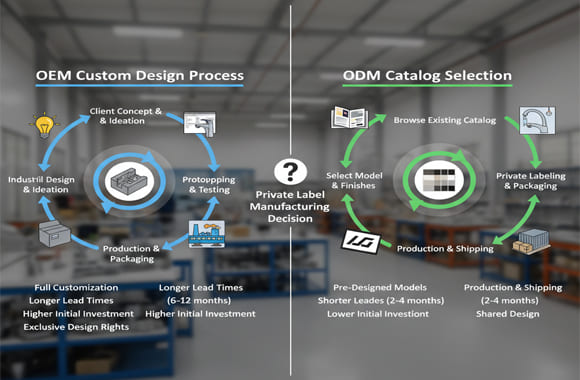
What You’ll Learn:
- Faucet-specific definitions of OEM vs ODM that go beyond generic explanations
- 6-dimension comparison covering costs, timelines, minimum orders, and control levels
- Stage-based decision matrix to match your business phase with the right model
- Critical contract clauses that protect your interests in both arrangements
- Red flags that indicate fake OEM capabilities or ODM limitations
First, Ditch the Generic Definitions—Here’s What OEM/ODM Actually Means in Faucets
Forget the textbook definitions you’ve read elsewhere. In the faucet manufacturing world, OEM and ODM have specific implications that affect your business success.
OEM (Original Equipment Manufacturing) in Faucets: Building YOUR Vision
OEM faucet manufacturing means: The factory produces faucets according to your specifications, designs, and quality standards under your brand name. You provide the blueprint; they provide the manufacturing expertise.
What this looks like in practice:
- You specify cartridge types (ceramic disc, ball valve, or cartridge-based)
- You determine spout reach, mounting configuration, and handle design
- You choose materials (brass composition, plating specifications, packaging)
- You set quality standards and testing requirements
- The factory builds tooling specifically for your products
Real OEM Example: A kitchen faucet brand wanting a unique pull-down sprayer mechanism works with the manufacturer to develop custom tooling for their proprietary spray head design. The resulting product can’t be offered to other customers without permission.
ODM (Original Design Manufacturing) in Faucets: Choosing from Proven Designs
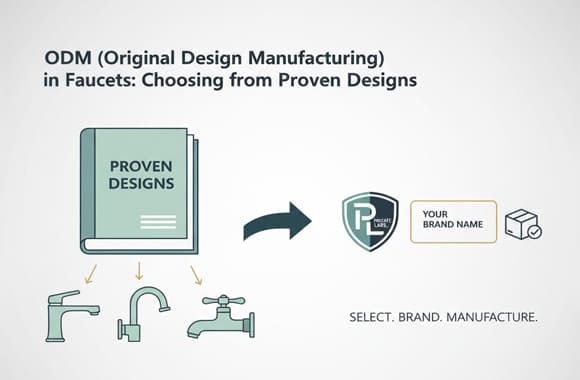
ODM faucet manufacturing means: You select from the factory’s existing catalog of proven designs, potentially with minor customizations like finish options or packaging changes.
What this looks like in practice:
- Factory shows you their catalog of 50-200 existing faucet models
- You choose designs that fit your brand positioning and price points
- Minor customizations possible: finishes, packaging, minor dimensional changes
- Tooling already exists and is amortized across multiple customers
- Faster time-to-market with lower minimum quantities
Real ODM Example: A home improvement retailer selects three kitchen faucet designs from a manufacturer’s catalog, requesting them in brushed nickel finish with their private label packaging. The same basic designs are available to other customers in different finishes.
The Hybrid Reality: Most Successful Brands Use Both
Here’s what the textbooks don’t tell you: Most successful faucet brands use both OEM and ODM strategically. They might use ODM for their entry-level products to establish market presence, then develop OEM signature pieces for differentiation.
Industry Insight: At SPRINGFAUCET, we’ve seen this hybrid approach succeed repeatedly. Brands often start with our ODM catalog to test market acceptance, then graduate to OEM development for their bestselling categories. Our thermostatic bathroom faucets are popular ODM choices for European markets, especially Nordic countries where temperature control is critical.
The 6-Dimension Comparison: OEM vs ODM for Faucet Manufacturing
This detailed comparison covers the factors that matter most to faucet brands and distributors:
| Dimension | OEM Manufacturing | ODM Manufacturing | Impact on Your Business |
|---|---|---|---|
| Initial Investment | 15,000−15,000-80,000 per SKU (tooling costs) | 0−0-5,000 per SKU (minor modifications) | OEM requires significant upfront capital |
| Minimum Order Quantity | 500-2,000 pieces per model per finish | 100-500 pieces per model | ODM enables testing with lower risk |
| Time to Market | 4-8 months (design + tooling + sampling) | 2-6 weeks (sampling + minor modifications) | ODM provides rapid market entry |
| Differentiation Potential | High – unique designs, exclusive features | Low – similar products available to competitors | OEM creates sustainable competitive advantages |
| Quality Control Level | Complete control over specifications | Limited to factory’s existing standards | OEM allows premium positioning |
| Long-term Pricing Power | High – exclusive designs command premiums | Moderate – commodity pricing pressure | OEM protects margins over time |
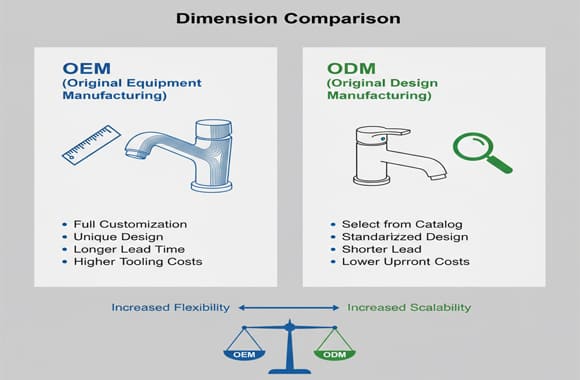
Cost Analysis Deep Dive
OEM Total Investment Breakdown:
- Design and engineering: 5,000−5,000-15,000
- Tooling (casting dies, machining fixtures): 10,000−10,000-50,000
- Sampling and testing: 3,000−3,000-8,000
- Certification costs: 2,000−2,000-7,000
ODM Total Investment Breakdown:
- Sample costs: 200−200-800
- Minor tooling modifications: 0−0-3,000
- Packaging design: 500−500-2,000
- Certification (if needed): 1,000−1,000-5,000
Pro Tip: Many buyers underestimate OEM certification costs. If you’re developing truly custom designs, you’ll need independent testing for UPC, NSF, or CE marking. Budget at least 5,000−5,000-15,000 for comprehensive testing of new designs.
Time-to-Market Reality Check: What Actually Happens
The theoretical timelines and the reality of faucet development often differ significantly. Here’s what actually happens:
OEM Development Timeline (Typical 6-Month Reality)
| Phase | Planned Duration | Actual Duration | Common Delays |
|---|---|---|---|
| Design Finalization | 2-3 weeks | 4-6 weeks | Client revisions, technical feasibility issues |
| Tooling Development | 8-10 weeks | 10-14 weeks | Complexity underestimation, supplier delays |
| First Sample Production | 1-2 weeks | 2-4 weeks | Tooling adjustments, quality issues |
| Testing and Certification | 3-4 weeks | 6-8 weeks | Test failures requiring design modifications |
| Pilot Production | 2-3 weeks | 3-5 weeks | Production line setup, operator training |
Reality Check: Factor in at least 25-30% additional time for unforeseen complications. Rush jobs typically cost 30-50% more and still take longer than planned.
ODM Development Timeline (Typical 6-Week Reality)
| Phase | Planned Duration | Actual Duration | Common Delays |
|---|---|---|---|
| Catalog Review & Selection | 1 week | 1-2 weeks | Decision-making, internal approvals |
| Sample Preparation | 1-2 weeks | 2-3 weeks | Finish options, packaging mockups |
| Testing (if required) | 1-2 weeks | 2-4 weeks | Usually only flow rate and basic function |
| Production Setup | 1 week | 1-2 weeks | Packaging changeover, quality briefings |
Decision Matrix: Matching Your Business Stage with the Right Model
Your choice between OEM and ODM should align with your business development stage, market position, and resource availability:
Stage 1: Market Entry (First 12 months)
Recommended Approach: ODM Focus (80% ODM, 20% OEM)
Why ODM Makes Sense:
- Lower financial risk while testing market acceptance
- Faster inventory turnover to generate cash flow
- Ability to offer complete product lines immediately
- Learning about customer preferences with minimal investment
When to Consider OEM at This Stage:
- You have a truly innovative feature that creates significant value
- You have exclusive distribution agreements requiring unique products
- Your target market has minimal competition (niche applications)
Stage 2: Market Establishment (Years 1-3)
Recommended Approach: Hybrid Strategy (60% ODM, 40% OEM)
ODM for: Entry-level and mid-range products that drive volume OEM for: Flagship products that define your brand identity
Key Considerations:
- Develop 1-2 signature OEM pieces while maintaining ODM breadth
- Use sales data to identify which categories deserve OEM investment
- Build relationships and learn manufacturing processes through ODM
Stage 3: Market Leadership (Years 3+)
Recommended Approach: OEM Focus (70% OEM, 30% ODM)
OEM for: Core product lines that differentiate your brand ODM for: Complementary products and rapid trend responses
Strategic Goals:
- Build sustainable competitive moats through exclusive designs
- Command premium pricing through unique value propositions
- Develop deep manufacturing partnerships for innovation
SPRINGFAUCET Success Story: One of our European partners started with 100% ODM selections from our catalog, focusing on thermostatic shower faucets. After identifying their bestselling configurations, they invested in OEM development of three signature models with unique temperature control features. This hybrid approach helped them capture 15% market share in Nordic bathroom fixtures within four years.
The 3 Critical Contract Clauses Most Buyers Skip (But Regret Later)
Whether you choose OEM or ODM, these contract provisions protect your interests and prevent costly disputes:
1. Intellectual Property and Exclusivity Rights
For OEM Contracts:
For ODM Contracts:
Why This Matters: Without clear IP clauses, you might invest in marketing a product only to find your competitors selling identical items at lower prices.
2. Quality Standards and Compliance Responsibility
Critical Language:
What to Include:
- Specific testing standards and frequencies
- Acceptable quality levels (AQL) for various defect types
- Recall and liability responsibilities
- Continuous compliance verification procedures
3. Capacity Allocation and Delivery Protection
Essential Provisions:
Why This Protects You: Successful products create capacity constraints. Without protection clauses, manufacturers might prioritize new customers or higher-margin orders over your established business.
Contract Negotiation Tip: Many buyers focus only on price and delivery terms. The most expensive problems come from inadequate IP protection and quality responsibility clauses. Spend extra time on these provisions—they determine your long-term success.
Red Flags: When an “OEM Factory” Is Actually Just ODM in Disguise
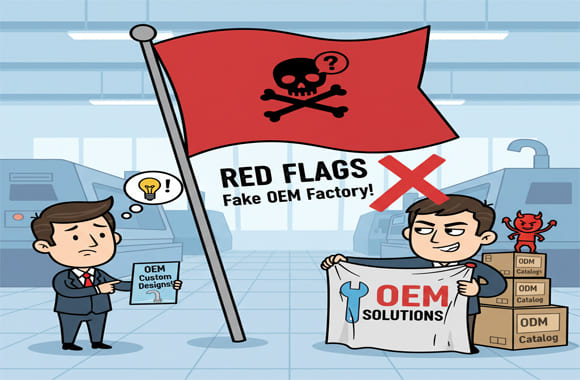
Many factories claim OEM capabilities to justify higher prices or minimum order quantities. Here’s how to identify genuine OEM capabilities vs. dressed-up ODM:
Genuine OEM Capabilities (What to Look For)
| Capability Area | Evidence of True OEM | Red Flags (Fake OEM) |
|---|---|---|
| Design Team | In-house engineers with CAD stations, design portfolios | Only sales staff, outsourced design services |
| Tooling Workshop | CNC machining centers, die/mold making equipment | No tooling capability, everything outsourced |
| Prototyping | 3D printing, rapid prototyping, sample machining | Long lead times, samples from existing tooling |
| Testing Facilities | Pressure testing, flow testing, cycle testing equipment | Basic quality checks, no development testing |
| Project Management | Dedicated engineers for customer projects | Single contact handling multiple responsibilities |
The “Catalog Customization” Trap
What They Say: “We can customize any aspect of our existing designs to meet your needs.”
What They Mean: “We can change finishes, handles, and minor dimensions, but the core functionality stays the same.”
How to Test Their Claims:
- Ask for a completely new spout design or unique mounting configuration
- Request proprietary cartridge integration or custom flow patterns
- Challenge them to modify internal waterways or pressure characteristics
If they hesitate or suggest “similar alternatives from our catalog,” you’re dealing with ODM capabilities dressed up as OEM.
The Tooling Ownership Question
Ask Directly: “If we develop custom tooling, who owns it? Can we transfer it to another manufacturer?”
True OEM Response: “You own the tooling. We can ship it to your specified location or another manufacturer if needed.”
Fake OEM Response: “The tooling stays here for efficiency, but it’s dedicated to your products.” (This means you don’t actually own it and can’t control your supply chain.)
Cost Comparison: Real-World ROI Analysis
Let’s examine two actual scenarios to show the financial implications of OEM vs ODM choices:
Scenario 1: Kitchen Faucet for Home Improvement Retailer
ODM Path:
- Initial investment: $3,000 (samples, packaging)
- Unit cost: $28 (1,000-piece orders)
- Time to market: 6 weeks
- Retail price achievable: $79-89 (competitive market)
- Gross margin: 65-68%
OEM Path:
- Initial investment: $45,000 (design, tooling, testing)
- Unit cost: 32(1,000−pieceorders,reducesto32 (1,000-piece orders, reduces to 26 at 5,000+ pieces)
- Time to market: 28 weeks
- Retail price achievable: $129-159 (unique features)
- Gross margin: 75-80%
Break-even Analysis:
- ODM breaks even immediately
- OEM breaks even at ~3,500 units sold
- OEM becomes more profitable after 5,000 units annually
Scenario 2: Bathroom Faucet for Boutique Brand
ODM Path:
- Limited differentiation in premium market segment
- Difficulty justifying premium prices
- Vulnerable to competitors with identical products
- Good for market testing, poor for brand building
OEM Path:
- Exclusive designs support premium positioning
- Protected from direct product competition
- Higher development costs justified by margin protection
- Essential for long-term brand value
Financial Planning Tip: Consider your 3-year sales projections, not just year-one volumes. OEM investments that seem expensive initially often deliver better returns as sales scale. ODM appears cheaper but may limit your growth potential in competitive markets.
Global Market Considerations: Regional Preferences for OEM vs ODM
Different markets have varying preferences for custom vs. standard products:
North American Market
OEM Preference: High – consumers expect innovation and unique features Key Factors:
- Strong patent protection encourages OEM investment
- Home improvement culture values differentiation
- Higher price tolerance for innovative features
- Strict lead-free compliance requires custom formulations
Recommended Strategy: OEM for signature pieces, ODM for entry-level lines
European Market
ODM Preference: Moderate to High – focus on proven performance Key Factors:
- Conservative buying patterns favor tested designs
- CE marking requirements standardized across manufacturers
- Energy efficiency and water conservation prioritized
- Strong preference for thermostatic controls in bathroom applications
Market Insight: Our thermostatic bathroom faucets perform exceptionally well in Nordic markets through ODM arrangements, where temperature safety and energy efficiency outweigh design novelty.
Asian Markets
ODM Preference: Very High – cost efficiency drives decisions Key Factors:
- Price sensitivity limits OEM investment ROI
- Faster market adoption cycles favor quick ODM deployment
- Local manufacturing reduces import duties and shipping costs
- Regional design preferences well-served by local ODM catalogs
| Market Region | OEM Success Rate | Average Price Premium | Recommended Approach |
|---|---|---|---|
| North America | 75% | 30-60% | OEM-heavy strategy |
| Western Europe | 60% | 20-40% | Balanced OEM/ODM |
| Nordic Europe | 45% | 15-25% | ODM-focused with selective OEM |
| Asia-Pacific | 30% | 10-20% | ODM-dominant strategy |
Manufacturing Partner Selection: OEM vs ODM Capability Assessment
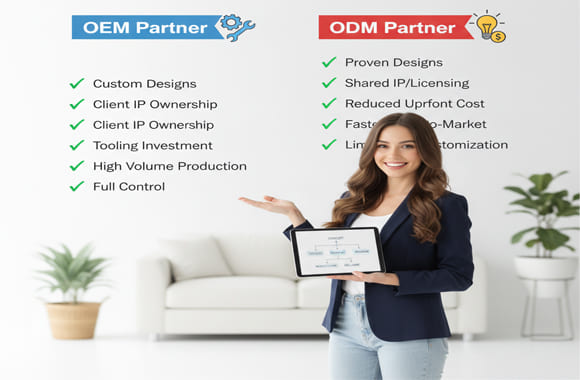
Your choice of manufacturing partner should align with your selected model:
Evaluating OEM Manufacturing Partners
Essential Capabilities:
- R&D Team Size: Minimum 3-5 engineers for complex faucet development
- Tooling Investment Capacity: Ability to fund $50,000+ tooling projects
- Prototyping Speed: 2-week turnaround for design iterations
- Testing Facilities: In-house pressure, flow, and endurance testing
- IP Protection: Demonstrated track record with confidential projects
Questions to Ask:
- “Show me three products you’ve developed exclusively for other customers in the last 24 months.”
- “What’s your average tooling development timeline for a completely new kitchen faucet design?”
- “How do you protect our IP if we terminate the relationship?”
Evaluating ODM Manufacturing Partners
Essential Capabilities:
- Catalog Breadth: 100+ proven designs across multiple categories
- Customization Flexibility: Finish options, minor dimensional changes
- Quality Consistency: Statistical process control for catalog products
- Market Responsiveness: Regular catalog updates reflecting trends
- Certification Coverage: Products pre-certified for target markets
Questions to Ask:
- “How many new designs do you add to your catalog annually?”
- “Which of your catalog products are bestsellers in my target market?”
- “What’s your typical MOQ for catalog products with custom finishes?”
Partner Selection Insight: At SPRINGFAUCET, we’ve structured our capabilities to excel at both models. Our ODM catalog reflects 20 years of market feedback and proven designs, while our OEM team has developed over 200 exclusive products for global brands. The key is finding partners who are honest about their strengths rather than claiming to excel at everything.
Quality Control Differences: OEM vs ODM Implications
The manufacturing model you choose affects quality control approaches and responsibilities:
OEM Quality Control Requirements
Your Responsibilities:
- Define detailed quality specifications beyond standard requirements
- Establish sampling and testing protocols for new tooling validation
- Monitor process capability during initial production runs
- Manage ongoing supplier audits and performance reviews
Manufacturer Responsibilities:
- Implement your quality standards in their production systems
- Provide process control data and statistical analysis
- Maintain traceability for custom tooling and processes
- Handle quality issues according to your specified procedures
Cost Implications: Budget 3-5% of product cost for ongoing quality management activities.
ODM Quality Control Framework
Your Responsibilities:
- Verify that catalog products meet your market requirements
- Conduct incoming inspection or third-party verification
- Monitor customer feedback and warranty claims
- Communicate market-specific quality expectations
Manufacturer Responsibilities:
- Maintain established quality levels for catalog products
- Provide quality documentation and test certificates
- Handle quality issues according to standard procedures
- Update processes based on aggregate customer feedback
Cost Implications: Quality costs typically 1-2% of product cost, built into standard pricing.
Technology Integration: Smart Faucets and Future Considerations
The rise of smart home technology creates new considerations for OEM vs ODM decisions:
Smart Faucet Development Trends
Current Technology Integration:
- Touchless activation sensors
- Temperature memory and preset functions
- Flow rate monitoring and conservation features
- Mobile app connectivity and remote control
- Voice assistant integration (Alexa, Google Home)
OEM Advantages for Smart Features:
- Proprietary algorithms for user experience differentiation
- Custom sensor integration and calibration
- Exclusive partnerships with technology providers
- Protected intellectual property for competitive advantages
ODM Limitations for Smart Features:
- Standard sensor packages limit differentiation
- Shared technology platforms reduce uniqueness
- Limited customization of software interfaces
- Technology refresh cycles may not match your timeline
Future-Proofing Your Manufacturing Strategy
Technology Evolution Considerations:
- Sensor Technology: Advancing rapidly – OEM allows exclusive access to newest innovations
- Connectivity Standards: WiFi 6, Matter protocol adoption – need flexibility for updates
- Data Privacy Regulations: GDPR, CCPA compliance – custom solutions may be required
- Sustainability Requirements: Water usage reporting, lifecycle tracking – differentiation opportunity
Technology Strategy Tip: If your brand targets tech-savvy consumers or smart home integration is core to your value proposition, OEM development becomes essential. ODM works well for basic electronic features but limits your ability to create breakthrough user experiences.
Financial Planning: ROI Models for OEM vs ODM
Understanding the complete financial picture helps make informed manufacturing decisions:
OEM Financial Model (3-Year Projection)
Year 1:
- Development investment: $50,000
- Sales volume: 2,000 units
- Unit margin: $45
- Net result: –((50,000) + (2,000 × 45)=45) = 40,000 profit
Year 2:
- Additional development: $10,000 (improvements)
- Sales volume: 8,000 units
- Unit margin: $47 (economy of scale)
- Net result: $366,000 profit
Year 3:
- Maintenance investment: $5,000
- Sales volume: 15,000 units
- Unit margin: $50 (full scale efficiency)
- Net result: $745,000 profit
3-Year Total ROI: 1,685% on initial investment
ODM Financial Model (3-Year Projection)
Year 1:
- Setup investment: $3,000
- Sales volume: 3,000 units (faster launch)
- Unit margin: $32
- Net result: $93,000 profit
Year 2:
- Marketing investment: $8,000
- Sales volume: 12,000 units
- Unit margin: $30 (competitive pressure)
- Net result: $352,000 profit
Year 3:
- Price pressure response: $5,000 (new sourcing)
- Sales volume: 18,000 units
- Unit margin: $28 (market commoditization)
- Net result: $499,000 profit
3-Year Total ROI: 31,033% on initial investment (but lower absolute profits)
Break-Even Analysis Considerations
| Factor | OEM Threshold | ODM Threshold | Decision Point |
|---|---|---|---|
| Minimum Annual Volume | 3,000+ units | 500+ units | ODM for low-volume testing |
| Market Price Sensitivity | Low-moderate | High | OEM for premium positioning |
| Competitive Landscape | Moderate competition | High competition | OEM for differentiation |
| Technology Integration | Important | Not critical | OEM for innovation leadership |
Contract Manufacturing vs. Private Label: Additional Considerations
Beyond OEM vs ODM, consider these alternative arrangements:
Contract Manufacturing
Best for: Brands with existing designs but no manufacturing capability Structure: You own designs, tooling, and IP; manufacturer provides production services only Investment: Highest control, highest risk, highest potential returns
White Label Manufacturing
Best for: Quick market entry with minimal investment Structure: Purchase pre-branded products and add your labeling/packaging Investment: Lowest barriers, fastest deployment, limited differentiation
Joint Development Partnerships
Best for: Innovative products requiring shared expertise and investment Structure: Shared development costs, shared IP ownership, exclusive territories Investment: Moderate risk, shared rewards, complex legal arrangements
Frequently Asked Questions

Q: Can I start with ODM and switch to OEM later for the same products?
Yes, but it requires complete redevelopment. You can’t simply modify existing ODM tooling for exclusive use. Many successful brands use this progression: ODM for market validation, then OEM development of proven bestsellers. Plan for 6-12 month development timelines when making this transition.
Q: How do minimum order quantities differ between OEM and ODM?
ODM typically requires 100-500 pieces per SKU due to existing tooling efficiency. OEM minimums are 500-2,000 pieces because custom tooling setup costs must be amortized. However, OEM unit costs often decrease more dramatically with volume, making large orders more cost-effective.
Q: What happens if my OEM manufacturer goes out of business?
This is why tooling ownership is critical. Ensure your contracts specify that you own all custom tooling and can retrieve it. Maintain detailed technical documentation and drawings. Consider keeping backup suppliers qualified for your key products. The risk is real but manageable with proper planning.
Q: How do certification requirements differ between OEM and ODM?
ODM products often come with existing certifications (UPC, NSF, CE), reducing your compliance costs. OEM products require independent testing and certification, which can cost 5,000−5,000-15,000 per product family. However, OEM allows optimization for specific market requirements rather than broad compliance.
Q: Can I use the same manufacturer for both OEM and ODM products?
Absolutely. Many manufacturers offer both services, and this can create operational efficiencies. You benefit from established relationships, shared quality systems, and potential volume discounts across your entire product line. Just ensure clear contracts defining which products fall under which model.
Making Your Decision: The Strategic Framework
After reviewing all factors, use this decision framework:
Choose OEM When:
- Your target market values innovation and unique features
- You have annual volume projections exceeding 5,000 units per SKU
- Differentiation is critical to your competitive strategy
- You can invest $25,000+ in development per product line
- Your brand positioning supports premium pricing
- Long-term market leadership is your goal
Choose ODM When:
- Speed to market is your top priority
- You’re testing new market segments with limited risk
- Your customers prioritize value over uniqueness
- Initial budgets are constrained (<$10,000 per product line)
- You need complete product lines quickly
- Market acceptance is uncertain
Use Hybrid Strategy When:
- You’re in the market establishment phase (years 1-3)
- Different product tiers serve different customer needs
- You want to balance innovation with operational efficiency
- Risk management across your product portfolio is important
- You’re building relationships while developing expertise
Conclusion: Building Your Private Label Success Strategy
The OEM vs ODM decision shapes your faucet business’s trajectory, but it’s not permanent. The most successful private label brands evolve their manufacturing strategy as they grow, using ODM for rapid market entry and validation, then graduating to OEM for sustainable differentiation.
Key takeaways for your decision:
- Match your business stage – Don’t over-engineer solutions for your current situation
- Plan for evolution – Today’s ODM success can fund tomorrow’s OEM innovations
- Focus on total ROI – Consider 3-year financial impacts, not just initial costs
- Protect your interests – Proper contracts prevent expensive problems later
- Choose the right partners – Manufacturer capabilities must match your chosen model
At SPRINGFAUCET, we’ve helped hundreds of brands navigate this decision successfully. Our dual capabilities in both OEM custom development and comprehensive ODM catalog selection allow partners to grow with us from startup to market leadership.
Ready to start your private label faucet journey? The manufacturing model you choose today will determine your competitive position tomorrow. Whether you start with proven ODM designs or invest in custom OEM development, success comes from matching your strategy to your business reality.
Recommended Internal & External Links:
- Internal: Complete B2B Faucet Sourcing Factory Audit Checklist – Verify manufacturer capabilities before committing
- Internal: Faucet Quality Standards Guide: UPC vs NSF & Lead Free Requirements for the US – Understanding certification requirements for different markets
- External: U.S. Patent and Trademark Office – Intellectual Property Basics – Understanding IP protection for custom designs
- External: ISO 9001 Quality Management Systems – International quality standards for manufacturing partners
- Product Reference: SPRINGFAUCET Thermostatic Bathroom Faucets – Example ODM catalog success in European markets
- External: World Intellectual Property Organization (WIPO) – International IP protection resources