

As a buyer in the global faucet market, you face a constant, critical decision that directly impacts your profitability, brand reputation, and market suitability: Zinc Alloy or Brass? This is not just a technical choice; it’s a strategic business decision.
The answer isn’t simple, and anyone telling you one is “better” than the other isn’t telling you the whole story. The right choice depends entirely on your target market, your price point, and your brand’s promise to its customers. With the price of copper reaching unprecedented highs on the LME (approaching $13,000/T), understanding the precise trade-offs has never been more crucial.
As an OEM/ODM faucet manufacturer serving diverse global clients, we navigate this decision daily. This guide is our expert B2B breakdown, designed to give you the clarity you need to source the right product for the right market, ensuring your business thrives.
Last Updated: Feb 2026 | Estimated Reading Time: 13 minutes
In This Definitive Guide, You’ll Discover:
- A deep dive into the material science of both Zinc Alloy and Brass.
- The specific global markets where each material dominates, and why.
- A transparent cost analysis reflecting today’s volatile commodity prices.
- The critical differences in durability, lifespan, and long-term performance.
- How to make the smartest sourcing decision to maximize your ROI and brand reputation.
The Core Dilemma: Strategic Cost vs. Long-Term Investment
Every sourcing decision begins with this fundamental conflict. Do you prioritize a lower upfront cost to capture a price-sensitive market, or do you invest in a premium material to build a brand based on quality and longevity?
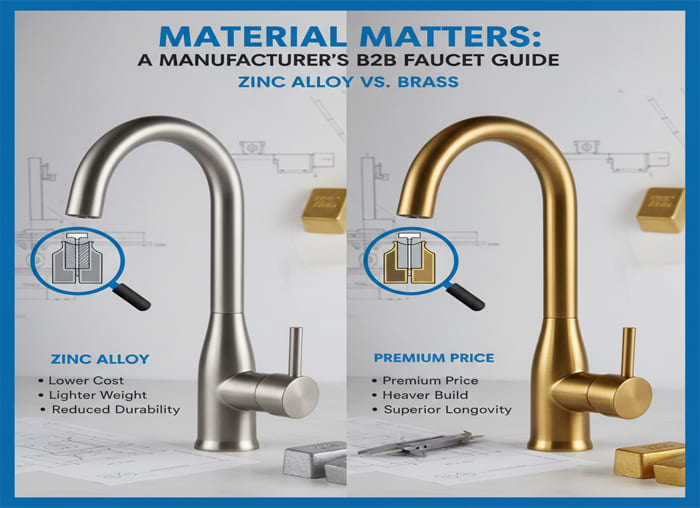
- The Price Equation: A zinc alloy faucet can be sourced for 1/3 to 1/2 the cost of an equivalent brass model. This is a massive advantage in markets where price is the primary purchasing driver.
- The Performance Equation: A brass faucet offers demonstrably superior durability, corrosion resistance, and a longer lifespan, which is a requirement in markets where quality and warranties are paramount.
Understanding where your target customer falls on this spectrum is the first step to making a profitable decision.
Deep Dive: Zinc Alloy Faucets – The Cost-Effective Contender
Zinc alloy faucets are a significant player in the global market, particularly in regions that demand affordability and design flexibility. They are often the go-to choice for large-scale construction projects, budget renovations, and entry-level product lines.
Primary Markets: The Middle East, Africa, parts of Southeast Asia, and South America.
The Business Case for Zinc Alloy
The primary advantage of zinc alloy is its low melting point and exceptional plasticity. From a manufacturing perspective, this is a game-changer. It allows us to use a process called die-casting, where molten metal is injected into a mold under high pressure.
This process is fast, efficient, and perfect for creating faucets with intricate, complex shapes and sharp design lines that would be difficult or expensive to achieve with brass.
| Zinc Alloy: Advantages for Your Business | Zinc Alloy: Disadvantages to Consider |
|---|---|
| ✅ Significant Cost Savings: Directly boosts your profit margins or allows for aggressive market pricing. | ❌ Limited Durability: The material is more brittle and prone to stress fractures over time (typical lifespan: 3-4 years). |
| ✅ Design & Styling Flexibility: Easily cast into modern, complex shapes to follow current trends. | ❌ Poor Corrosion Resistance: The base metal will corrode quickly if the plating is compromised. |
| ✅ Faster Production Cycles: Die-casting is a rapid manufacturing process, allowing for shorter lead times. | ❌ Plating Failure: Prone to “bubbling” or blistering as water gets under the chrome layer, leading to visible rust spots. |
| ✅ Lower Tooling Costs: Molds for die-casting are often less expensive than those for forging brass. | ❌ Lower Brand Perception: Associated with “entry-level” or “budget” quality, which can impact brand positioning. |
Manufacturer’s Tip: The quality of the electroplating on a zinc alloy faucet is everything. It is the faucet’s only armor against corrosion. When sourcing, always demand detailed specifications on the thickness of the chrome and nickel layers. A few extra microns can significantly extend the product’s aesthetic life.
Deep Dive: Brass Faucets – The Unquestioned Benchmark of Quality
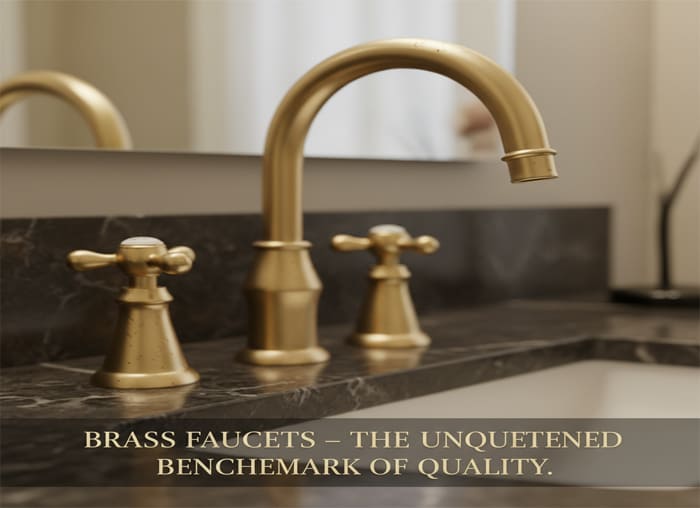
Brass, an alloy of copper and zinc, has been the gold standard for faucet manufacturing for over a century, and for good reason. Its inherent properties make it exceptionally well-suited for handling water pressure and constant use.
Primary Markets: Europe, North America, Australia, and high-end segments in all markets.
The Business Case for Brass
 v
v
The strength of brass lies in its robustness and reliability. It is highly resistant to corrosion from water, can withstand extreme temperatures, and has natural antimicrobial properties that inhibit the growth of bacteria.
While its higher cost—dramatically inflated by current copper prices—is a significant factor, it is an investment in product longevity and brand reputation. For markets with stringent plumbing codes (like NSF/ANSI 61 in the USA or AS/NZS 3718 in Australia) and high consumer expectations, brass is often the only acceptable choice. We produce various grades, including standard brass and DZR/lead-free brass, to meet these specific international standards.
| Brass: Advantages for Your Business | Brass: Disadvantages to Consider |
|---|---|
| ✅ Exceptional Durability & Longevity: A well-made brass faucet can last for decades, supporting long-term warranties. | ❌ High & Volatile Cost: Directly tied to the LME copper price, making cost forecasting challenging. |
| ✅ Superior Corrosion Resistance: Naturally resists rust and degradation from water exposure. | ❌ Heavier Weight: Can increase shipping costs compared to lighter zinc alloy models. |
| ✅ High Perceived Value: Commands a higher price point and builds a premium brand image. | ❌ Less Design Flexibility (for some complex shapes): Machining and forging can be more restrictive than die-casting. |
| ✅ Health & Safety: Naturally antimicrobial. Can be produced in lead-free formulations to meet strict global standards. | |
| ✅ 100% Recyclable: High scrap value and excellent environmental credentials. |
Strategic Comparison: A Head-to-Head Breakdown for Buyers
The choice is never black and white. It’s about aligning a product’s characteristics with your market’s specific demands. This table provides a direct, at-a-glance comparison to aid your strategic sourcing.
| Feature | Zinc Alloy Faucet | Brass Faucet | What This Means For Your Business |
|---|---|---|---|
| Unit Cost | Low (1/3 to 1/2 of Brass) | High (Tied to LME Copper) | Zinc offers higher margins or lower shelf prices. Brass requires positioning as a premium product. |
| Target Market | Price-sensitive regions (Middle East, Africa) | Quality-focused regions (Europe, USA, Australia) | Align your product with your market’s expectations to avoid failure. |
| Durability | Lower (3-4 year lifespan) | Very High (10+ year lifespan) | Brass supports long warranties and builds brand trust. Zinc is suited for projects with shorter life cycles. |
| Corrosion Resistance | Low. Relies entirely on plating. | Very High. The base material itself is resistant. | High humidity or coastal areas demand brass. Plating failure on zinc leads to rapid degradation. |
| Brand Positioning | Entry-Level, Budget, Project-Grade | Premium, Luxury, Professional-Grade | Your choice of material directly defines how your brand is perceived in the market. |
| Health & Safety | Inert when properly plated. | Naturally antimicrobial. Lead-free options available. | Brass is the clear winner for markets with strict health and safety regulations. |
| Manufacturing | Fast, efficient die-casting. | Slower forging and machining. | Zinc allows for faster order fulfillment. Brass requires longer planning and lead times. |
The SpringFaucet OEM/ODM Solution: The Right Material for Your Market
This is where the concept of “best” becomes personal to your business. The best faucet is the one that sells successfully in your target market and meets your customers’ expectations.
As a dedicated OEM/ODM manufacturing partner, our role isn’t to push one material over another. Our role is to provide the optimal solution for your specific business needs. We understand that a client developing a luxury hotel in Germany has completely different requirements than a distributor supplying large-scale housing projects in Nigeria.

Our approach is consultative:
- For European & American Markets: We engineer and supply high-grade, lead-free brass faucets that meet all necessary certifications (NSF, cUPC, WRAS).
- For Middle Eastern & African Markets: We provide cost-effective, stylishly designed zinc alloy faucets with enhanced, multi-layer plating to maximize their aesthetic lifespan in demanding environments.
Our diverse production capabilities mean you don’t have to compromise. We can develop a product portfolio for you that includes both zinc alloy and brass, allowing you to compete effectively across different market segments. Our Basin Faucet Collection showcases this flexibility, featuring a range of designs that can be produced in the material best suited for your business goals.
Frequently Asked Questions (FAQ)
Q1: How can my team visually identify the difference between a zinc and a brass faucet? The most reliable method is weight. A brass faucet will feel significantly heavier and more substantial in the hand than a zinc alloy faucet of the same size. A gentle tap will also produce a duller, lower-pitched sound from zinc, whereas brass will have a clearer, more resonant ring.
Q2: Can a high-quality plating make a zinc faucet last as long as a brass one? No. While a thick, expertly applied plating can dramatically prolong the aesthetic life of a zinc faucet by protecting it from cosmetic corrosion, it cannot change the underlying mechanical properties of the metal. The zinc body will still be more brittle and susceptible to cracking under stress over time than a solid brass body.
Q3: For a B2B order, what are the typical Minimum Order Quantities (MOQs) for each material? MOQs are generally more flexible for zinc alloy faucets due to the high-speed nature of die-casting. Brass faucets may have slightly higher MOQs because the forging and machining processes are more involved. However, as an OEM partner, we work with clients to find viable solutions for their order volumes.
Conclusion: Your Partner for Strategic Sourcing
The zinc alloy versus brass debate is not about finding a single winner. It’s about recognizing that they are two different tools for two different jobs.
- Zinc Alloy is the tool for capturing price-sensitive markets, enabling trendy designs, and fulfilling large-scale projects with tight budgets.
- Brass is the tool for building a premium brand, offering long-term warranties, and meeting the highest standards of quality and safety.
The ultimate key to success is partnering with a manufacturer who is not only an expert in production but also understands the nuances of your specific global market. By aligning your product material with your market’s demands, you create a sustainable, profitable, and successful business.
Recommended Links
Internal Links:
- The Complete Guide to Faucet Certifications (NSF, cUPC, WRAS)
- SUS304 Stainless Steel vs. Brass Faucets: A B2B Analysis
- Understanding Faucet Finishes: A Manufacturer’s Guide to PVD and Electroplating
External Links (Authoritative Sources):
- London Metal Exchange (LME): Official Copper Prices – The primary data source for the cost driver behind brass.
- International Zinc Association (IZA) – An authoritative resource on the properties and applications of zinc and its alloys.
- Copper Development Association Inc. (CDA) – A leading source for technical information on copper and brass alloys.