
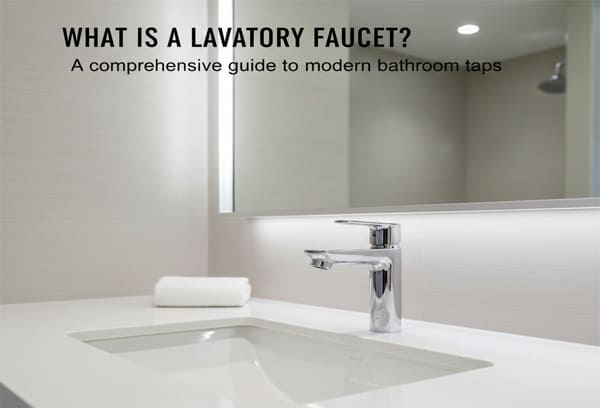
When you start a bathroom renovation or simply decide to replace an old faucet, you’ll inevitably encounter the term “Lavatory Faucet.” If you feel a bit puzzled, don’t worry—it’s just industry jargon for a bathroom sink faucet. As an expert with decades of hands-on experience in faucet manufacturing and design, I’m here to demystify this term, guide you through your choices, and reveal the incredible innovations transforming this everyday fixture.
Simply put, a lavatory faucet is the faucet designed for a bathroom sink (also known as a washbasin or vanity). Its job is to provide hot and cold water for personal hygiene—washing hands, brushing teeth, and washing your face. But its role is evolving from a simple mechanical device into an intelligent, sustainable, and highly personal hub within the modern bathroom. This guide will cover everything from the absolute basics to the cutting-edge technology you need to know about.
Last Updated: Dec 2025 | Estimated Reading Time: 15 minutes
The Key Differences: Lavatory vs. Kitchen vs. Tub Faucets
While they all deliver water, their designs are highly specialized for their specific tasks.
| Faucet Type | Primary Function | Typical Flow Rate (GPM) | Key Design Features |
|---|---|---|---|
| Lavatory Faucet | Hand washing, personal hygiene | 1.0 – 1.5 GPM | Smaller, diverse decorative styles, focused on ergonomics for hand washing. |
| Kitchen Faucet | Food prep, dishwashing | 1.8 – 2.2 GPM | Taller spout (high-arc), often includes pull-down/pull-out sprayers, multiple spray functions. |
| Tub Faucet | Filling a bathtub quickly | 4.0 – 7.0+ GPM | Very high flow rate, simple and robust design, often paired with a shower diverter. |
The First Step: Your Sink & Countertop Dictate Your Faucet Choice
Before you fall in love with a faucet’s design, you must check your sink’s configuration. This is the most critical step and will narrow your options immediately.
1. Count the Holes & Measure the Distance
Look at the top of your sink or countertop where the current faucet is mounted.
- Single-Hole Faucet: The clean, modern standard. The handle and spout are combined into a single unit that mounts through one hole. Perfect for smaller vanities and minimalist designs.
- 4-Inch Centerset Faucet: A very common setup. The spout and handles are fixed together on a 6-inch base plate (escutcheon). It installs into three holes, where the distance between the centers of the two outer holes is exactly 4 inches.
- 8-Inch Widespread Faucet: The most premium and flexible configuration. The two handles and the spout are three separate pieces. This setup requires three holes, and the distance between the handle centers can typically be adjusted from 8 to 16 inches. This offers a grand, customizable look ideal for larger vanities.
2. Match the Faucet Height to Your Sink Style
The type of sink you have is just as important as the holes in your counter.
- Standard Height Faucet: Designed for traditional undermount sinks (mounted below the counter) or self-rimming drop-in sinks. These faucets have a moderate height that provides comfortable space for handwashing within the basin.
- Vessel Faucet (Tall Faucet): If you have an artistic vessel sink that sits on top of the counter like a bowl, you must select a vessel faucet. These are significantly taller, with a long body and a high-arcing spout designed to clear the high rim of the sink and deliver a graceful, splash-free stream of water.
3. Choose Your Preferred Water Control
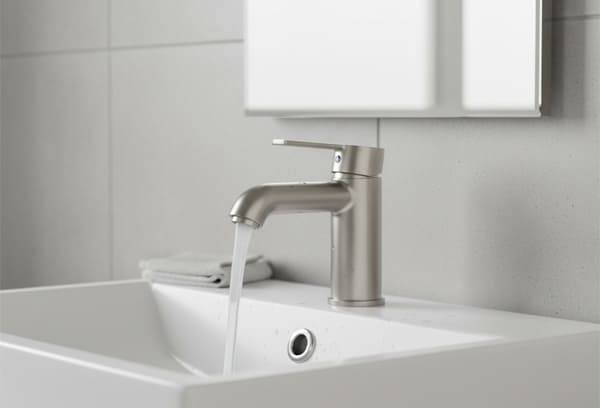
- Single-Handle Faucet: The most popular modern choice. A single lever controls both water volume (by lifting up/down) and temperature (by moving left/right). It’s intuitive, easy to use with one hand, and has a clean aesthetic.
- Double-Handle Faucet: The classic, traditional option. Two separate handles for hot and cold water give you precise temperature adjustment and a timeless, symmetrical look.
4. Consider a Wall-Mount Faucet
For a truly high-end, minimalist aesthetic, a wall-mount faucet is an excellent choice. It is installed on the wall behind the sink, freeing up the entire countertop for a clean, uncluttered look that is exceptionally easy to wipe down.
Important Consideration: Choosing this option requires advance planning. The water supply lines and valve must be installed inside the wall during the construction or rough-in phase of your project. This makes it a more complex installation and can complicate future repairs.
Beyond the Basics: A Manufacturer’s Guide to Materials & Durability
The look of a faucet is important, but what it’s made of determines how long it will last. As manufacturers, we know that true quality starts with the raw materials.
| Material | Durability & Performance | Health & Safety | Manufacturer’s Insight & Best For |
|---|---|---|---|
| DZR Brass | Superior | Lead-Free Certified | Dezincification-Resistant Brass. The pinnacle of faucet materials. In areas with aggressive (soft or acidic) water, standard brass can slowly lose zinc, becoming brittle. DZR brass is engineered to prevent this. Best For: A lifetime investment in any water condition. |
| Lead-Free Brass | Excellent | Lead-Free Certified | The industry gold standard. Heavy, durable, and highly resistant to corrosion. This is the workhorse material for high-quality faucets worldwide. Best For: The vast majority of quality-conscious residential and commercial projects. |
| SUS 304 Stainless Steel | Very Good | Inherently Lead-Free | Naturally 100% lead-free and will not corrode. It provides a modern, sleek look, especially in a brushed finish. Best For: Health-conscious homes and contemporary designs. |
| Zinc Alloy | Fair | Varies | Lightweight and less expensive. We strongly advise against using zinc alloys for the main faucet body as it’s prone to corrosion. It is, however, an acceptable material for handles where it isn’t in constant contact with water. |
| ABS Plastic | Fair | Lead-Free | Primarily used for non-pressurized components like aerator housings or some decorative shrouds. Not suitable for the main body of the faucet. |
Expert Tip: The “heft test” is a reliable indicator of quality. A solid brass or stainless steel faucet will feel substantial and heavy in your hand. A faucet that feels surprisingly light is likely made from zinc or has plastic components, which will not stand the test of time.
The Invisible Revolution: The Future of Lavatory Faucets is Here
The humble faucet is undergoing a profound transformation. It’s evolving from a simple valve into a smart, hygienic, and responsive device.
Smarter Interaction: From Manual to Intuitive
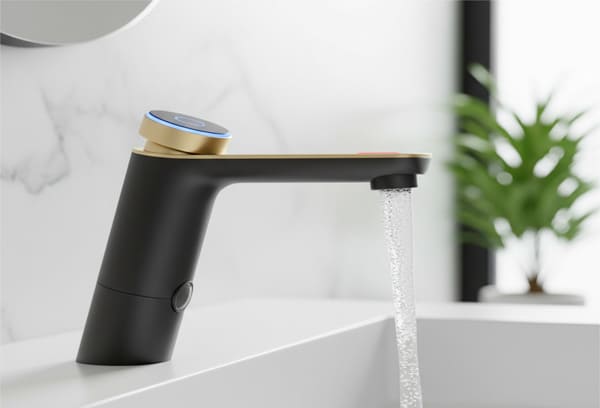
- Beyond Basic Motion Sensing: Early touchless faucets could be finicky. The new generation uses advanced sensors that can differentiate between a quick hand rinse and a longer, continuous stream for washing your face.
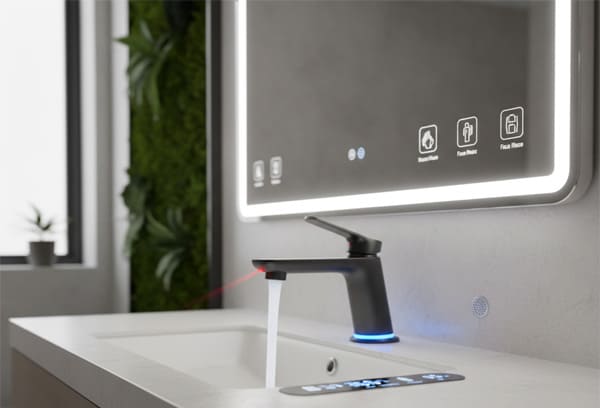
- Voice & Gesture Control: Integration with smart home systems (Alexa, Google Assistant) is becoming a reality. You can ask your faucet for water at a specific temperature. Gesture controls allow you to wave to adjust temperature and flow without ever touching the fixture.
- Digital Interfaces: Small, integrated displays provide real-time feedback on water temperature and consumption, helping you save water by making you more aware of your usage.
Wellness & Hygiene: Antimicrobial Surfaces
The focus on health has spurred innovation in materials. Faucets are now being crafted with copper-infused alloys or specialized PVD coatings that inherently inhibit the growth of bacteria on the surface. These “invisible” technologies, often certified by standards like NSF/ANSI 51, provide a constant layer of active protection.
This commitment to clean design and superior materials is a philosophy we apply across our entire product range. The same principles of minimalist aesthetics and durable construction found in a specialized fixture like the SpringFaucet Minimalist Outdoor Shower Faucet are embedded in the DNA of our indoor lavatory faucets, ensuring a cohesive and high-quality experience throughout your home.
Sustainable by Design: The Faucet as a Smart Resource Manager
The most significant evolution is the faucet’s role in home sustainability.
- Greywater Recycling: The most innovative systems capture the “greywater” from handwashing, filter it through a multi-stage process (like activated carbon and UV sterilization), and divert it to the toilet cistern for flushing. This can save a household thousands of gallons of fresh water annually.
- On-Device Energy Harvesting: To power smart features without batteries, faucets are being developed with micro-turbines that harness the energy of the water flow itself, or with photovoltaic films that use ambient bathroom light to trickle-charge an internal power cell.
- Modular, Repairable Design: Instead of replacing an entire faucet when one component fails, the future is modular. A faulty sensor or cartridge can be easily swapped out by the user, dramatically reducing waste and long-term cost.
A New Way to Shop: 3 Expert Tips for Choosing Your Next Faucet
As faucets become more advanced, your buying criteria should evolve too.
- Prioritize “Invisible Tech” Over Brand Prestige: Don’t just look at the logo. Ask for the technical specifications. A faucet certified to NSF/ANSI 61 (ensuring it’s safe for drinking water) and made from DZR Brass is a smarter investment than a non-certified faucet from a big-name brand.
- Test for Real-World Scenarios: Ask the tough questions. How does the sensor perform in low light? What anti-scaling technology is used to prevent hard water buildup? What is the minimum water pressure (PSI) required for smart features to work?
- Evaluate Total Cost of Ownership (TCO), Not Just Purchase Price: The cheapest faucet to buy is rarely the cheapest to own.
| Cost Factor | Basic Faucet (e.g., Zinc Body) | Quality Faucet (e.g., Brass Body, Modular) |
|---|---|---|
| Initial Price | us$6.50- us$14.30 | us$15.00-us$55.90 |
| Expected Lifespan | 3 – 5 Years | 15+ Years |
| Potential Repairs | Leaks, corrosion. Often requires full replacement. | Cartridge replacement (20),Sensormodule(20), Sensor module (50). |
| 15-Year TCO | us$21.50−us$37.90+ (Assuming 2-3 replacements) | us$15.00−us$50.00 (Assuming one minor repair) |
Frequently Asked Questions (FAQs) {#faq}
Q1: What is a faucet aerator and why is it important? The aerator is the small screen at the tip of the spout. It infuses the water stream with air, creating a soft, non-splashing flow and reducing water consumption. If your faucet’s flow weakens, the first step is always to unscrew and clean the aerator.
Q2: What does WaterSense certified mean? WaterSense is an EPA program. A WaterSense labeled lavatory faucet uses a maximum of 1.5 GPM and is certified to be at least 20% more water-efficient than standard faucets without sacrificing performance. It’s a key label to look for if water conservation is a priority.
Q3: Can I install a 4-inch centerset faucet on a single-hole sink? No, a centerset faucet requires three holes. However, you can almost always install a single-hole faucet on a 4-inch, three-hole sink by using the included base plate (escutcheon) to cover the extra holes.
Conclusion: You’re Ready to Choose with Confidence
You now know that “lavatory faucet” is simply the professional term for your bathroom sink faucet. More importantly, you understand that this simple fixture is packed with technology and design choices that can significantly impact your daily routine, your home’s hygiene, and your environmental footprint.
When making your selection, remember the foundational steps: count your holes, measure the distance, match your sink’s height, and choose the control style you prefer. Then, elevate your choice by considering the quality of the materials, the durability of the finish, and the smart, sustainable features that will serve you well into the future. Armed with this knowledge, you are no longer just a shopper; you are an informed expert ready to select the perfect lavatory faucet for your home.
Recommended Links
Internal Links:
- Our Faucets: Explore Our Philosophy of Minimalist Design & Durability
- Blog: Kitchen Faucet 101: A Manufacturer’s Ultimate Guide
- About Us: See Our Commitment to Quality Manufacturing
External Links (Authoritative Sources):
- Wikipedia: Tap (Valve) – For a deep dive into the mechanics and history of faucets.
- EPA WaterSense Program – The definitive resource for understanding water-efficient plumbing fixtures and finding certified products.
- NSF International: Certified Plumbing Products – An independent organization that tests and certifies faucets to ensure they meet public health and safety standards.