
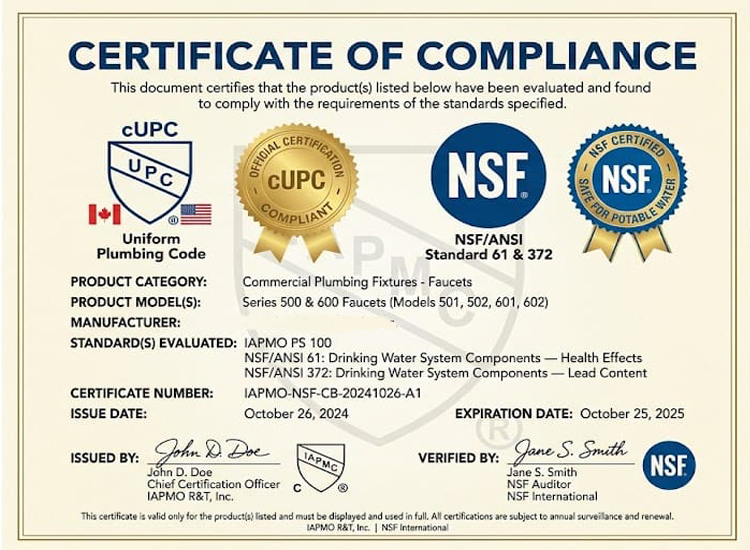
You’ve sourced a beautiful new faucet line. The samples look premium, the price is right, and the supplier sent over a crisp PDF with a cUPC logo and an NSF mark. You’re ready to ship 5,000 units to the U.S.
Six weeks later, your container hits Long Beach. Customs holds it. The reason? The certificate covers Model A, but you’re shipping Model A-BLK. Or worse, the certificate expired six months ago, and nobody noticed. Now you’re staring at $50,000 in demurrage fees, a stock-out, and a very angry Amazon account manager.
If this sounds like a nightmare scenario, it’s because it happens every week in the faucet industry.
For B2B buyers, importers, and Amazon private-label sellers, faucet certifications aren’t just technical trivia—they are the gatekeepers to the U.S. market. Between cUPC, NSF/ANSI 61, NSF/ANSI 372, and the federal Lead-Free law, the compliance landscape is a minefield. One wrong move, and your products are illegal to sell in California, Washington, and most major retailers.
This guide cuts through the noise. We’ll break down exactly what these certifications mean, how to properly verify them (beyond just looking at a logo), and what clauses you need in your Purchase Orders to protect your business in 2026.
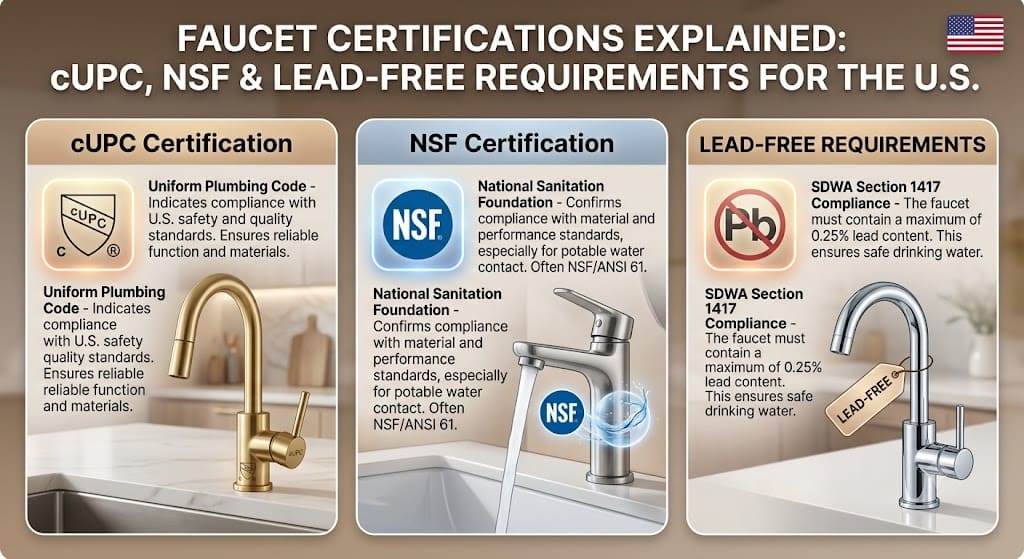
Table of Contents
-
- The hook: A real-world risk scenario for B2B buyers and importers.
-
- Featured snippet target: The fastest way to verify a faucet is truly certified.
-
- Explores liability, channel access (Amazon/Home Depot), and state-level enforcement.
-
- Defines the Uniform Plumbing Code and the IAPMO certification process.
-
- Breaks down the difference between chemical leaching (61) and lead content (372).
-
- Explains the federal SDWA requirement and the California AB 100 update.
-
- Actionable guide: Model matching, directory lookup, physical stamps, and CoCs.
-
- Identifies common supplier tricks and Photoshopped documentation.
-
- Provides the exact clauses and specifications to include in procurement contracts.
-
- Visual summary of cUPC, ICC-ES, NSF 61, NSF 372, and WaterSense.
- Answers specific queries like “Is cUPC required in Texas?” and “Does CE count in the USA?”
📋 TL;DR — Featured Snippet Target
The short answer: Any faucet sold for potable water use in the U.S. must legally meet the federal “lead-free” definition (≤0.25% weighted average lead content across wetted surfaces, Safe Drinking Water Act). In practice, that means your faucet should carry (1) cUPC (IAPMO, proves UPC code compliance + usually bundles NSF 61/372), (2) NSF/ANSI 61 (health effects / chemical leaching), and (3) NSF/ANSI 372 (lead content verification). For B2B buyers, the compliance workflow isn’t “does it have a logo on the box?” — it’s: model-level certificate lookup on IAPMO/NSF directories, physical stamping check, and a per-shipment Certificate of Conformance (CoC) tied to PO/lot number.
H2: Why Faucet Certifications Are a Business Problem, Not a Sticker Problem
If you’re importing, private-labeling, distributing, or specifying faucets for the U.S. market, certifications sit at the intersection of three risk zones:
- Legal — Selling non-lead-free potable faucets violates the SDWA; California, Washington, and Vermont enforce aggressively.
- Channel — Home Depot, Lowe’s, Costco, and Amazon all require documented compliance before listing. Amazon will kill an ASIN in California if lead-free can’t be proven.
- Liability — Commercial specs (schools, hospitals, government) flow down warranty + compliance risk to the distributor.
⚠️ The most common B2B fail: a supplier shows you a PDF with a cUPC logo, but the certificate covers Model Awhile they’re shipping you Model A-BLKand Model A-PRO. Unless those exact SKUs are listed in the scope, you’re uncertified in the eyes of an inspector.
This guide breaks down what each mark actually means, which laws back it, how to verify it’s real, and what to bake into a purchase order so you don’t find out the hard way.
H2: What Is cUPC? (And How It Differs from UPC / ICC-ES)
H3: cUPC = Certified to the Uniform Plumbing Code
cUPC is issued by IAPMO (International Association of Plumbing and Mechanical Officials). The “c” means it’s recognized in both the U.S. and Canada (the Canadian half traces to CSA alignment). The underlying code is the Uniform Plumbing Code (UPC), adopted by California, Washington, Oregon, Nevada, Vermont, and ~15–20 other states.
For faucets, a cUPC listing typically bundles these standards together:
Standard Covers ASME A112.18.1 / CSA B125.1 Mechanical performance — pressure, leak, torque, finish adhesion, hose cycle (pull-out/pull-down) NSF/ANSI 61 Drinking water health effects (leaching) NSF/ANSI 372 Lead content (≤0.25% weighted avg) UPC Chapters 4 / 6 Fixture acceptance per jurisdiction H3: UPC vs. cUPC vs. ICC-ES (The Trio B2B Buyers Mix Up)
Mark Issuer Code Base Strongest In cUPC IAPMO UPC CA, WA, OR, VT, NV, Mountain West UPC — The code itself — ICC-ES PMG ICC IPC (Intl Plumbing Code) States on IPC track (TX, FL, Southeast) 📌 Practical advice: If you’re targeting California or Washington retail, cUPC is the safer bet — both states reference UPC by name in their plumbing boards. ICC-ES is an acceptable alternative in IPC states, but many West-Coast distributors won’t bother with the explanation work.
H3: What Products Fall Under cUPC?
Per IAPMO scope, the faucet-related family includes:
- Kitchen / bath / bar / laundry faucets
- Anti-siphon frost-proof yard hydrants
- Handheld showerheads (ASSE 1014)
- Flexible water connectors (ASME A112.18.6)
- Ceramic cartridges, supply lines, valves
If your supplier tells you “our factory has cUPC,” ask which product families — a factory can hold cUPC on valves but not on faucets, and the certificates don’t cross-pollinate.
H2: NSF/ANSI 61 vs. 372 — What Each One Actually Tests
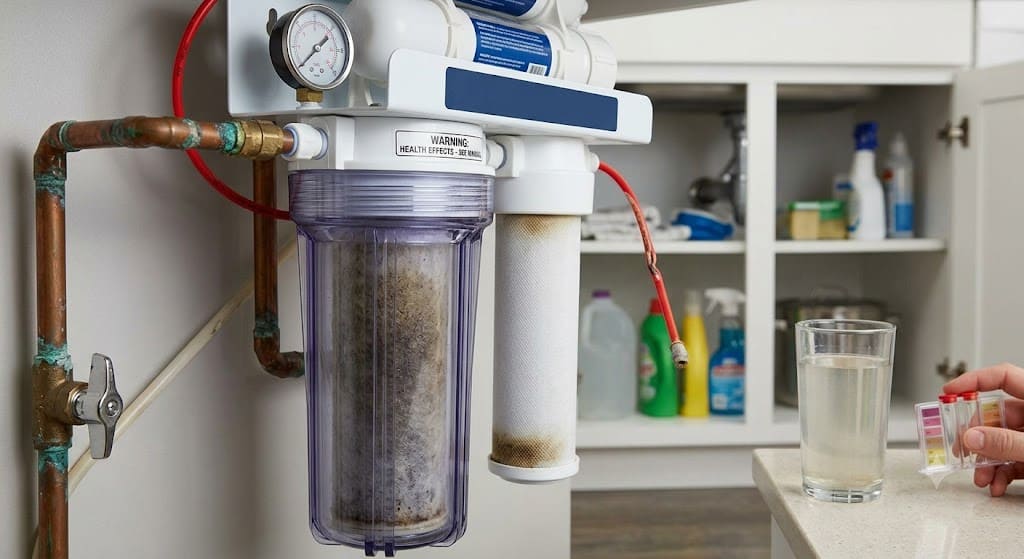
NSF International issues multiple faucet-relevant marks. Importers routinely lump them together; they’re not the same.
H3: NSF/ANSI 61 — Drinking Water System Components – Health Effects
Tests whether chemical contaminants leach from the faucet into drinking water — lead, cadmium, arsenic, VOCs, and 150+ other substances under aggressive water protocols (static + dynamic, cold 23°C / sometimes hot 55°C).
- Required de facto in all 50 states for potable faucets, even where not state-mandated — retailers won’t list without it.
- Covers all wetted parts: body, cartridge, aerator, supply nuts, hoses.
- For kitchen pull-downs, the hose inner lining must also be 61-compliant (a frequent weak point).
H3: NSF/ANSI 372 — Lead Content (The Legal Proof)
This is the material-level test that proves compliance with the federal lead-free law. Uses XRF or chemical digestion to calculate weighted average lead across wetted surfaces.
- Threshold: ≤0.25% (federal ceiling).
- Mark appears as “NSF/ANSI 372”, “LF”, or “Lead-Free” stamped on the faucet.
- Note: NSF 372 is onlyabout lead content. It does not test general chemical leaching — that’s 61’s job. You need both.
H3: NSF/ANSI 61 Annex G vs. 372 — The EPA Recognition Detail
Here’s a nuance most B2B blogs skip: the EPA recognizes three paths to prove “lead-free” for plumbing products under the SDWA:
- NSF/ANSI 372 (lead content only)
- NSF/ANSI 61, Annex G (lead leaching protocol — older path, still valid)
- California AB 1953, Section 116875 (state-level, aligned to 0.25%)
So when a certificate says “NSF 61 compliant,” check whether it’s the base 61 (general health) or 61 + Annex G (lead-specific). For faucets, you almost always want both 61 and372 called out explicitly.
H3: NSF/ANSI 18 — The One B2B Buyers Forget
If you’re sourcing commercial kitchen pre-rinse, bar faucets, or food-prep taps, NSF 18 (Manual Food and Beverage Dispensing Equipment) enters the spec. Residential kitchen faucets don’t need it; commercial food-zone faucets do. Mismatched spec = rejected at plan review.
H2: U.S. Lead-Free Law — What “Lead-Free” Actually Means (It’s Not Zero)
H3: The Federal Definition (SDWA Section 1417, Revised 2014)
After the 2014 SDWA amendment, “lead-free” for plumbing fittings & fixtures is defined as:
≤ 0.25% weighted average lead content across all wetted surfaces.
Details that change how you buy:
- “Lead-free” ≠ zero lead. It’s a weighted calculation, not a total ban.
- Wetted surfaces only — a decorative brass cap that never touches water doesn’t count.
- Each component calculated separately then weighted by surface-area-contact. The cartridge housing, valve seat, and spout interior all enter the math.
- California AB 1953 was the earlier state law; all states now align to the 0.25% federal floor, but California enforcement is still the most aggressive in the union.
H3: California AB 100 (2021) — The Update B2B Buyers Miss
California AB 100, signed Oct 2021, mandates NSF/ANSI/CAN 61-2020 as the lead-testing standard for “endpoint drinking water devices” sold in California — that’s the last-riser fixtures (faucets, bubblers, hose bibbs).
What this means for you: If you’re shipping faucets into California post-2021, your NSF 61 certificate should reference the current edition of the standard (61-2020 or later). Older certificates referencing withdrawn editions can still be valid if unexpired, but retailers updating their QA decks will ask for current-edition alignment.
H3: Who Enforces (and What’s at Stake)
Level Who Lever Federal EPA (SDWA) Civil penalties per violation Federal CPSC Recalls (leaching / lead) State CA AG / plumbing boards (CA, WA, VT) Stop-sale, fines Commercial Retailer QA (HD, Lowe’s, Amazon) ASIN delist, chargeback Local Building inspector Reject at rough/final Amazon specifically: a single CA consumer complaint + inability to produce NSF 372 documentation = listing removal + potential 3P liability. For private-label brands, this is the #1 existential risk.
H2: How to Properly Verify a Certified Faucet (5-Step Workflow)
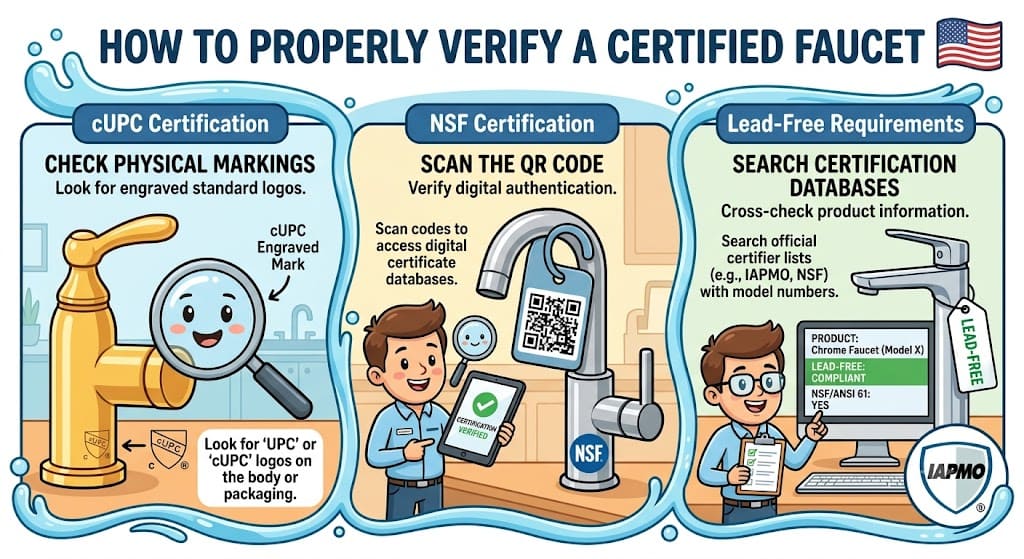
Eighty percent of B2B compliance disasters come from trusting a PDF logo. Here’s the audit that survives port inspection and retailer QA.
Step 1 — Match the ExactModel Number on the Certificate
Certificates list specific model numbers or family ranges (e.g., “ABC-100 series, includes ABC-100, ABC-100-BLK, ABC-100-PRO”).
- Red flag: Supplier says “same mold, different color, same cert.” Colors don’t change wetted path → usuallyfine, but the SKU still needs to be listed in the scope or covered under a family clause.
- Private-label brands: your brand name may NOT appear on the certificate (it’s issued to the manufacturer). That’s normal — but the OEM model that maps to your SKU must be listed.
Step 2 — Look Up the Certificate Number on the Issuer’s Directory
Issuer Directory IAPMO (cUPC) iapmo.org → “Listed Products” NSF nsf.org → “Certified Products” ICC-ES icc-es.org → “PMG Listings” Type the certificate number, not just the brand. You should see:
- Issue date + expiry
- Model scope (exact SKUs)
- Standards referenced (ASME A112.18.1, NSF 61, NSF 372)
- Latest audit status
💡 Save a screenshot of the directory result with every CoC packet. If the supplier’s PDF “quietly expires,” you have proof of what was valid at PO time.
Step 3 — Check Physical Stamping on the Faucet Body
Federal law requires permanent marking on potable fittings. Typical locations:
- Underside of spout
- Base shank / mounting nut
- Escutcheon underside
- Supply-line nut (for connectors)
Look for: “cUPC”, “NSF/ANSI 61”, “NSF/ANSI 372” or “LF”, plus a manufacturer ID (so it’s traceable). If the faucet has zero markings but the supplier claims cert → walk.
Step 4 — Request Per-Shipment CoC (Certificate of Conformance)
Not the same as the certificate. A proper CoC says:
“This shipment of [Qty] pcs of Model [X], PO #[Y], Lot #[Z], mfg date [MM/YY], produced at [factory address], conforms to cUPC / NSF 61 / NSF 372 per certificate #[XXXX].”
- On supplier letterhead
- References PO + batch/lot
- Signed/dated (not just a JPEG logo)
Retailers and port inspectors lean on this for chain-of-custody. Factories that can’t produce CoCs per batch are either lazy or hiding something.
Step 5 — XRF Spot-Check (Optional but Power-Move for B2B)
Some distributors (and some diligent factories) run handheld XRF on incoming brass batches to verify lead content matches the 372 claim. You don’t need this for every container, but for high-volume PL brands it’s cheap insurance (<$50/sample at a third-party lab).
H2: Red Flags — How to Spot a Fake or Stale Certificate 🚩
Red Flag What It Means Cert # returns no result on IAPMO/NSF site Photoshopped or revoked Model # not in scope Certificate belongs to a different SKU PDF has no issuer contact / no expiry Amateur fake “cUPC” but no NSF 61/372 bundled Incomplete for potable use Supplier offers to “add cUPC laser mark for $X/unit” 🚩 Illegal — mark can’t be bought Certificate expired >6 months ago Factory let audit lapse NSF 61 listed but no Annex G / no 372 Doesn’t prove lead-free Factory has cUPC on valves, not on faucets Different product families don’t cross
H2: B2B Buyer’s PO & Spec Sheet — What to Write In
If you’re a distributor, Amazon PL, contractor-specifier, or procurement agent, bake these into the commercial docs before deposit.
Minimum Compliance Spec (Residential Kitchen/Bath, U.S. Potable)
Commercial / Gov-Spec Add-Ons
- NSF 18 — if foodservice / bar / prep sink
- ADA (ANSI A117.1) — lever torque ≤ 5 lbf, reachable ranges; required for govt/commercial specs
- WaterSense (EPA) — 1.5 GPM (kitchen) / 1.2 GPM (bath) max; unlocks municipal rebates + marketing
- Finish warranty in writing (PVD ≥ 5 yrs for spec grade)
Common B2B Mistakes (That Get You Burned)
- “cUPC factory” ≠ every SKU certified. Factories certify 2–3 hero SKUs, hope you don’t notice the other 20 aren’t listed.
- Cartridge vendor swap mid-production. Factory changes cartridge supplier → wetted path changes → cert maybe voided. Put a “no component substitution without buyer written consent” clause in the PO.
- Colorway assumption. Black PVD vs. chrome usually shares a cert ifwetted path identical — but the family scope must say so.
- Ignoring factory audit frequency. Products with NSF 61/372 require 2 factory audits per year; ordinary products get 1. If your supplier says “we get audited once a year” but sells you NSF 61 faucets, something’s off.
- CE ≠ cUPC. European CE (EN 817) does not satisfy U.S. law. You’ll see Alibaba listings: “CE & cUPC” — if the cUPC cert is stale, the CE doesn’t rescue you in U.S. ports.
H2: Quick Comparison Table — U.S. Faucet Marks at a Glance
Mark Issuer Proves Mandatory for U.S. Potable? cUPC IAPMO UPC code compliance (bundles 61+372 typically) De facto yes (CA/WA/OR + retail) ICC-ES PMG ICC IPC-based alt to cUPC Acceptable alt (IPC states) NSF/ANSI 61 NSF No harmful leaching Yes (potable) NSF/ANSI 61 Annex G NSF Lead leaching (older lead-free path) Acceptable alt to 372 NSF/ANSI 372 NSF Lead content ≤0.25% Federal law WaterSense EPA Low-flow performance Voluntary (marketable) ADA (A117.1) ANSI Accessible operation Commercial/gov spec NSF 18 NSF Food-zone safety Commercial kitchen only
H2: FAQ — Schema-Ready Long-Tail Catchers
Q: Is cUPC required in all 50 states?
A: Not technically. UPC is adopted by ~20 states (strongest: CA, WA, OR, VT, NV). IPC-track states (TX, FL, much of Southeast) may accept ICC-ES instead. But for national retail distribution, cUPC is the de facto standard — big-boxers and Amazon target all states, so they default to cUPC + NSF 61/372.
Q: Can I sell a U.S. faucet with only CE marking?
A: No. CE (EN 817) covers EU directives; it does not satisfy SDWA, cUPC, or NSF requirements. You need U.S.-recognized certs. CE alone won’t pass retailer QA or port inspection.
Q: Does “lead-free” mean zero lead?
A: No. Federal law (SDWA) defines it as ≤0.25% weighted average across wetted surfaces. “Lead-free” is a legal threshold, not a material purity claim.
Q: Do pull-down kitchen faucets need a different cert than bathroom faucets?
A: Same core (cUPC + NSF 61 + 372), but pull-downs add hose cyclic durability and retraction weight testing under ASME A112.18.1. Also the hose inner lining must be NSF 61-compliant — a frequent miss on cheap units.
Q: My private-label brand name isn’t on the certificate — is that a problem?
A: No, that’s normal. cUPC/NSF certificates are issued to the manufacturer, not the brand. Your PL brand won’t appear. What must appear: the OEM model number that maps to your SKU, listed in the scope. Keep a mapping sheet (Your-SKU ↔ OEM-Model ↔ Cert-#) in your compliance folder.
Q: How much does cUPC + NSF certification cost a factory?
A: Roughly $8k–$20k+ per SKU family (testing + initial audit + annual fees), depending on complexity and whether 61+372 are bundled. That’s why factories certify hero SKUs first — and why B2B buyers must verify theirSKU is in scope.
Q: What’s the difference between NSF 61 and NSF 61 Annex G?
A: Base NSF 61 tests general chemical leaching (150+ contaminants). Annex G is the lead-specific leaching protocol — the older lead-free proof path. Post-2014, most buyers ask for NSF 372 instead (material-level lead content, easier to verify). But EPA still recognizes both.
Q: Can aluminum-body faucets get cUPC?
A: Rare. Aluminum corrodes under standard cUPC test conditions for kitchen potable use; most aluminum faucets on the market are decorative or utility-only. If a supplier claims cUPC on an aluminum kitchen faucet, ask to see the certificate scope — it’s likely a different product category.
H2: Closing — The Risk/Reward Frame

Certifications feel like paperwork — until they’re not. One non-compliant SKU in a 5,000-unit container can mean port hold, ASIN kill, state AG letter, or class-action exposure.
The flip side: if you nail the workflow — model-level directory lookup, physical stamp check, per-shipment CoC, PO clauses blocking component swaps, and tracking that NSF 61/372 triggers 2×/year audits — you can sell into the highest-margin U.S. channels (big-box, gov spec, ADA commercial) where uncertified competitors can’t follow.