
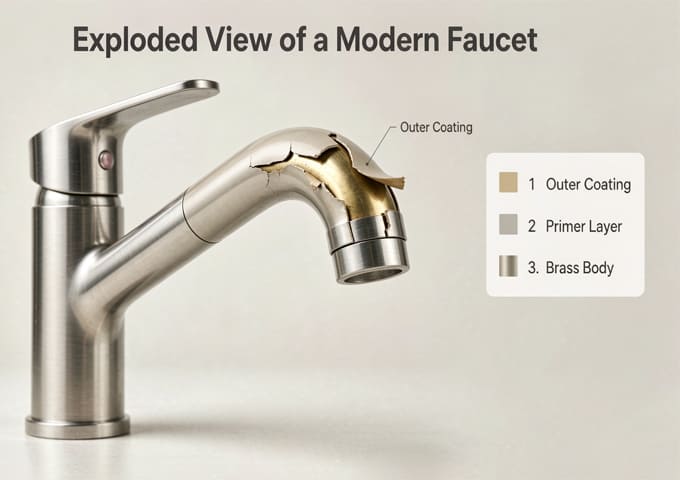
When you choose a new faucet, your eyes are drawn to the design—the graceful curve of the spout, the sleek handle, the brilliant finish. But the most critical decision you’ll make has nothing to do with what you can see. The true story of a faucet’s quality, durability, and even its safety is hidden beneath that shiny surface. It’s all about the core material.
As an OEM/ODM manufacturer with nearly two decades of experience crafting faucets for global markets, we at SPRINGFAUCET know that the body material is the single most important factor determining how a faucet will perform over a decade of daily use. This guide will give you a manufacturer’s insider perspective, moving beyond the marketing to reveal what’s really under the finish, so you can make a choice that lasts.
Last Updated: November 2026 | Estimated Reading Time: 16 minutes
This Guide Will Teach You:
- Why traditional brass, used by brands like Grohe and Kohler, has been the king—and why that’s changing.
- The difference between premium stainless steel (SUS304/316) and its budget counterpart (SUS201).
- The truth about low-cost zinc alloy and plastic faucets and their proper place in the market.
- How a single economic factor—the soaring price of copper—is reshaping the entire industry.
- How to choose the right material for your specific environment, from a humid coastal home to a busy city apartment.
The Gold Standard: The Enduring Legacy of Brass
For generations, brass has been the undisputed champion of faucet manufacturing. A copper and zinc alloy, brass has a combination of properties that make it nearly perfect for handling water.
It’s the material that industry leaders like Grohe and Kohler built their reputations on. Why? First, it’s highly resistant to corrosion from water, which is obviously critical. Second, it has natural antimicrobial properties thanks to its copper content, helping to keep the internal waterways of the faucet cleaner. Finally, it’s an excellent material for casting and machining, allowing for the creation of intricate and robust designs.
However, the world of brass isn’t simple. Early brass faucets contained significant levels of lead to improve malleability. Today, global standards demand the use of low-lead or lead-free brass. For example, DZR (Dezincification Resistant) brass is engineered to resist corrosion in soft water areas, while alloys like C46400 are certified for safe drinking water applications in markets like North America.
Industry Insight: When a manufacturer says “solid brass,” it’s a sign of quality. It means the entire faucet body is made from this durable material, not just plated to look like it. This is a key differentiator from budget alternatives.
Brass at a Glance
| Feature | Description | What This Means for You |
|---|---|---|
| Durability | Excellent. A well-made brass faucet can easily last 15-30 years. | A long-term investment that resists wear and tear from daily use. |
| Corrosion Resistance | Very Good. Especially with modern alloys. | Your faucet won’t degrade from the inside out. Essential for longevity. |
| Cost | High. This is a premium material, and its price is tied to copper. | You will pay more upfront, but you’re buying a product built to last. |
| Health & Safety | Excellent (with certified low-lead brass). | Ensures your drinking water remains safe and free from lead contamination. |
Pro Tip: If a deal on a “solid brass” faucet seems too good to be true, it likely is. Unscrupulous manufacturers may use recycled brass with high impurity levels, including lead, or misrepresent a zinc faucet as brass. Always buy from a reputable source that can provide material certifications.
The Economic Shift: When Markets Demand Alternatives
The global market is not monolithic. As economies in Africa, the Middle East, and parts of Asia grew, so did the demand for affordable housing and plumbing fixtures. This created a huge market for products at a much lower price point than traditional brass faucets could meet. This is where zinc alloy and plastic entered the scene.
Simultaneously, a massive global event began squeezing the industry: the skyrocketing price of copper. As of November 6, 2026, the LME copper price has surged to an astonishing $13,755.50 per ton. This has more than doubled the raw material cost of a brass faucet in just a few years, forcing manufacturers and consumers alike to seek viable alternatives.
Suggested Image: A line graph showing the dramatic upward trend of LME copper prices from 2020 to November 2026, with a callout box highlighting the current price. Image file name: lme-copper-price-surge-2026.jpg
Zinc Alloy: The Great Impostor?
Zinc alloy (often called “zamak”) is the material behind most of the ultra-cheap, brass-looking faucets you might find online or in discount stores. It’s very easy to die-cast, allowing for complex shapes to be made quickly and cheaply. It also takes a chrome finish very well, so on the shelf, it can look identical to a brass faucet.
However, zinc is not brass. It is far more brittle and has significantly lower corrosion resistance. It is prone to developing internal pitting and can crack under high water pressure or from a simple accidental knock. For this reason, reputable manufacturers never use zinc for the main pressure-bearing body of a faucet. Its proper use is for non-pressurized parts like handles or decorative shrouds where its low cost and design flexibility are assets.
Plastic (ABS): The Lightweight Contender
Plastic, specifically Acrylonitrile Butadiene Styrene (ABS), also has a place. While whole-body plastic “taps” are generally reserved for utility sinks or temporary situations, ABS is a fantastic material for specific faucet components. It’s lightweight, completely impervious to mineral buildup (limescale), and inexpensive. You’ll find it used for aerator housings, pull-out spray heads on kitchen faucets, and shower handsets. In these applications, it reduces weight, improves handling, and lowers costs without compromising the core integrity of the fixture.
The Game Changer: The Rise of Stainless Steel
Faced with the punishing cost of brass and the quality issues of zinc, the industry turned to a material that was once considered too difficult and expensive to work with: stainless steel. Advances in manufacturing technology have made it a top-tier, viable alternative.
Stainless steel is an iron alloy containing chromium, which forms a passive, rust-proof layer on the surface. Unlike brass, it is 100% lead-free by its very nature. It’s incredibly strong, hygienic, and has a modern aesthetic that many people prefer. But not all stainless steel is created equal.
Understanding the Grades: SUS201 vs. SUS304 vs. SUS316
When you see “stainless steel faucet,” you need to ask: “Which grade?” This is a question a knowledgeable manufacturer like SPRINGFAUCET always addresses.
- SUS304 (or Grade 304): This is the workhorse of the industry, often called “18/8” stainless steel for its 18% chromium and 8% nickel content. SUS304 offers an excellent balance of corrosion resistance, durability, and cost. It is the perfect material for the vast majority of kitchen and bathroom applications.
- SUS316 (Marine Grade): This is a premium grade with the same properties as 304, but with the addition of molybdenum. This small addition dramatically increases its resistance to chlorides. This makes SUS316 the absolute best choice for coastal areas or any environment with salt in the air. For a home near the ocean, a 316 stainless steel faucet will resist surface rust and pitting far better than any other material.
- SUS201: This is a lower-cost grade of stainless steel where manufacturers reduce the expensive nickel content and replace it with manganese. While it is still stainless steel, it has significantly lower corrosion resistance than 304. In a humid or damp environment, a 201 faucet can begin to show small spots of rust over time. It’s a budget option, but it comes with a trade-off in longevity.
Pro Tip: An easy way to spot a potential SUS201 faucet is the price. If a “stainless steel” faucet is priced similarly to a zinc alloy one, it’s almost certainly made from the lower 201 grade. A true SUS304 or SUS316 faucet is a premium product with a price that reflects its superior material.
The Newcomer: What is “Space Aluminum”?
You may have recently seen faucets marketed as being made from “space aluminum.” This is typically a standard aluminum alloy that has been anodized, often in matte colors like black or grey.
Aluminum is very lightweight and completely resistant to rust. However, it is a much softer metal than brass or stainless steel. It is more susceptible to dents and scratches. While suitable for bathroom accessories like towel bars and shelves, its durability as a primary material for a pressurized water faucet is still largely unproven in the long term compared to the decades of performance from brass and stainless steel. It’s an interesting trend, but one to approach with caution for a high-use fixture.
Comprehensive Material Comparison
| Material | Durability | Corrosion Resistance | Cost (Raw Material) | 100% Lead-Free? | Best For… |
|---|---|---|---|---|---|
| Low-Lead Brass | Excellent | Very Good | High | No (but certified safe) | High-end residential & commercial, classic designs. |
| SUS304 Stainless | Excellent | Excellent | Medium-High | Yes | Modern kitchens & baths, health-conscious users. |
| SUS316 Stainless | Superior | Superior | Very High | Yes | Coastal homes, yachts, harsh chemical environments. |
| Zinc Alloy | Poor | Poor | Very Low | Yes | Handles, decorative parts only. NOT for faucet bodies. |
| Plastic (ABS) | Fair | Superior | Very Low | Yes | Spray heads, non-pressurized components, utility taps. |
| Space Aluminum | Fair | Good | Low | Yes | Bathroom accessories; unproven for primary faucet bodies. |
A Manufacturer’s Philosophy: Material for the Market
As an OEM/ODM partner for clients worldwide, SPRINGFAUCET doesn’t believe in a one-size-fits-all solution. Our job is to engineer the best possible product for a specific market, price point, and use case.
Our popular Modern Bathtub Faucet is a perfect example of this philosophy in action. It’s a best-seller in the dynamic markets of the Middle East and Africa. Why? Because it hits the perfect balance. The core is a robust, solid brass body that conveys quality and ensures long-term, leak-free performance. We then offer it with a range of high-performance finishes that are in high demand, such as a tough-as-nails matte black, a sleek brushed silver (PVD), and a flawless triple-plated chrome. This strategy delivers the durability of brass with the modern aesthetics and accessible price point that these markets require. It’s not about what’s cheapest; it’s about delivering maximum value and reliability.
Practical Guide: Matching Material to Your Environment
| Your Situation | Recommended Material | Why It’s the Best Choice |
|---|---|---|
| High-End Family Home (City) | Low-Lead Brass or SUS304 Stainless | Both offer premium feel and long-term durability. The choice often comes down to classic (brass) vs. modern (steel) aesthetics. |
| House on the Coast/Beachfront | SUS316 Stainless Steel (Mandatory) | Unbeatable resistance to salt in the air. A brass or SUS304 faucet will show pitting and corrosion here much faster. |
| Busy Public Restroom | SUS304 Stainless Steel | Extremely durable, hygienic, and easy to clean. It withstands heavy use and harsh cleaning chemicals better than finished brass. |
| Budget Apartment Renovation | Low-Lead Brass (if budget allows) or a reputable SUS304 faucet. | Avoid the temptation of zinc. Investing in a solid core material prevents costly leaks and replacements down the line. |
| “House-Flipping” Project | Low-Lead Brass | It has the perceived weight and quality that discerning buyers look for and signals that no corners were cut on the fixtures. |
Pro Tip: The weight of a faucet is often a good initial indicator of its quality. A solid brass or stainless steel faucet will feel substantial and heavy in your hand. A zinc alloy faucet will feel surprisingly light for its size.
FAQ: Your Material Questions Answered
Q1: So, is stainless steel officially better than brass now? Not necessarily. Both are excellent premium materials. High-quality low-lead brass is still a fantastic choice with a long track record. Stainless steel’s main advantages are being 100% lead-free by nature and having a more modern look. The best choice depends on your budget, style preference, and water conditions.
Q2: How can I tell what my current faucet is made of? It can be difficult once installed. One clue is to look at the aerator threads. On a chrome-plated brass faucet, the threads are often yellowish. On a chrome-plated zinc faucet, they might be grayish-white. A stainless steel faucet will be a solid grey material through and through. The magnet test is also useful: high-quality SUS304/316 is largely non-magnetic, whereas cheaper SUS201 or other steel alloys may be slightly magnetic.
Q3: Are zinc alloy faucets dangerous? “Dangerous” might be too strong a word for most applications, but they are unreliable. The primary risk is property damage from leaks or cracks. They are simply not built to withstand constant water pressure over many years. For drinking water, it’s always best to stick to certified lead-free materials like brass or stainless steel.
Q4: I live in a hard water area. Does material matter? Yes, but the finish and internal components matter more for hard water. Both brass and stainless steel are great core materials. Limescale will build up on any material. However, a stainless steel surface or a high-quality PVD finish on brass is often easier to clean and more resistant to damage from mineral buildup than a basic chrome finish.
Conclusion: Look Beyond the Shine
The finish is what you see, but the material is what you’re buying. In a world of rising material costs and a flood of low-cost alternatives, understanding the fundamental difference between brass, stainless steel, and zinc is more important than ever.
- Brass remains the trusted, traditional choice for quality, with a premium feel.
- Stainless Steel (SUS304/316) has emerged as the modern, 100% lead-free powerhouse, offering incredible durability.
- Zinc and Plastic have their place in non-critical components, but should never be the core of a faucet you depend on.
Your faucet is one of the hardest-working fixtures in your home. Don’t be seduced by a low price or a shiny surface alone. By asking “what’s it made of?”, you are investing not just in a fixture, but in peace of mind, safety, and long-term value. As a manufacturer, our advice is simple: choose a partner and a product built on a foundation of quality materials. It’s a decision that will pay you back every day for years to come.
Recommended Internal & External Links:
- Internal Link: Modern Bathtub Faucet – See an example of a product designed with a robust brass core and high-performance finishes for demanding markets.
- Internal Link: Water Quality’s Impact on Faucets – Learn how the water quality and your faucet what’s the real connection.
- Internal Link: The Perfect Shower System A 2026 Buyers Guide – Explore how to choose the perfect shower system for your home.
- External Link: London Metal Exchange – Copper Prices – View real-time and historical data on copper, the key driver of brass pricing.
- External Link: The Nickel Institute – Grades of Stainless Steel – An authoritative resource on the different types of stainless steel and their properties.
- External Link: Wikipedia – Brass – A comprehensive technical and historical overview of brass as a material.