Hard water is the invisible chronic disease of your property. You can’t see it in a glass, but its effects are silently costing you money, destroying your appliances, and diminishing your quality of life. According to the U.S. Geological Survey, a staggering 85% of American homes are plagued by hard water, with similar severe issues in Northern China and other regions globally. This isn’t just a minor nuisance; it’s a relentless financial drain, costing the average U.S. household 800to800 to 1,500 annually in wasted energy, premature appliance replacement, and excessive cleaning costs. This guide is your complete framework for diagnosing the threat, assessing its impact, and implementing a professional-grade solution to protect your most valuable investment: your home.
Last Updated: April 2026 | Estimated Reading Time: 17 minutes
This Guide Will Empower You To:
- Diagnose Your Risk: Learn 4 easy methods to test your home’s water hardness.
- Understand the Damage: See how hard water systematically destroys pipes, appliances, and fixtures.
- Quantify Your Losses: Use our detailed cost analysis to understand the real financial impact.
- Explore Pro-Level Solutions: Compare whole-house softeners, TAC systems, and targeted treatments.
- Make a Smart Investment: Utilize our decision framework to calculate ROI and choose the right system.
- (For B2B Professionals): Discover how to turn water quality into a value-added service for your clients.
What Exactly Is Hard Water? The Science Behind the Scale
In simple terms, hard water is water with a high concentration of dissolved minerals, primarily calcium (Ca²⁺) and magnesium (Mg²⁺). As rainwater filters through limestone, chalk, and gypsum deposits in the ground, it picks up these mineral ions.
When you heat this water, a chemical reaction called thermal decomposition occurs. The dissolved calcium bicarbonate transforms into insoluble calcium carbonate—what we commonly know as limescale, scale, or mineral buildup. This is the white, chalky residue that wreaks havoc on your home.
How Hard is Your Water?
Water hardness is measured in grains per gallon (GPG) or milligrams per liter (mg/L). Here’s how to interpret your results:
| Hardness Level | Grains Per Gallon (GPG) | Milligrams Per Liter (mg/L) | What This Means For You |
|---|---|---|---|
| Soft | < 1.0 | < 17.1 | Ideal. Minimal soap scum, no scale buildup. |
| Slightly Hard | 1.0 – 3.5 | 17.1 – 60 | Noticeable soap scum, requires more detergent. |
| Moderately Hard | 3.5 – 7.0 | 60 – 120 | Visible spots on dishes, minor scale on fixtures. |
| Hard | 7.0 – 10.5 | 120 – 180 | Significant scale buildup. Appliances lose efficiency, clothing feels stiff. |
| Very Hard | > 10.5 | > 180 | Severe problem. Rapid pipe clogging, frequent appliance failure, major costs. |
Actionable Tip: Not sure where to start? Check your municipality’s annual water quality report online. It’s a free, quick way to get a baseline hardness level for your area.
The Domino Effect: How Hard Water Systematically Destroys Your Home
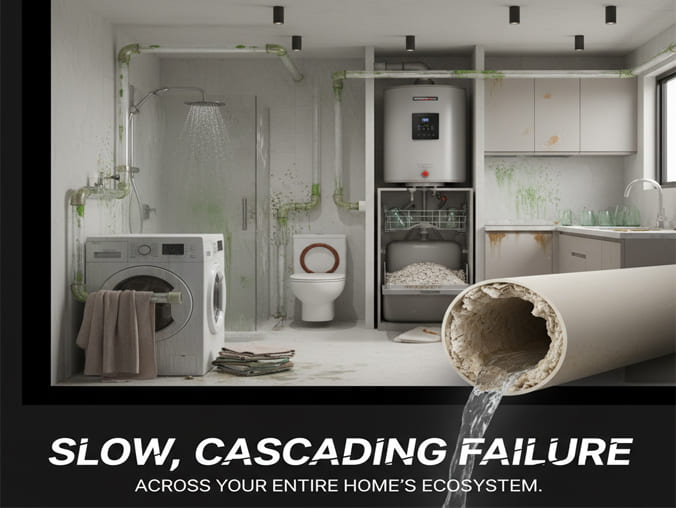
The damage from hard water isn’t a single event; it’s a slow, cascading failure across your entire home’s ecosystem.
1. Your Plumbing System: Arteries Hardening with Scale
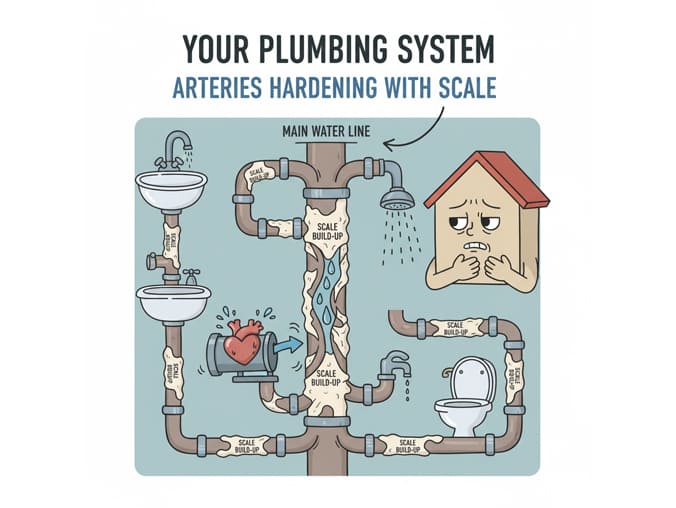
Think of your home’s pipes as its circulatory system. Hard water causes “arteriosclerosis” in these pipes.
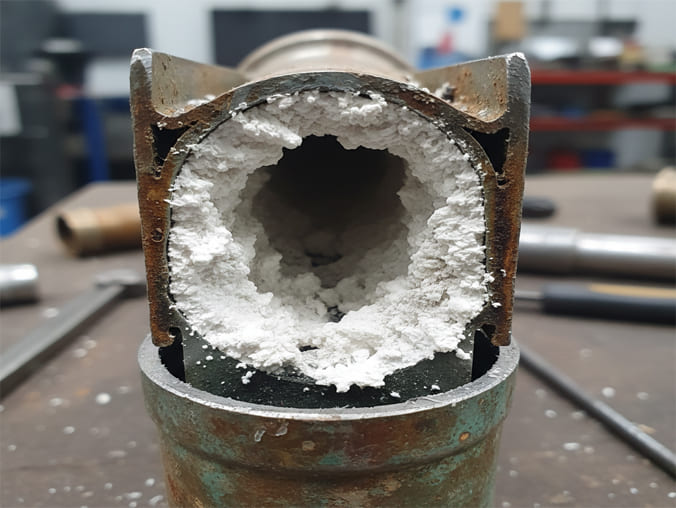
- Constricted Flow: Limescale accumulates at a rate of 0.5mm to 2mm per year in hard water areas. In just 5-7 years, this can reduce a pipe’s internal diameter by up to 50%.
- Plummeting Water Pressure: The relationship is not linear. A 25% reduction in pipe diameter can lead to a 50% drop in water pressure due to the principles of fluid dynamics. This is why your upstairs shower might feel weak.
- Accelerated Corrosion: Scale deposits create a condition called “under-deposit corrosion.” Oxygen differences between the scaled and clean areas of the pipe form a mini-battery, leading to aggressive pitting and eventual pinhole leaks—a costly and destructive surprise.
2. Your Water-Using Appliances: The Efficiency Killers
Every appliance that uses hot water is fighting a losing battle against scale.
- Water Heaters: This is ground zero for hard water damage. Just 1.6mm of scale (about the thickness of a dime) on the heating element forces it to work 12% harder, wasting energy. This can increase your water heating bills by over $100 per year and lead to premature failure.
- Dishwashers & Washing Machines: Hard minerals interfere with detergents, forcing you to use 30-50% more soap to get the same clean. The abrasive minerals also damage fabrics and moving parts, shortening the lifespan of these appliances by up to 40%.
- Faucets & Shower Heads: The Visible Victims The delicate components inside modern faucets are highly susceptible. Scale clogs the aerator and shower nozzles, reducing flow by 40% or more within just 6 months. Even worse, it builds up inside the valve cartridge—the heart of the faucet—causing it to become stiff, leak, and ultimately fail, reducing its lifespan by 60%.
A Manufacturer’s Perspective: The Anti-Scale Advantage
As an OEM/ODM faucet manufacturer, SpringFaucet works directly with importers and wholesalers who understand the real-world challenges their customers face. A common request, especially for markets with hard water, is the integration of anti-scale aerators and easy-clean nozzles. These components are made with silicone or specially treated polymers that prevent scale from adhering firmly, allowing it to be wiped away with a simple finger swipe. This small feature significantly extends the faucet’s life and improves user satisfaction, providing a clear competitive advantage. It’s a prime example of how we engineer products, like our range of durable, specialized commercial taps, to meet specific market demands.
3. Your Quality of Life & Health
The impact isn’t just financial. Hard water directly affects your daily life.
- Skin & Hair: Hard water soap scum (the residue left when soap reacts with minerals) clogs pores and can exacerbate conditions like eczema, psoriasis, and dry skin. Hair can feel dull, brittle, and difficult to manage.
- Fabrics & Clothing: Mineral deposits get trapped in fabric fibers, making clothes feel stiff and rough. Colors fade faster, and the lifespan of your clothing is reduced.
- Endless Cleaning: You’re spending more time and money scrubbing away soap scum from showers, fighting spots on your dishes, and using 2-3 times more cleaning products, all with less effective results.
Quantifying the Financial Drain: Your Hard Water “Tax”
It’s easy to dismiss these issues as minor annoyances, but the cumulative financial impact is staggering. Here’s a conservative estimate of what very hard water (10+ GPG) could be costing a typical single-family home.
| Damage Category | 5-Year Estimated Cost | 10-Year Consequence & Impact |
|---|---|---|
| Energy Waste (Water Heater) | 1,200−1,200 – 2,500 | Premature water heater replacement (averted cost of $1,500+). |
| Appliance Repair & Replacement | 1,500−1,500 – 3,000 | Dishwasher, washing machine, coffee maker lifespans cut by 30-50%. |
| Plumbing & Fixture Maintenance | 800−800 – 2,000 | Increased risk of catastrophic leaks; replacement of faucets & showerheads. |
| Increased Consumables | 600−600 – 1,200 | Constant drain on budget for extra detergents, soaps, and harsh cleaners. |
| Estimated Total Loss | 4,100−4,100 – 8,700 | Property maintenance costs increase by 25-40%; reduced resale appeal. |
This isn’t an expense; it’s a hidden tax on your property. The good news is, you can stop paying it.
The Ultimate Solution Matrix: From Targeted Fixes to Total Protection
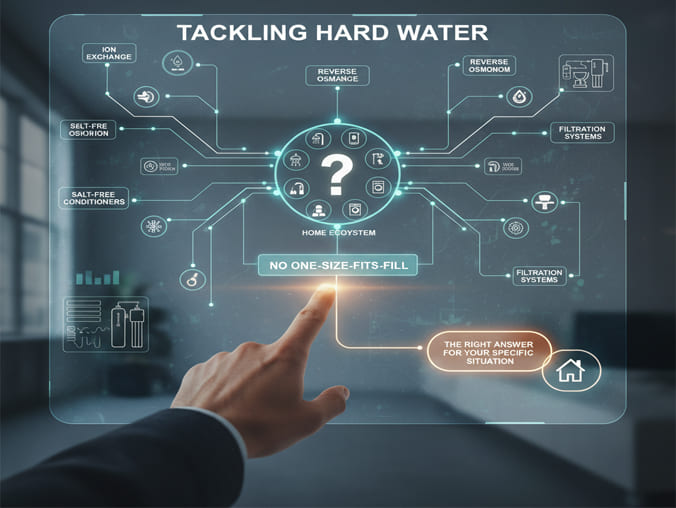
Tackling hard water requires a strategic approach. There is no one-size-fits-all answer, but there is a right answer for your specific situation.
Level 1: Whole-House Water Softening Systems (The Gold Standard)
This is the definitive solution that treats water at the point of entry, protecting every pipe, appliance, and fixture in your home.
| System Type | How It Works | Best For | Key Considerations |
|---|---|---|---|
| Ion Exchange Softener | Resin beads attract and trap hard mineral ions (Ca, Mg), releasing soft sodium (Na) or potassium (K) ions in their place. | The industry standard for severe hardness. Over 99% effective at removing minerals. Provides soft water for all uses. | Requires salt/potassium refills. Uses water for regeneration cycle. Adds trace amounts of sodium to water. |
| Template Assisted Crystallization (TAC) | A catalytic media causes hard mineral crystals to form, but they remain suspended in the water and won’t stick to surfaces. | Eco-conscious homeowners in moderately hard water areas. No salt, no waste water, no electricity. A “conditioner,” not a softener. | Does not technically “soften” water (minerals remain). May be less effective in very high hardness or with high iron. |
Level 2: Point-of-Use & Targeted Solutions
If a whole-house system isn’t feasible, these solutions offer protection for critical areas.
- Reverse Osmosis (RO) System: Installed under the sink, this system forces water through a semi-permeable membrane to remove up to 99% of all contaminants, including hard minerals. It produces superior quality drinking water and is a perfect companion to a whole-house system.
- Scale Inhibitors: These are small devices installed on the water line leading to a specific appliance (like a tankless water heater). They use magnetic fields or catalytic processes to condition the water, similar to TAC systems. They are a good, budget-friendly option for protecting a single, high-value appliance.
Level 3: Proactive Maintenance & Cleaning
- Descale Your Water Heater: Once a year, flush your water heater and use a food-grade citric acid solution to dissolve existing scale.
- Clean Your Faucet Aerators: Every 3 months, unscrew your faucet aerators and showerheads and soak them overnight in white vinegar. The acetic acid will dissolve the mineral buildup and restore flow.
For B2B Professionals: Turning Water Quality into a Business Opportunity
For plumbers, real estate agents, and property managers, hard water is not a problem—it’s a massive, untapped opportunity for value-added services.
- Productize a “Water Health Audit”: Offer a service package that includes a professional water hardness test, an inspection of key appliances, a pressure test, and a customized solution report. This positions you as an expert advisor, not just a service provider.
- Create Tiered Solutions: Don’t just sell one product. Offer a “Good, Better, Best” model:
- Basic: Targeted scale inhibitors on key appliances.
- Complete: A whole-house ion exchange or TAC system.
- Premium: A whole-house system plus an RO system and a subscription-based maintenance plan.
- Innovate with Service Models: Lower the barrier to entry for homeowners. Consider offering water softener systems on a lease or a “Hardware-as-a-Service” model with a monthly fee that includes all maintenance and salt refills.
Frequently Asked Questions (FAQ) {#faq}
Q1: Is softened water safe to drink? Does it taste salty? For most people, yes. An ion-exchange softener adds a small amount of sodium, but the amount is minimal—less than what’s in a slice of white bread. It doesn’t taste salty. If you are on a strict sodium-restricted diet, you can use potassium chloride instead of sodium chloride salt, or opt for a TAC system paired with an RO system for drinking water.
Q2: My house is old. Is it too late to fix the damage? It is never too late. While a softener won’t remove thick, existing scale overnight, it does stop any further buildup immediately. Over time, the soft water will slowly dissolve and wash away some of the existing scale, potentially improving flow and efficiency. For severely clogged pipes, a professional cleaning may be needed before installing the system.
Q3: How do I know if I need a whole-house system or just a point-of-use filter? A whole-house system is highly recommended if you meet any two of the following criteria: your water hardness is above 7 GPG, you own multiple water-using appliances you want to protect, members of your household have sensitive skin, or you plan to live in the property for 3+ years.
Q4: Are water softeners complicated to maintain? Not at all. Modern high-efficiency systems are fully automated. Your only task is to add salt to the brine tank about once a month, which takes less than 15 minutes. Some systems even have smartphone apps that will remind you.
Your Decision Framework: Making a Smart Investment
Investing in water treatment is one of the few home improvements that pays for itself. Here’s how to decide.
1. Assess Your Risk
- What is your water hardness in GPG? (The higher the number, the greater the urgency).
- What is the value of your home and appliances?
- Do you have sensitive skin or other health concerns?
- What are your long-term plans for the property?
2. Calculate Your Return on Investment (ROI)
- Initial Investment: 1,500−1,500 – 3,500 (for a professionally installed whole-house system).
- Annual Savings: 800−800 – 1,200 (from energy, soap, appliance longevity, and reduced maintenance).
- Payback Period: 1.5 to 3.5 years.
- Increased Property Value: A well-maintained plumbing system and a whole-house water treatment system are attractive selling points that can increase a home’s valuation by 1-2%.
3. Your Implementation Roadmap
- Phase 1 (Immediate): Test your water. Get a professional quote. Begin targeted maintenance like cleaning aerators.
- Phase 2 (Within 3 Months): Implement your core solution (e.g., install a whole-house softener).
- Phase 3 (Ongoing): Enjoy the benefits. Stick to a simple annual maintenance schedule.
Hard water is a costly, destructive force, but it’s a battle you can win. By understanding the science, quantifying the cost, and implementing the right solution, you can protect your property, save money, and improve your family’s quality of life. You’re not just buying an appliance; you’re investing in the long-term health of your home.
Recommended Internal & External Links:
Internal Links:
- How to Choose the Right Faucet Finish for Your Modern Bathrooms
- How to Choose the Perfect Shower System a 2026 Buyers Guide
- Plumbing 101: Understanding Your Home’s Water System
External Links (Authoritative Sources):
- USGS Water Hardness Map & Information – Official data and explanations from the U.S. Geological Survey.
- Water Quality Association (WQA) – A non-profit organization providing information and certification for water treatment products.
- NSF International – Water Treatment Certification Guide – An independent body that certifies water treatment products for safety and performance claims.