
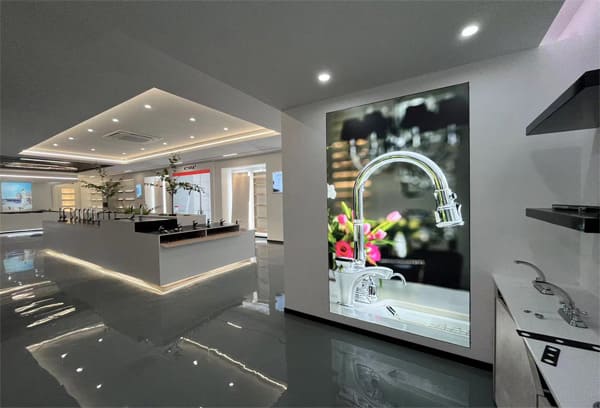
Have you ever stopped to think about the engineering marvel that is your kitchen or bathroom faucet? It’s a device you use dozens of times a day, delivering hot and cold water with precision, yet its creation is a complex symphony of design, metallurgy, and meticulous quality control. From our perspective as a faucet manufacturer, it’s a process we’ve perfected over years of practice.
This is your exclusive tour of the factory floor. We will guide you through the 8 critical stages of faucet production, from a digital idea on a computer screen to the carefully packaged product ready to be shipped to your project. You’ll learn why we choose certain materials, how we ensure a leak-proof body, and what quality checks are non-negotiable at every step.
Last Updated: Dec 2025 | Estimated Reading Time: 13 minutes
The 8 Key Stages of Faucet Manufacturing
Manufacturing a high-quality faucet is a sequential process where every step builds upon the last. A failure in Stage 2 will result in a defective product in Stage 8. Here is the complete journey:
- Stage 1: Design & Prototyping (R&D) – The faucet is born as an idea.
- Stage 2: Casting & Forming – Raw metal is given its initial shape.
- Stage 3: CNC Machining – The rough casting is precisely milled.
- Stage 4: Polishing – The raw body is prepared for its beautiful finish.
- Stage 5: Finishing (Plating & Coating) – The faucet gets its protective and decorative layer.
- Stage 6: Assembly – All components come together.
- Stage 7: 100% Quality Testing – The ultimate check for leaks and performance.
- Stage 8: Cleaning & Packaging – The final preparation for its new home.
Stage 1: Design & Development (R&D)
Everything begins with a concept. This could be a new aesthetic trend, a customer’s specific OEM request, or an innovation in functionality.
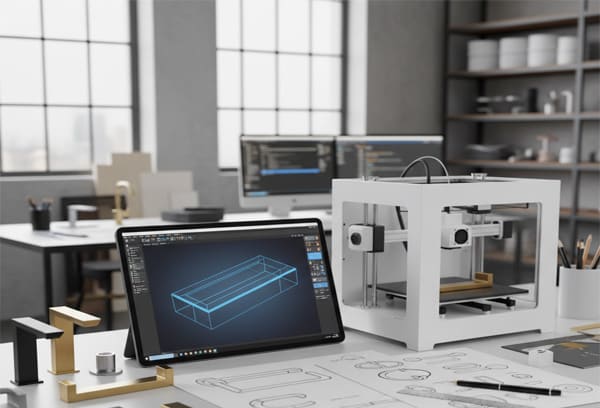
- CAD (Computer-Aided Design): Our engineers translate the initial sketches into precise 2D and 3D digital models. Every curve, internal waterway, and connection point is meticulously planned. This digital blueprint ensures that all components, like the cartridge and aerator, will fit perfectly.
- Mold Development: Once the CAD design is finalized, we create the master molds. For a brass faucet, this is typically a set of steel molds that will form the exterior shape of the faucet. The internal cavities of these molds are the negative space of the final product. This is a high-cost, high-precision step, as the quality of the mold directly determines the quality of every faucet cast from it.
Manufacturer’s Tip: We often use 3D printing to create a resin prototype from the CAD file. This allows us to physically hold and evaluate the design’s ergonomics and scale before committing to the expensive steel mold production.
Stage 2: Casting & Forming the Faucet Body

This is where the faucet takes its physical form from molten metal. For most high-quality faucets, this means casting brass.
- Making the Sand Core: A faucet isn’t a solid block of metal; it has complex internal channels for hot and cold water. To create these hollow pathways, we create a “sand core.” Sand mixed with a resin binder is pressed into a core mold and hardened. This sand core is a perfect replica of the inside of the faucet.
- Gravity Die Casting: The sand core is carefully placed inside the steel faucet mold. The two halves of the mold are clamped shut. Then, molten, lead-free brass (heated to around 950°C / 1740°F) is poured into the mold. We primarily use the gravity casting method, which relies on gravity to fill the mold cavity. This process results in a denser, less porous casting compared to lower-pressure methods, which is critical for preventing pinhole leaks later.
- Cooling & De-coring: After casting, the molds travel down a cooling line. Once solidified, the rough faucet casting is removed. The faucet is then put onto a vibrating machine or shot-blasted to break up and remove the sand core from the inside, leaving the internal waterways clear. The rough “gates” and edges (excess material from the casting process) are then cut off.
| Casting Method | Density/Quality | Surface Finish | Best Application in Plumbing |
|---|---|---|---|
| Gravity Die Casting | Excellent | Good | Faucet Bodies: Creates a dense, pressure-tight structure essential for preventing leaks. |
| Sand Casting | Fair | Rough | Large, simple shapes: Drain covers, large valve bodies. Not ideal for faucet waterways. |
| Die Casting (High Pressure) | Good | Excellent | Zinc Alloy Parts: Perfect for faucet handles and decorative parts where a flawless surface is key, but not for the main body. |
Stage 3: CNC Machining & Initial Leakage Testing
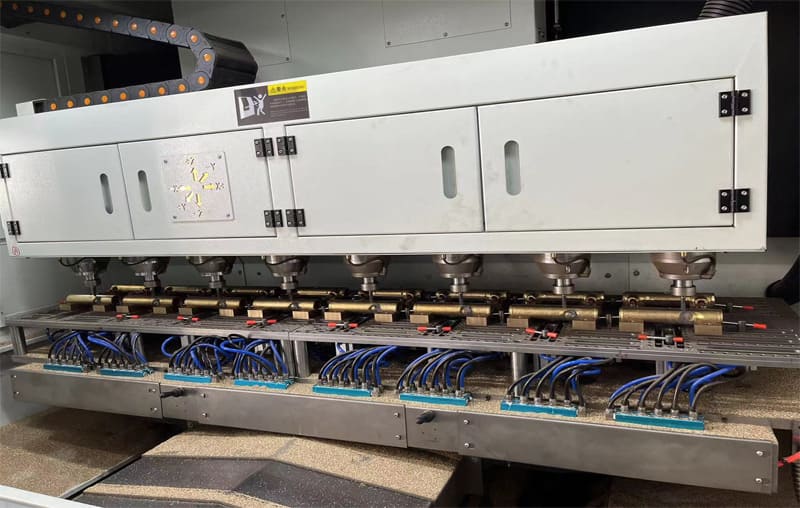
The raw casting is strong but not precise. It now goes to the CNC (Computer Numerical Control) machining center to be perfected.
- Machining: The casting is locked into a jig, and a computer-controlled machine uses various drills and cutting tools to perform high-precision operations. This includes:
- Threading the inlets for the water supply lines.
- Creating a perfectly flat base for a stable installation.
- Milling the internal cavity where the cartridge will sit to exact tolerances (often within 0.05mm).
- First Leakage Test: This is a critical quality control point. Before any more value is added (like polishing and plating), we subject the raw machined body to a high-pressure air test. The body is submerged in water, and we force compressed air into it. If even one tiny bubble emerges, it indicates a porous casting. That body is immediately rejected and sent to be melted down. Passing this test is mandatory to proceed.
Stage 4: Polishing
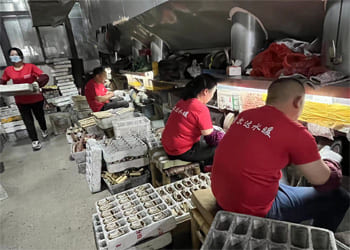
This stage is part craftsmanship, part science. It transforms the dull, machined surface into a smooth, mirror-like finish, which is essential for proper plating adhesion.
The faucet body goes through a series of polishing stations, starting with coarse abrasive wheels to remove surface imperfections and gradually moving to finer and finer wheels.
- Rough Polishing: Removes casting marks and deep scratches.
- Medium Polishing: Smooths the surface and begins to develop a shine.
- Fine Polishing (Buffing): Creates the final, flawless, mirror-like surface using soft cloth wheels and polishing compounds.
Insider Tip: The quality of the final chrome or PVD finish is 90% dependent on the quality of the polishing. Any tiny scratch or imperfection left after polishing will be magnified by the plating process. This is a highly skilled, labor-intensive step.
Stage 5: Finishing (Plating, PVD, or Painting)
Now the faucet gets its durable and beautiful “skin.”
- Electroplating (e.g., Chrome): This is the most traditional method. The polished faucet is hung on a rack and submerged in a series of chemical baths. Through an electrical current, thin layers of metals like nickel and finally chromium are molecularly bonded to the brass surface. A thick, multi-layer plating is key to corrosion resistance.
- PVD (Physical Vapor Deposition): A more advanced and durable process used for finishes like Brushed Gold, Gun Metal, and high-end Brushed Nickel. It takes place in a high-tech vacuum chamber, creating an incredibly hard, scratch-resistant, and tarnish-resistant finish.
- Powder Coating / Painting: Used for finishes like Matte Black. An electrostatically charged powder or paint is sprayed onto the faucet and then baked in an oven to create a smooth, durable, and uniform colored finish.
After finishing, another rigorous visual inspection is performed. Any piece with a blemish, thin spot, or imperfection is rejected.
Stage 6: Assembly
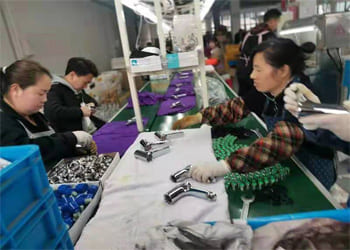
Here, the finished body and all the individual components come together on a dedicated assembly line.
- Sub-Assemblies: While the faucet body is being cast and polished, other components like handles, spouts, and hoses are manufactured simultaneously in their own production lines.
- Cartridge Installation: The “heart” of the faucet, the ceramic disc cartridge, is carefully installed and secured with a brass retaining nut, torqued to precise specifications.
- Component Assembly: The spout (with its O-rings), aerator, handle, and flexible hoses are all attached.
- OEM Customization: For our B2B clients, this is when we use a laser engraving machine to precisely etch their brand logo onto the handle or body, providing a permanent, professional branding solution.
| Component | Function | Quality Indicator We Look For |
|---|---|---|
| Ceramic Cartridge | Controls water flow & temperature | Brand reputation (e.g., Kerox, Sedal), smooth handle feel, >500,000 cycle rating. |
| Aerator | Shapes the water stream, saves water | Brand reputation (e.g., Neoperl), easy-to-clean silicone nozzles, specified GPM flow rate. |
| Flexible Hoses | Connect faucet to water supply | High-tensile braided stainless steel or nylon exterior, PEX inner tube, cUPC/NSF certification. |
| O-Rings | Create watertight seals on moving parts | High-quality EPDM rubber that resists degradation from chlorine and high temperatures. |
Stage 7: 100% Quality & Performance Testing
This is the most important stage for the end-user. Every single faucet that comes off our assembly line undergoes two mandatory tests. There are no exceptions.
- Air Pressure Test: We connect the assembled faucet to a high-pressure air line (typically 0.6-0.8 Mpa). The faucet is closed, and our technicians check for any drop in pressure, which would indicate a leak in the cartridge or seals.
- Water Pressure Test: The faucet is then connected to water lines that simulate real-world high and low household water pressures (typically 0.3-0.5 Mpa). We operate the handle, swivel the spout, and use the pull-down sprayer, visually inspecting every joint and connection for the slightest hint of a drip.
- Process Ispection: QC inspector during the faucet production.
Any faucet that fails either test is sent back for diagnosis and repair or is rejected.
Stage 8: Final Cleaning & Packaging & Inspection by QC
The fully tested and approved faucet moves to the final stage.
- Cleaning & Waxing: The faucet is meticulously cleaned to remove any fingerprints or water spots from testing. A light coat of protective wax is often applied to a chrome faucet to enhance its shine and protect it during shipping.
- Packaging: The faucet is carefully placed into a protective cloth bag and then fitted into custom-molded foam or cardboard inserts. All necessary components (installation hardware, manual, warranty card) are included before the product is sealed in its final retail box, ready for shipment.
- Inspection by QC: random inspection in the finished warehouse.
Conclusion: A Commitment to Excellence
As you can see, making a faucet is far more than just screwing some parts together. It is a rigorous, multi-stage process that combines heavy industry with fine craftsmanship. Each step, from the integrity of the initial casting to the final 100% water test, is a critical link in the chain of quality.
Understanding this process allows you to appreciate the value behind a well-made faucet and gives you, especially our B2B partners, the confidence that a manufacturer like SpringFaucet has the expertise and the quality control systems in place to deliver a product that is not only beautiful but built to last.
Recommended Links
Internal Links:
- SpringFaucet Homepage: Explore Our Full Range of Manufactured Faucets
- About Us: Learn More About Our Factory and Quality Control Processes
- Blog: Kitchen Faucet 101: A Manufacturer’s Ultimate Guide
External Links (Authoritative Sources):
- The American Society of Mechanical Engineers (ASME): This organization sets the A112.18.1 standard, which governs the performance and safety of plumbing fittings in North America.
- Wikipedia: Casting (Metalworking) – Provides a technical overview of different metal casting processes.
- NSF International: An organization that provides public health and safety-based risk management solutions, including testing and certifying faucets for lead-free compliance.