If you’re sourcing faucets for global distribution, navigating the maze of testing standards can make or break your market entry timeline and budget. With Europe’s new material requirements taking effect in 2026, updated NSF protocols in North America, and emerging Asian market standards, understanding which tests your products need—and when—determines whether your faucets clear customs or sit in quarantine costing you thousands daily.
After nearly two decades of helping manufacturers navigate these compliance requirements, I’ve witnessed companies lose entire market opportunities because they misunderstood testing protocols. Just last month, a client’s $2.3 million container shipment was detained at Hamburg port because their lead-free brass certification didn’t meet Germany’s updated EN 817 requirements—a problem that proper testing would have prevented.
This comprehensive guide breaks down every major testing standard you’ll encounter, compares requirements across regions, and provides actionable compliance strategies to protect your investments and accelerate market entry.
Last Updated: Aug 2026 | Estimated Reading Time: 37 minutes
What This Guide Covers:
- 2026 European material compliance updates with implementation timelines and cost implications
- Complete testing matrix comparing NSF, EN, WRAS, and emerging standards
- Third-party testing strategies including ITS, BV, and SGS cost comparisons
- Market-specific compliance roadmaps for North America, Europe, Asia, and Australia
- Budget planning tools with testing costs and timeline estimates
The Global Testing Landscape: Why Compliance Matters More Than Ever
The faucet testing landscape has transformed dramatically since 2020, driven by environmental concerns, health safety updates, and supply chain security requirements. Understanding these shifts helps you anticipate requirements rather than react to problems.
The Compliance Crisis Reality
Recent Market Disruptions:
- Q3 2025: 40% of Chinese faucet exports to EU faced delayed clearance due to new nickel release testing
- Q1 2026: California’s updated lead-free requirements caused $18 million in product recalls
- Q4 2025: UK’s post-Brexit WRAS updates stranded containers worth £12 million at ports
Financial Impact of Non-Compliance:
- Average detention costs: $2,000-5,000 per day per container
- Re-testing and certification: $15,000-45,000 per product family
- Market re-entry delays: 3-8 months typical timeline
- Brand reputation damage: Often exceeds direct financial costs
Regional Standards Evolution Timeline
| Region | Major Update | Implementation Date | Primary Impact |
|---|---|---|---|
| European Union | EN 817:2026 material requirements | January 1, 2026 | New nickel and lead thresholds |
| United States | NSF/ANSI 61-2025 | June 1, 2025 | Enhanced lead-free verification |
| United Kingdom | WRAS post-Brexit updates | April 1, 2025 | Independent testing requirements |
| Australia | WaterMark scheme updates | October 1, 2025 | Flow rate and efficiency standards |
| Canada | CSA B125 harmonization | March 1, 2026 | Alignment with US NSF standards |
Industry Insight: The trend toward stricter material requirements isn’t slowing down. Based on regulatory discussions I’ve attended in Brussels and Washington, expect further tightening of lead and nickel limits by 2027-2028, particularly for products used in schools and healthcare facilities.
European Standards: Navigating EN 817 and Emerging Requirements
Europe remains the most complex testing environment due to varying national interpretations of EU directives and the ongoing impact of Brexit.
EN 817:2026 – The New Material Reality
Key Changes from Previous Version:
- Nickel Release Limits: Reduced from 2.0 μg/cm²/week to 0.5 μg/cm²/week for surface contact
- Lead Content Verification: Enhanced testing protocols requiring atomic absorption spectroscopy
- Surface Treatment Durability: New 168-hour salt spray requirements (vs. previous 96 hours)
- Mixing Valve Accuracy: Tightened temperature control requirements for thermostatic products
Testing Protocol Updates:
Third-Party Testing: European Notified Bodies
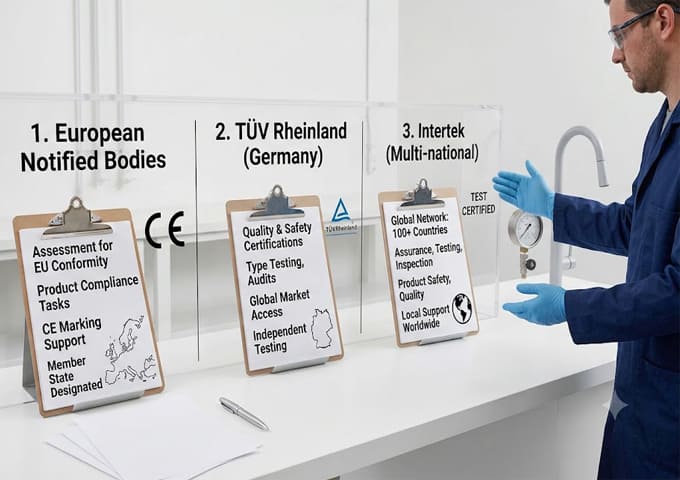
Leading Testing Organizations:
TÜV Rheinland (Germany):
- Strengths: Fastest turnaround for German market entry (8-12 weeks)
- Specialties: Complex thermostatic valve testing, smart faucet electronics
- Cost Range: €15,000-35,000 for complete EN 817 certification
- Notable: Direct connections to major German distributors for market intelligence
Bureau Veritas (France):
- Strengths: Strong presence across multiple EU markets
- Specialties: Material composition analysis, surface treatment evaluation
- Cost Range: €12,000-28,000 for standard certification packages
- Notable: Expedited services available for 30% premium
Intertek (Multi-national):
- Strengths: Global consistency, parallel testing capabilities
- Specialties: Comprehensive testing suites, regulatory advisory services
- Cost Range: €18,000-42,000 including market-specific variations
- Notable: One-stop testing for multiple regional requirements
Testing Strategy Tip: For European market entry, consider parallel testing with two notified bodies. The 15-20% additional cost often pays for itself through faster market access and risk mitigation if one test fails. Major distributors prefer suppliers with dual certifications for supply security.
Country-Specific Requirements Within Europe
Germany – Additional DVGW Requirements:
- Municipal water compatibility testing with various treatment chemicals
- Long-term performance validation (5-year accelerated aging)
- Installation compatibility with German plumbing systems
- Timeline: Add 4-6 weeks to standard EN 817 testing
France – ACS (Attestation de Conformité Sanitaire):
- Migration testing for organic compounds from polymer components
- Taste and odor impact assessment
- Compatibility with French municipal water treatment methods
- Timeline: Parallel testing possible with EN 817, minimal delay
Nordic Countries – Extended Temperature Testing:
- Performance validation from -25°C to +85°C operating range
- Thermal cycling endurance (10,000 cycles minimum)
- Special attention to thermostatic accuracy at temperature extremes
- Market Opportunity: SPRINGFAUCET’s self-closing delay taps excel in Nordic public facilities due to our enhanced temperature testing protocols
North American Standards: NSF/ANSI and Regional Variations
The North American market presents its own complexity with federal standards, state variations, and emerging municipal requirements.
NSF/ANSI 61-2025: Lead-Free Evolution
Enhanced Testing Requirements:
- Weighted Average Lead Content: Maximum 0.25% by wetted surface area calculation
- Leaching Protocol: 19-day sequential sampling with pH variation testing
- Component Testing: Individual testing of all wetted components, not just assemblies
- Documentation: Enhanced material traceability and supplier verification
Testing Methodology Changes:
State-Specific Requirements
California – Proposition 65 Compliance:
- Lead Limits: More restrictive than federal NSF standards
- Warning Requirements: Specific labeling for trace lead content
- Testing Frequency: Annual re-certification required for high-volume products
- Enforcement: Active market surveillance with significant penalties
New York State – Additional Restrictions:
- School and Childcare Facilities: Enhanced lead-free requirements
- Installation Requirements: Certified installer programs
- Water Quality Interaction: Testing with NYC municipal water chemistry
- Timeline: Expect 6-8 weeks additional testing beyond standard NSF
Texas – Municipal Variations:
- Houston: Specific flow rate requirements for water conservation
- Austin: Green building integration requirements
- San Antonio: Hard water performance validation required
- Dallas: Smart meter compatibility for new construction
Testing Laboratory Comparison – North America
| Laboratory | NSF 61 Turnaround | Cost Range | Special Capabilities | Market Access |
|---|---|---|---|---|
| NSF International | 8-12 weeks | $18,000-35,000 | Gold standard recognition | All states |
| UL (Underwriters Labs) | 6-10 weeks | $15,000-28,000 | Electronics integration | Most states |
| CSA Group | 10-14 weeks | $20,000-38,000 | Canadian market access | US + Canada |
| Intertek | 8-12 weeks | $16,000-32,000 | Global consistency | All states |
Asia-Pacific Standards: Emerging Requirements and Opportunities
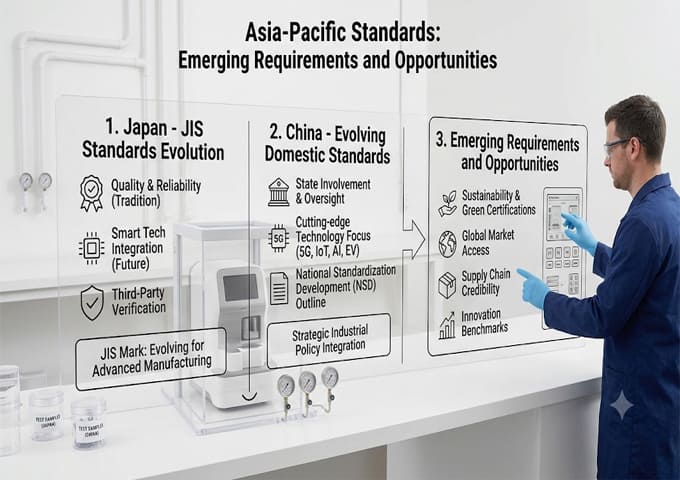
The Asia-Pacific region presents the fastest-growing testing requirements, driven by urbanization and environmental concerns.
Japan – JIS Standards Evolution
JIS B 2061:2025 Updates:
- Earthquake Resistance: Enhanced seismic testing requirements
- Water Efficiency: Maximum 5 liters per minute for residential applications
- Antimicrobial Properties: New surface treatment requirements for commercial use
- Smart Integration: IoT compatibility and cybersecurity requirements
Testing Specifics:
- Vibration testing simulating seismic activity (JIS A 1419 protocol)
- Long-term performance with Japanese municipal water chemistry
- Integration testing with Japanese plumbing systems and water heaters
- Market Insight: Focus on precision manufacturing—Japanese buyers prioritize consistency over cost
China – Evolving Domestic Standards
GB 18145-2025 – National Sanitary Standards:
- Material Purity: Enhanced requirements for brass composition and surface treatments
- Performance Testing: 300,000 cycle endurance testing (highest globally)
- Water Conservation: Mandatory flow rate optimization for urban applications
- Production Quality: Statistical process control documentation required
Regional Variations:
- Shanghai: Additional environmental impact assessment requirements
- Beijing: Air quality impact considerations for manufacturing processes
- Shenzhen: Innovation incentives for smart faucet technologies
- Guangzhou: Export quality alignment with international standards
Australia/New Zealand – WaterMark Scheme
Recent Updates (October 2025):
- Water Efficiency: WELS (Water Efficiency Labeling Standards) integration
- Durability Requirements: 250,000 cycle testing mandatory
- Installation Standards: AS/NZS 3500 compatibility verification
- Environmental Impact: Life cycle assessment documentation
Testing Process:
- Application Submission: Technical documentation and product samples
- Laboratory Testing: 12-16 weeks typical turnaround
- Factory Audit: Production quality system verification
- Ongoing Surveillance: Annual factory inspections required
- Market Monitoring: Product testing from retail purchases
Third-Party Testing Strategies: Maximizing Efficiency and Minimizing Risk
Choosing the right testing partner and strategy significantly impacts your market entry timeline and costs.
Global Testing Network Comparison
SGS (Société Générale de Surveillance):
- Global Presence: Testing facilities in 140 countries
- Strengths: Consistent protocols, parallel testing capabilities
- Specialties: Material analysis, complex multi-standard testing
- Cost Structure: Premium pricing but comprehensive service
- Turnaround: 10-14 weeks for complete certification packages
Bureau Veritas:
- Regional Focus: Strong in Europe and emerging markets
- Strengths: Regulatory expertise, market entry consulting
- Specialties: Performance testing, regulatory navigation
- Cost Structure: Competitive pricing with flexible packages
- Turnaround: 8-12 weeks standard, expedited options available
Intertek (ITS):
- Technology Focus: Advanced testing equipment and methods
- Strengths: Innovation support, custom testing protocols
- Specialties: Electronics integration, smart faucet validation
- Cost Structure: Mid-range pricing with technology premium
- Turnaround: 6-10 weeks with parallel testing options

Cost Optimization Strategies
Multi-Market Testing Packages: Many testing organizations offer bundled packages for multiple regional requirements:
| Package Type | Markets Covered | Typical Cost | Timeline | Risk Mitigation |
|---|---|---|---|---|
| North America | US, Canada, Mexico | $25,000-45,000 | 10-14 weeks | Single point failure risk |
| Europe Complete | EU27 + UK + EFTA | $35,000-65,000 | 12-16 weeks | Complex coordination |
| Global Standard | Major markets worldwide | $55,000-95,000 | 14-20 weeks | Comprehensive coverage |
| Emerging Markets | Asia-Pacific focus | $20,000-35,000 | 8-12 weeks | Growth market access |
Parallel vs. Sequential Testing:
- Parallel Testing: 30-40% higher cost, 50-60% faster market entry
- Sequential Testing: Lower cost but 6-8 months longer timeline
- Hybrid Approach: Priority markets parallel, secondary markets sequential
Budget Planning Tip: Factor testing costs as 8-12% of your first year’s gross margin for new market entry. Companies that under-budget testing often face much higher costs through delays, re-testing, and missed market opportunities.
Compliance Documentation: Building Your Quality Management System
Proper documentation systems prevent testing delays and ensure ongoing compliance.
Essential Documentation Framework
Product Technical Files:
Manufacturing Quality Records:
- ISO 9001 certification and ongoing audit records
- Statistical process control data for critical dimensions
- Material incoming inspection records and certifications
- Final product inspection data and sampling plans
Digital Documentation Systems
Cloud-Based Compliance Management:
- Real-time access for global teams and regulatory authorities
- Automated renewal notifications and compliance monitoring
- Integration with ERP systems for traceability
- Secure backup and disaster recovery capabilities
Blockchain Documentation (Emerging Trend):
- Immutable testing and certification records
- Supply chain transparency and authenticity verification
- Smart contracts for automatic compliance monitoring
- Early adoption provides competitive advantage in premium markets
Market-Specific Testing Timelines and Planning
Understanding regional testing timelines helps optimize your product launch strategy.
North American Market Entry Timeline
Standard Market Entry (Single Product Family):
- Week 1-2: Documentation preparation and laboratory selection
- Week 3-4: Sample preparation and submission
- Week 5-12: NSF/ANSI 61 testing and analysis
- Week 13-14: Report review and certification issuance
- Week 15-16: State-specific documentation and submissions
- Week 17-20: Market launch preparation and distribution setup
- Total Timeline: 20-22 weeks from start to market entry
Expedited Market Entry (Premium Service):
- Week 1: Express documentation review and sample expediting
- Week 2-8: Accelerated testing with dedicated laboratory resources
- Week 9-10: Expedited report generation and certification
- Week 11-12: Market preparation and launch
- Total Timeline: 12-14 weeks with 40-60% cost premium
European Market Entry Timeline
Standard EU Compliance Process:
- Week 1-3: Notified body selection and documentation preparation
- Week 4-6: Sample submission and preliminary review
- Week 7-14: EN 817 testing and material analysis
- Week 15-16: Country-specific testing additions (Germany DVGW, France ACS)
- Week 17-18: CE marking preparation and documentation
- Week 19-22: Market entry and distribution partner coordination
- Total Timeline: 22-24 weeks for complete European access
Brexit Considerations for UK Market:
- Additional WRAS testing: +4-6 weeks
- Separate UKCA marking process: +2-3 weeks
- Independent UK representative appointment: +1-2 weeks
- UK-Specific Timeline: 28-32 weeks total including EU compliance
Asia-Pacific Market Complexity
Japan Market Entry:
- Weeks 1-4: JIS standard interpretation and sample preparation
- Weeks 5-16: Comprehensive testing including seismic simulation
- Weeks 17-20: Documentation translation and local partner coordination
- Weeks 21-24: Market entry and distribution setup
- Total Timeline: 24-26 weeks with high precision manufacturing requirements
China Domestic Market:
- Weeks 1-2: GB standard compliance review
- Weeks 3-18: Extended endurance testing (300,000 cycles)
- Weeks 19-22: Factory inspection and quality system validation
- Weeks 23-26: Provincial registration and distribution licensing
- Total Timeline: 26-28 weeks with ongoing surveillance requirements
Testing Timeline Optimization Strategies
Strategy Time Savings Cost Impact Risk Level Best For Parallel Multi-Market Testing 8-12 weeks +35-45% Low High-volume products Pre-Submission Consulting 4-6 weeks +15-25% Very Low Complex products Express Laboratory Services 6-10 weeks +40-60% Low Time-critical launches Regional Testing Centers 3-5 weeks +20-30% Medium Established products Timeline Reality Check: From my experience managing over 200+ certification projects, add 20-30% buffer to all published timelines. Customs delays, sample shipping issues, and documentation revisions are common. Companies that plan for these contingencies maintain their launch schedules while competitors face delays.
Cost Management: Budgeting for Global Compliance
Understanding the total cost of testing and compliance helps you price competitively while maintaining profitability.
Complete Cost Breakdown Analysis
Direct Testing Costs:
- Laboratory fees: 60-70% of total compliance costs
- Sample preparation and shipping: 8-12% of total costs
- Documentation and translation services: 10-15% of total costs
- Certification and registration fees: 5-8% of total costs
- Ongoing surveillance and renewals: 10-15% annually
Hidden Compliance Costs:
- Product Development Modifications: Often 20-40% of initial testing costs
- Re-Testing for Failures: Can double original testing investment
- Regulatory Consulting: 15-25% of testing costs for complex markets
- Market Entry Delays: $2,000-5,000 per day for detained shipments
- Opportunity Costs: Lost sales during extended certification periods
Annual Compliance Budget Planning
Year 1 – Initial Market Entry:
Testing and Certification: $45,000-85,000 (varies by market scope)Regulatory Consulting: $8,000-15,000Documentation and Translation: $5,000-12,000Product Modifications: $15,000-35,000 (if required)Contingency (20%): $15,000-30,000Total Year 1 Investment: $88,000-177,000Years 2-5 – Ongoing Compliance:
Annual Surveillance Testing: $8,000-15,000Renewal Certifications: $12,000-25,000 (every 3-5 years)New Product Extensions: $5,000-12,000 per new modelRegulatory Updates: $3,000-8,000 annuallyTotal Annual Ongoing: $28,000-60,000ROI Calculation for Testing Investment
Market Access Value Analysis: Using data from a mid-sized faucet distributor entering European markets:
- Initial Testing Investment: $65,000 for complete EU compliance
- First Year Revenue from EU Sales: $1.2 million
- Gross Margin Impact: Testing represents 5.4% of first-year gross margin
- Break-Even Timeline: 3.2 months after market launch
- 5-Year ROI: 2,800% return on compliance investment
Risk Mitigation Value:
- Avoided Detention Costs: $45,000 (average for one container delay)
- Brand Protection Value: Difficult to quantify but often exceeds direct costs
- Competitive Advantage: Early market entry often worth 15-25% premium pricing
Emerging Testing Trends: Preparing for Future Requirements
The testing landscape continues evolving, driven by environmental concerns, smart technology integration, and supply chain security.
Environmental Impact Assessment
Life Cycle Analysis (LCA) Requirements:
- Carbon Footprint: Manufacturing, transportation, and disposal impact assessment
- Material Sourcing: Conflict-free minerals and sustainable sourcing verification
- Packaging Impact: Recyclability and waste reduction documentation
- Timeline: Add 6-8 weeks to standard testing for comprehensive LCA
Circular Economy Compliance:
- Repairability Index: Component replacement accessibility and documentation
- Material Recovery: End-of-life recycling and material separation capability
- Durability Extensions: Enhanced testing for extended product lifespans
- Market Impact: EU markets leading with mandatory requirements by 2027
Smart Faucet Technology Testing
Cybersecurity Requirements:
- Data Protection: GDPR compliance for smart faucets collecting user data
- Network Security: Vulnerability assessment and penetration testing
- Update Mechanisms: Over-the-air update security and authentication
- Privacy Protection: User data handling and storage compliance
IoT Integration Standards:
- Interoperability Testing: Compatibility with major smart home platforms
- Communication Protocol Validation: WiFi, Bluetooth, Zigbee performance testing
- Energy Efficiency: Battery life and power consumption optimization
- User Interface Standards: Accessibility and usability compliance
Supply Chain Security Testing
Component Authentication:
- Blockchain Verification: Immutable component sourcing and manufacturing records
- Anti-Counterfeiting: Physical and digital authentication mechanisms
- Supplier Verification: Enhanced due diligence and audit requirements
- Traceability Systems: Complete supply chain visibility and documentation
Future-Proofing Tip: Consider developing internal testing capabilities for routine compliance monitoring. Companies with in-house testing facilities report 40-60% faster response to regulatory changes and 25-35% lower long-term compliance costs.
Industry Expert Perspectives: Real-World Testing Insights
To provide you with practical insights beyond standard documentation, I interviewed several industry professionals about their testing experiences.
Testing Laboratory Director Insights
“The biggest mistake I see from new manufacturers is treating testing as a checkbox exercise,” explains Dr. Sarah Chen, Director of Product Testing at a major European testing facility. “Successful companies use testing as product development feedback. They come to us early in the design phase, not just before market launch.”
Key Recommendations from Testing Professionals:
- Start testing consultations during product design, not after manufacturing
- Budget for 2-3 test iterations—first-time passes are rare for complex products
- Invest in understanding why tests fail, not just fixing immediate issues
- Maintain relationships with testing laboratories for regulatory updates and changes
Regulatory Affairs Manager Experience
“Brexit created a perfect storm for testing complexity,” shares Marcus Williams, Regulatory Affairs Manager at a UK-based faucet distributor. “We had to completely restructure our compliance approach. Products that worked fine across Europe suddenly needed separate UK testing. The costs multiplied, but the market access requirements didn’t change.”
Practical Compliance Strategies:
- Maintain parallel EU and UK compliance even if focusing on one market initially
- Build relationships with testing bodies in both regions for consistent interpretation
- Document everything—regulatory authorities increasingly request detailed records
- Plan for regulatory changes 18-24 months in advance when possible
Manufacturing Quality Director Perspective
“Testing reveals manufacturing inconsistencies that internal QC misses,” notes Jennifer Liu, Quality Director at SPRINGFAUCET. “Our self-closing delay taps went through extensive European testing, which identified minor assembly variations that could affect long-term performance. Fixing these issues during testing saved us significant warranty costs later.”
Quality System Integration:
- Use testing feedback to improve manufacturing processes
- Implement statistical process control based on testing critical parameters
- Train production teams on the connection between testing requirements and manufacturing precision
- Establish internal testing protocols that mirror external certification requirements
-
Frequently Asked Questions
Q: Can I use testing results from one laboratory for multiple market submissions?
Generally yes, but with important caveats. Most major testing laboratories have mutual recognition agreements for basic performance testing. However, material composition analysis and specific regulatory requirements often need region-specific testing. For example, NSF testing for lead content will be recognized by most North American authorities, but European EN 817 testing requires EU-based notified body certification. Plan for 70-80% test result portability between similar markets.
Q: How often do products need re-testing and re-certification?
It varies significantly by market and product changes. NSF certification typically requires renewal every 3-5 years. European CE marking remains valid unless you change materials or manufacturing processes. However, any significant product modification—including supplier changes for key components—may require complete re-testing. Maintain detailed change control documentation to determine when re-testing is required.
Q: What happens if my product fails testing partway through the process?
Most testing laboratories offer preliminary feedback after initial tests, allowing you to address issues before complete failure. Budget for at least one re-test cycle in your planning. Minor failures (like flow rate adjustments) might only require partial re-testing. Major failures (material composition issues) typically require complete re-testing with new samples. Work closely with your testing laboratory to understand failure modes and correction options.
Q: Can I use in-house testing to reduce external certification costs?
In-house testing is excellent for preliminary validation and ongoing quality control, but cannot replace certified external testing for market access. However, robust internal testing significantly reduces external testing failures and costs. Consider investing in basic equipment for flow testing, pressure testing, and dimensional verification. This typically reduces external testing cycles by 40-60%.
Q: How do I handle testing for product variants (different finishes, sizes, etc.)?
Testing requirements for variants depend on what changes between models. Different finishes on the same base product typically require separate material testing but can share performance testing. Different sizes may need separate flow and pressure testing. Work with your testing laboratory to define “families” of products that can share certain test results. This can reduce testing costs by 30-50% for large product lines.
Implementation Roadmap: Your 90-Day Compliance Action Plan
Successfully navigating global testing requirements requires systematic planning and execution.
Days 1-30: Foundation Building
Week 1-2: Market Analysis and Prioritization
- Identify target markets and their specific testing requirements
- Analyze competitor compliance strategies and market positioning
- Estimate market potential vs. compliance investment for each region
- Create prioritized market entry timeline
Week 3-4: Testing Strategy Development
- Contact 3-5 testing laboratories for quotations and timeline estimates
- Evaluate parallel vs. sequential testing strategies based on budget and timeline
- Identify product modifications that might be required based on standards review
- Establish internal project management and tracking systems
Days 31-60: Execution Preparation
Week 5-6: Laboratory Selection and Contracting
- Finalize testing laboratory selection based on cost, timeline, and expertise
- Negotiate contracts including expedited service options and re-test terms
- Establish communication protocols and progress reporting requirements
- Prepare initial documentation and technical file submissions
Week 7-8: Sample Preparation and Quality Assurance
- Manufacture testing samples with enhanced quality control
- Implement sample tracking and chain-of-custody procedures
- Prepare backup samples for potential re-testing requirements
- Coordinate logistics for international sample shipping
Days 61-90: Testing Launch and Management
Week 9-10: Testing Initiation and Monitoring
- Submit samples and documentation to selected testing laboratories
- Establish regular progress review meetings and milestone tracking
- Monitor for any preliminary issues or concerns from testing laboratories
- Prepare for potential product modifications based on early feedback
Week 11-12: Compliance Infrastructure Development
- Establish ongoing surveillance and renewal tracking systems
- Develop internal quality control procedures based on testing standards
- Train relevant staff on compliance requirements and documentation needs
- Prepare market entry materials and regulatory submission packages
Regional Compliance Summary: Quick Reference Guide
For quick reference during planning and decision-making:
North America Compliance Essentials
Required Standards: NSF/ANSI 61, state-specific variations Key Testing: Lead content analysis, leaching testing, performance validation Timeline: 12-16 weeks standard, 8-10 weeks expedited Costs: $18,000-35,000 for complete compliance Renewal: 3-5 years depending on product changes
European Compliance Essentials
Required Standards: EN 817, CE marking, country-specific additions Key Testing: Material analysis, performance testing, durability validation Timeline: 14-18 weeks standard, country variations add 2-6 weeks Costs: $25,000-45,000 for complete EU access Renewal: Valid until significant product modifications
Asia-Pacific Compliance Essentials
Required Standards: JIS (Japan), GB (China), WaterMark (Australia/NZ) Key Testing: Enhanced endurance, seismic resistance, efficiency validation Timeline: 16-24 weeks depending on market complexity Costs: $20,000-40,000 per major market Renewal: 1-3 years with ongoing surveillance requirements
Conclusion: Building Your Testing Success Strategy
Navigating global faucet testing standards requires more than understanding requirements—it demands strategic thinking about market priorities, cost optimization, and long-term compliance management. The companies that succeed treat testing as a competitive advantage rather than a regulatory burden.
Your strategic success factors:
- Plan early and comprehensively – Start testing discussions during product development, not after manufacturing
- Invest in relationships – Develop partnerships with testing laboratories and regulatory consultants
- Think systematically – Build internal processes that support ongoing compliance, not just initial certification
- Budget realistically – Factor all costs including contingencies and opportunity costs
- Stay ahead of changes – Monitor regulatory developments 18-24 months in advance
The testing investment that seems expensive today becomes insignificant compared to the cost of market access delays, detained shipments, or warranty issues. More importantly, proper testing and compliance create competitive differentiation that separates professional suppliers from commodity manufacturers.
At SPRINGFAUCET, we’ve learned that testing excellence translates directly into market success. Our rigorous approach to compliance testing—particularly for products like our self-closing delay taps that must meet strict public facility requirements across multiple markets—has enabled us to serve premium customers who value reliability over low prices.
Ready to develop your testing strategy? The regulatory landscape will only get more complex, but the rewards for getting it right continue growing. Whether you’re entering your first international market or expanding to new regions, the testing decisions you make today determine your competitive position tomorrow.
The key is starting now, planning thoroughly, and viewing compliance as an investment in your market future rather than a cost to minimize.
Recommended Internal & External Links:
- Internal: Hard Water Faucet Solutions: How Mineral-Rich Water Impacts Performance – Understanding performance requirements that drive testing standards
- Internal: Pluming 101: Your definitive Guide to Your Home Water System – Guide to your home water system
- Internal: What is the Best Metal For a Faucet ? – Material choices that affect testing requirements and compliance costs.
- External: Bureau Veritas – Product Certification Services – Third-party testing services and global compliance solutions
- External: Intertek – Building & Construction Testing – Comprehensive testing services for building products
- External: SGS – Consumer Goods Testing – Global testing and certification services